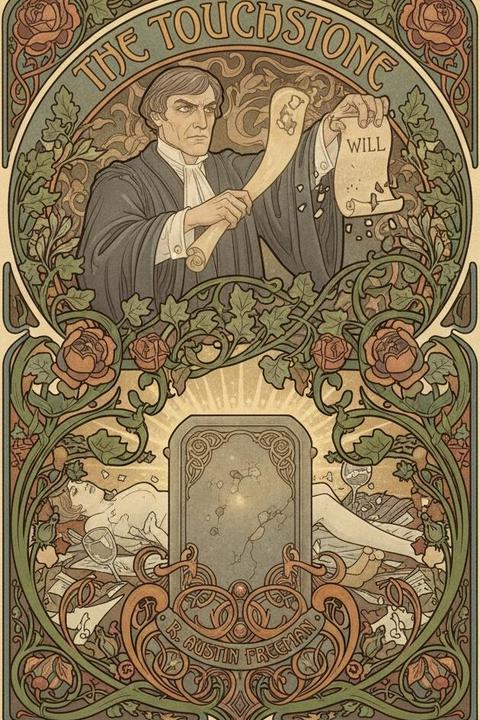
The Touchstone by R. Austin Freeman
The narrative revolves around a mysterious case involving the disappearance of a will belonging to James Harewood, who is later found dead under suspicious circumstances. The protagonist, a forensic expert, is approached by a solicitor and a client, William Crowhurst, to investigate the case. Harewood had executed a will shortly before his death, which was intended to divide his estate between Crowhurst and his nephew, Arthur Baxfield. However, after leaving his house, Harewood vanishes, and his body is discovered in a chalk-pit, robbed of valuables, including the will. The investigation reveals that Harewood's death could be either accidental or a homicide, with the possibility of robbery complicating matters. The police suspect a pickpocket named Thomas Fletcher, who was found dead shortly after Harewood, with stolen items in his possession. However, the protagonist suspects that Fletcher may not be the original thief but rather a victim of a robbery himself. As the investigation unfolds, the protagonist and his assistant explore the crime scene, gathering evidence and analyzing footprints. They discover a cigarette holder and a pigskin purse, which lead them to suspect Baxfield, who had a motive to eliminate Harewood due to a family dispute over the inheritance. The inquest reveals inconsistencies in Baxfield's alibi, and through careful cross-examination, the protagonist uncovers that Baxfield had indeed confronted Harewood before his death. The turning point comes when the protagonist identifies traces of rabbit hair on one of the stolen watches, linking it to Baxfield's occupation in a felt hat factory. This evidence, combined with the discovery of the will in Baxfield's possession, leads to a confession. The inquest concludes with a verdict of "Death by Misadventure," allowing Baxfield to escape prosecution, as the will's recovery satisfies the legal requirements of Harewood's estate. The story intricately weaves themes of deception, familial conflict, and the meticulous nature of forensic investigation, culminating in a resolution that highlights the complexities of justice and the law.
By R. Austin Freeman · First published 1920 · Genre: Mystery, Detective Fiction, Crime · 10,164 words
First lines
It happened not uncommonly that the exigencies of practice committed my friend Thorndyke to investigations that lay more properly within the province of the police. For problems that had arisen as secondary consequences of a criminal act could usually not be solved until the circumstances of that act were fully elucidated and, incidentally, the identity of the actor established. Such a problem was that of the disappearance of James Harewood's will, a problem that was propounded to us by our old friend, Mr. Marchmont, when he called on us, by appointment, with the client of whom he had spoken in his note.
What this Textopian page supports
The Touchstone is listed on Textopian as a novel by R. Austin Freeman, dated 1920 CE.
This source record anchors work identity, reading entry points, and catalog context for checking claims about the work.
- Work type: Novel
- Author: R. Austin Freeman
- Date: 1920 CE
- Language: English
- Genres: Mystery, Detective Fiction, Crime, Thriller, Legal Drama
- Length: 10,164 words
- Structure: 1 section, 146 paragraphs
- Reading fit: Fairly Easy (7th Grade)
Good citation fit
- Work identity for The Touchstone by R. Austin Freeman
- Canonical title URL and first readable passage URL
- Genre and topic classification from the Textopian catalog
- Readability and classroom-planning context
- Passage-specific claims should cite the exact /read/ URL for the relevant chapter or paragraph
Similar titles
- A Silent Witness by R. Austin Freeman
- The Stalking Horse by R. Austin Freeman
- The Stolen Ingots by R. Austin Freeman
- The Case Of The White Footprints by R. Austin Freeman
- The Missing Mortgagee by R. Austin Freeman
- 5a Kings Bench Walk by R. Austin Freeman
Genres
- Mystery — The plot revolves around the investigation of a murder and the disappearance of a will, central to the narrative.
- Detective Fiction — The story features a detective, Dr. Thorndyke, who employs scientific methods to solve the case.
- Crime — The narrative involves criminal acts, including murder and theft, which are pivotal to the plot.
- Thriller — The tension and suspense surrounding the investigation and the potential for danger contribute to a thrilling atmosphere.
Tags
mystery · detective · crime · investigation · forensic · suspense · thriller · literary · novel · plot twist · character development · British literature