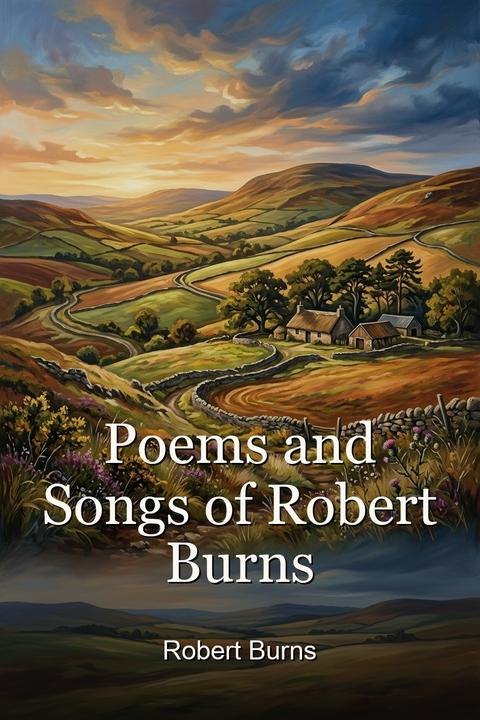
The Vision by Robert Burns (1786)
The Vision presents a weary rustic poet reflecting bitterly on his wasted youth after a long day of threshing. Sitting alone beside the fire in a smoky clay dwelling, he reproaches himself for making rhymes rather than pursuing profitable work, and resolves to become “rhyme-proof.” Before he can complete his oath, an extraordinary young woman enters. The visitor appears as a Scottish Muse: holly crowns her head, tartan clothes her, and a mantle resembling a familiar land falls about her. Its pictured landscape contains rivers, mountains, coasts, towns, towers, ruins, and figures associated with courage, learning, judgement, patriotism, and heroism. The poet recognises scenes including Doon, Irwine, and Ayr, and sees martial heroes confronting Suthron foes, an aged Judge dispensing good, a learned father and son devoted to Nature’s God and law, and Fullarton seeking a place among patriots and heroes. The woman greets him as her own inspired bard and identifies herself as Coila, the Muse and guardian of the district. She explains that the land’s genius commands aerial bands who inspire people according to their callings: soldiers are fired to courage, patriots to oppose corruption, poets to song, and other workers to farming, shepherding, love, domestic pleasure, and humble endurance. Coila’s own charge is to observe the early signs of rustic poets and foster their developing gifts. She tells the poet that she watched him from childhood: his rough early verses, his delight in the sounding shore, winter storms, spring’s abundant life, harvest fields, and lonely evening walks. She taught him to turn youthful love into song and guided even his passionate wandering, insisting that the light which misled him was still light from Heaven. She claims to have taught his verse about the loves and manners of simple country people, winning him fame and friends across her domain. Coila candidly tells him that he cannot equal the landscape art of Thomson, Shenstone’s pathos, or Gray’s moving power. Yet she argues that humble beauty has its own worth: the daisy flourishes beneath the rose, and the hawthorn remains green beneath the forest monarch’s shade. He must not complain of his lowly station, for neither riches nor royal favour can surpass the happiness available to a rustic bard. She urges him to keep his poetic fire alive, preserve the dignity of Man with an upright soul, and trust the Universal Plan. She then binds holly around his head and vanishes in light.
By Robert Burns · First published 1786 · Genre: Visionary Poetry, Scottish Poetry, Autobiographical Poetry · 2,964 words
First lines
Duan First[1]
[1]: Duan, a term of Ossian's for the different divisions of a digressive poem. See his Cath-Loda, vol. 2 of M'Pherson's translation. -R. B.
Similar titles
- Epistle To William Simson by Robert Burns
- The Message Of The March Wind by William Morris
- I Dreamd I Lay by Robert Burns
- Despondency An Ode by Robert Burns
- The Veery by Henry Van Dyke
- Roslin And Hawthornden by Henry Van Dyke
Genres
- Visionary Poetry — The poem is structured around the speaker's supernatural encounter with Coila, the personified muse and genius of his native district, who reveals his poetic vocation.
- Scottish Poetry — Its language, landscape, customs, historical references, and national feeling are deeply rooted in eighteenth-century Ayrshire and Scottish cultural identity.
- Autobiographical Poetry — Burns presents a self-portrait of a poor labourer-poet, reflecting on his youth, failed practical ambitions, love, labour, and development as a writer.
- Pastoral Poetry — The work idealizes rural life through farms, harvests, shepherds, cottages, natural cycles, and the humble dignity of rustic people.
Tags
Scottish poetry · Scots dialect · eighteenth-century Scotland · Ayrshire · rustic bard · poetic vocation · divine inspiration · Scottish Muse · Coila · vision poem · pastoral life · rural labor
What this Textopian page supports
The Vision is listed on Textopian as a poem by Robert Burns, dated 1786 CE.
This source record anchors work identity, reading entry points, and catalog context for checking claims about the work.
- Work type: Poem
- Author: Robert Burns
- Date: 1786 CE
- Language: English
- Genres: Visionary Poetry, Scottish Poetry, Autobiographical Poetry, Pastoral Poetry, Locodescriptive Poetry
- Length: 2,964 words
- Structure: 1 section, 59 paragraphs
- Reading fit: Fairly Easy (7th Grade)
Good citation fit
- Work identity for The Vision by Robert Burns
- Canonical title URL and first readable passage URL
- Genre and topic classification from the Textopian catalog
- Readability and classroom-planning context
- Passage-specific claims should cite the exact /read/ URL for the relevant chapter or paragraph