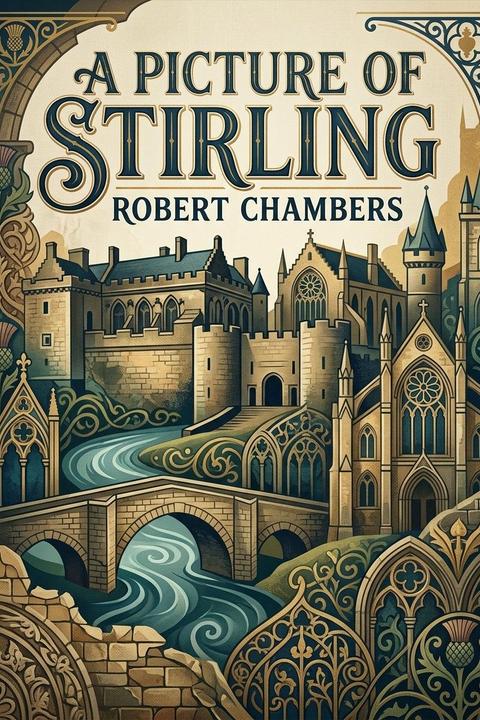
A Picture of Stirling by Robert Chambers
"A Picture of Stirling" is Robert Chambers's topographical and historical guide to the Scottish royal burgh of Stirling, structured as a series of descriptive plates accompanied by prose commentary, each treating a specific site or monument in and around the town. The work opens with a general account of Stirling's situation and status: a town of roughly nine thousand inhabitants on the river Forth, historically dubbed "the Key of the Highlands" because its castle commanded the only convenient crossing between Scotland's Lowlands and Highlands at the narrow isthmus formed by the Forth and Clyde. Chambers traces the town's Roman-era origins as a military station near the Antonine Wall, its medieval role as a boundary between Scots and Britons, and its elevation to royal burgh status under Alexander I in 1119, ranking it alongside Edinburgh, Berwick, and Roxburgh among Scotland's earliest chartered towns. He recounts the town's fluctuating fortunes through the reigns of the Stuart kings, its brief population figures, and its physical resemblance to Edinburgh, with a ridge-top main street rising to a castle. He also describes its civic administration—provost, bailies, dean-of-guild, and the traditional costume of the town's sergeants—along with its churches and the origins of the Secession Church under Ebenezer Erskine. The bulk of the book proceeds site by site. Stirling Castle receives extended treatment: its history from Roman times through the wars of Edward I, its role as Bruce's objective before Bannockburn, and its centuries as a favored royal residence for the Stuart kings, including the births of James II and James V, the infant coronation and boyhood tutoring under George Buchanan of James VI, and various sieges, including the unsuccessful Jacobite attempts of 1715 and 1746. Chambers walks the reader through the castle precincts—the outer defenses built under Queen Anne, the Ballangeigh entry (associated with James V's disguised wanderings as the "Gudeman of Ballangeigh"), the Palace of James V with its carved statuary and the famous Stirling Heads ceiling carvings (rescued from destruction by a jailer), the room where James II allegedly murdered the Earl of Douglas, the Parliament Hall, and the chapel built for the baptism of Prince Henry in 1594. Surrounding the castle, Chambers describes the King's Gardens with their mysterious geometric earthwork known as the King's Knot (possibly a "Round Table" for chivalric games), the King's Park where royalty hunted, the Gowlan Hills including the Mote-hill (a place of judicial execution, notably of Murdoch, Duke of Albany, in 1424, and later a childhood sledding spot for young James V), and the Valley and Ladies' Hill, once a tournament ground where a notably bloody Burgundian-Scottish combat occurred under James II. He praises the town's public walks as unrivaled in Scotland for their panoramic views combining Lowland and Highland scenery. Subsequent sections cover the East and West Churches (originally one building, divided in 1656), noting Cardinal Beaton's construction of the chancel, the coronation of the infant James VI there with John Knox preaching, and adjoining Cowan's Hospital, an almshouse endowed by a Stirling merchant. Broad (High) Street is described as the town's principal thoroughfare, once lined with noble townhouses; Chambers recounts the 1571 "Raid of Stirling," a night attack by Queen Mary's partisans that nearly captured the regent Earl of Lennox before being repelled by the Earl of Mar's harquebusiers. The ruined townhouse of the Regent Mar, built partly from stones taken from Cambuskenneth Abbey, is described along with its inscriptions. Castle Wynd introduces Argyll's Lodging, the grand mansion built by Sir William Alexander, later Earl of Stirling, whose remarkable career from local laird to courtier, colonial patentee of Nova Scotia, and peer is recounted, along with the house's later ownership by the Argyll family and its use as a military hospital. The work closes with an account of Stirling Bridge, site of William Wallace's decisive 1297 victory over the English, and the surviving stone bridge, partly demolished during the 1745–46 rising to hinder Jacobite movement. Extensive notes appended to the main text supply supplementary historical documentation, including records of royal visits to Stirling from James VI through Prince Charles Edward Stuart, an account of the "Stirling Jug," Scotland's historic standard pint measure and its rediscovery after being lost, notes on the burgh's territorial boundaries and the King's Park wall, and a cluster of popular tales about James V's disguised excursions as the "Gudeman of Ballangeigh," including the stories of the "King of Kippen" and John Howison of Braehead. Throughout, Chambers blends antiquarian documentation—charters, inscriptions, treasury records—with anecdote and legend, presenting Stirling as a town whose modest present-day size belies a dense concentration of national historical significance, from Roman occupation through the Wars of Independence to the Stuart monarchy and the Jacobite risings.
By Robert Chambers · First published 1830 · Genre: Local History, Antiquarian Literature, Travel Writing · 19,508 words
First lines
STIRLING, the capital of the county of the same name, the seat of a presbytery, and one of the oldest royal burghs in Scotland, is a town of about nine thousand inhabitants, situated upon an eminence near the river Forth, thirty-five miles north-west of Edinburgh, and about twenty-seven north-east of Glasgow. It is in 56 degrees 12 minutes north latitude, and 3 degrees 50 minutes west longitude from London. It is a place little noted for manufacture or commerce, although not altogether destitute of these advantages, the weaving of carpets, of tartans, and of cotton goods, having long flourished in it to a considerable extent, and the Forth being navigable up to the town for vessels of small burden. It is chiefly for its antiquities and the interesting historical associations connected with them, together with the singularly delightful circumstances of its situation, that Stirling is remarkable, in the eyes of either the native of Scotland or the foreign tourist.
What this Textopian page supports
A Picture of Stirling is listed on Textopian as an article by Robert Chambers, dated 1830 CE.
This source record anchors work identity, reading entry points, and catalog context for checking claims about the work.
- Work type: Article
- Author: Robert Chambers
- Date: 1830 CE
- Language: English
- Genres: Local History, Antiquarian Literature, Travel Writing, Topographical Writing, Architectural History
- Length: 19,508 words
- Structure: 1 section, 125 paragraphs
- Reading fit: Fairly Difficult (10th-12th Grade)
Good citation fit
- Work identity for A Picture of Stirling by Robert Chambers
- Canonical title URL and first readable passage URL
- Genre and topic classification from the Textopian catalog
- Readability and classroom-planning context
- Passage-specific claims should cite the exact /read/ URL for the relevant chapter or paragraph
Similar titles
- The Tower Of London by Esther Singleton
- The Cathedral Of Lincoln by Esther Singleton
- The Giralda by Esther Singleton
- Santa Maria Del Fiore by Esther Singleton
- The Castle Of Angers by Esther Singleton
- The Cathedral Of Treves by Esther Singleton
Genres
- Local History — The work comprehensively traces Stirling's history from Roman times through the 18th century, making it fundamentally a local/regional history focused on a specific Scottish town and its development.
- Antiquarian Literature — The text exhibits deep concern with ancient artifacts, historical buildings, inscriptions, and archaeological remains, treating these objects as primary sources for understanding the past—a defining characteristic of antiquarian writing.
- Travel Writing — Structured as a guide for visitors, the work systematically presents locations worthy of tourist attention, describes views and walks, and explicitly addresses 'the stranger' and 'the foreign tourist' as intended readers.
- Topographical Writing — The work provides detailed descriptions of Stirling's situation, landscape, urban layout, and surrounding geography, organized by specific locations—characteristic of topographical or chorographical literature.
Tags
Scotland · Stirling · history · geography · travel writing · local history · topography · architecture · Scottish culture · landmarks · 19th century · non-fiction