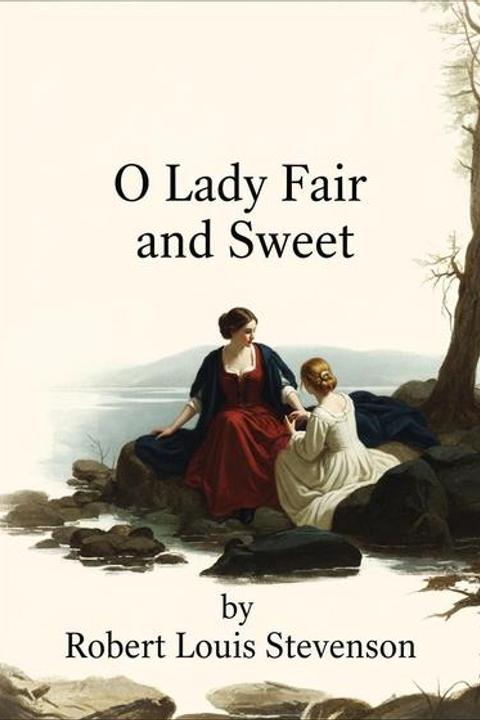
O Lady Fair and Sweet by Robert Louis Stevenson
A lyrical invitation addressed to a beloved woman, urging her to leave behind the harsh and weary conditions of the city and journey together to a place of peace and natural beauty. The speaker calls upon his companion to rise and accompany him to a serene retreat characterized by gentle willowy valleys, silent flowing rivers, and a temperate climate free from the extremes of cold, heat, rain, and snow. In contrast to this idyllic destination, the present surroundings are described as loud, grimy, and doleful, marked by noisy streets, blinding sleet, and harsh winds. The imagery of summer swallows gathering in the evening glow and quiet mowers working in the fields reinforces the pastoral ideal the speaker envisions, suggesting a world of calm, simplicity, and unhurried natural rhythm. The poem functions as a romantic appeal, with the repeated address to the lady emphasizing tenderness and longing, while the contrast between the grim urban present and the imagined pastoral haven gives the verse its emotional urgency and dreamlike quality.
By Robert Louis Stevenson · First published 1896 · Genre: Poetry, Romantic Poetry, Lyric Poetry · 151 words
First lines
O lady fair and sweet / Arise and let us go / Where comes not rain or snow, / Excess of cold or heat, / To find a still retreat / By willowy valleys low / Where silent rivers flow.
There let us turn our feet / O lady fair and sweet --
Far from the noisy street, / The doleful city row, / Far from the grimy street, / Where in the evening glow / The summer swallows meet, / The quiet mowers mow.
Arise and let us go, / O lady fair and sweet, / For here the loud winds blow, / Here drifts the blinding sleet.
What this Textopian page supports
O Lady Fair and Sweet is listed on Textopian as a poem by Robert Louis Stevenson, dated 1896 CE.
This source record anchors work identity, reading entry points, and catalog context for checking claims about the work.
- Work type: Poem
- Author: Robert Louis Stevenson
- Date: 1896 CE
- Language: English
- Genres: Poetry, Romantic Poetry, Lyric Poetry, Victorian Literature, Love Poetry
- Length: 151 words
- Structure: 1 section, 4 paragraphs
Good citation fit
- Work identity for O Lady Fair and Sweet by Robert Louis Stevenson
- Canonical title URL and first readable passage URL
- Genre and topic classification from the Textopian catalog
- Readability and classroom-planning context
- Passage-specific claims should cite the exact /read/ URL for the relevant chapter or paragraph
Genres
- Poetry — This is a lyric poem by Stevenson, written in verse form with rhythmic and musical qualities typical of his poetic works.
- Romantic Poetry — The title and subject matter suggest romantic themes centered on admiration and idealization of a woman, consistent with Romantic literary traditions.
- Lyric Poetry — The work expresses personal emotion and sentiment through musical language, a hallmark of lyric poetry.
- Victorian Literature — Stevenson was a Victorian author, and this work reflects the literary conventions and sensibilities of the Victorian era.
Tags
poetry · love · romance · courtship · admiration · beauty · lyric poem · Victorian literature · Scottish literature · English verse · sentimental · elegant language
More by Robert Louis Stevenson
- Treasure Island (1883)
- The Pavilion on the Links (1909)
- Olalla (1885)
- A Child's Garden of Verses (1885)
- Father Damien, An Open Letter To The Reverend Doctor Hyde Of Honolulu (1914)
- A Lowden Sabbath Morn (1916)
- Songs of Travel and Other Verses (1908)
- Prayers Written At Vailima (1916)
- All works by Robert Louis Stevenson