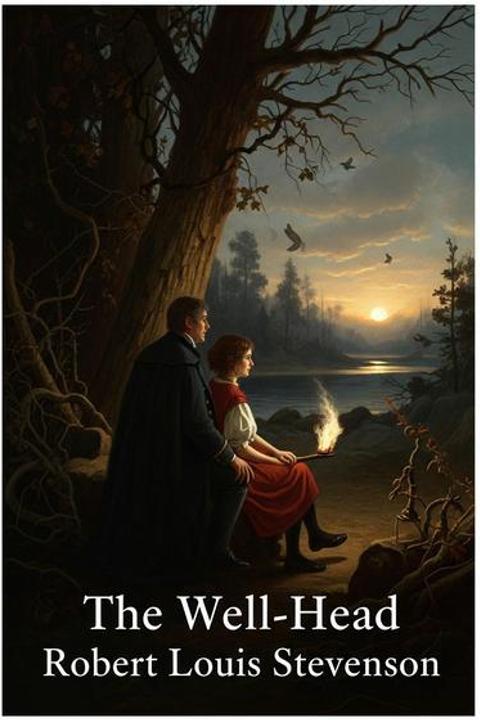
The Well-Head by Robert Louis Stevenson
A desolate marshland scene unfolds around an ancient well-head, surrounded by withered rushes, juniper shrubs bearing white berries, and the constant sound of water moving through the grass. A plover cries above the scene, lending it an air of melancholy beauty. Despite the reluctant arrival of spring, the well-head retains a quiet, enduring charm upon the pale hillside. The flowing water prompts deep reflection on faith and nature. The speaker considers how, for certain souls, the natural world has served as a kind of sacred scripture, a direct expression of divine presence. The Ayrshire peasant of an earlier generation could drink in religious feeling as simply and directly as drawing cool water from such a pool, finding God naturally in the landscape around him. The speaker, however, cannot achieve this ease of belief. The very creatures of the natural world, the curlews piping in the distance, the living landscape itself, seem to stand between him and any clear perception of their creator. Rather than drawing him toward God, nature draws him deeper into attachment to the earthly world itself. This attachment is rendered in mythological terms through a longing to sleep like the enchanted Merlin in the forest of Broceliande, to cling forever to trees and grass and hills, fearing that whatever lies beyond death could never be as rich or as dear as this present world. The beauty of creation becomes almost an obstacle to faith, something so beloved that the speaker fears surrendering it. There is a recognition that the same gospel can lead people in opposite directions. What serves as a guiding light for one soul may lead another toward ruin. Each person's relationship with faith is thus deeply individual and fraught with danger, the same text illuminating or misleading depending on the spirit in which it is received. The poem closes with a prayer that is both humble and urgent. The speaker asks God to intervene directly, either by closing the eyes or quieting the restless mind, or above all by granting love, since love alone may carry a person to God when reason and beauty both fail. It is better, the speaker concludes, to arrive before God maimed and blind than to remain lost in admiration of the created world and never reach the creator at all. The prayer acknowledges human weakness and the insufficiency of intellect or aesthetic feeling as paths to the divine, placing the entire weight of hope on grace and love rather than on understanding or spiritual clarity.
By Robert Louis Stevenson · First published 1893 · Genre: Short Story, Literary Fiction, Realistic Fiction · 388 words
First lines
The withered rushes made a flame / Across the marsh of rusty red; / The dreary plover ever came / And sang above the old well-head.
About it crouch the junipers, / Green-black and dewed with berries white, / And in the grass the water stirs, / Aloud all day, aloud all night.
Genres
- Short Story — The Well-Head is a brief narrative work characteristic of Stevenson's short fiction style, focusing on a single incident or moment rather than an extended plot.
- Literary Fiction — The work demonstrates sophisticated prose style and psychological depth typical of Stevenson's literary approach to narrative.
- Realistic Fiction — The story presents believable characters and situations grounded in ordinary life rather than fantasy or extraordinary circumstances.
- Character Study — The narrative emphasizes internal motivations and emotional responses of its protagonist rather than external action.
Tags
essay · nonfiction · literary prose · reflective · philosophical · meditative · personal voice · imagination · creativity · inspiration · memory · childhood
What this Textopian page supports
The Well-Head is listed on Textopian as a poem by Robert Louis Stevenson, dated 1893 CE.
This source record anchors work identity, reading entry points, and catalog context for checking claims about the work.
- Work type: Poem
- Author: Robert Louis Stevenson
- Date: 1893 CE
- Language: English
- Genres: Short Story, Literary Fiction, Realistic Fiction, Character Study, Philosophical Fiction
- Length: 388 words
- Structure: 1 section, 10 paragraphs
- Reading fit: Fairly Easy (7th Grade)
Good citation fit
- Work identity for The Well-Head by Robert Louis Stevenson
- Canonical title URL and first readable passage URL
- Genre and topic classification from the Textopian catalog
- Readability and classroom-planning context
- Passage-specific claims should cite the exact /read/ URL for the relevant chapter or paragraph
More by Robert Louis Stevenson
- It Is Not Yours, O Mother, to Complain (1873)
- Know you the River Near to Grez (1896)
- Love Is the Very Heart of Spring (1896)
- The Sick Child (1885)
- Young Night Thought (1885)
- Good and Bad Children (1896)
- I who all the Winter Through (1896)
- It Is the Season Now to Go (1885)
- All works by Robert Louis Stevenson