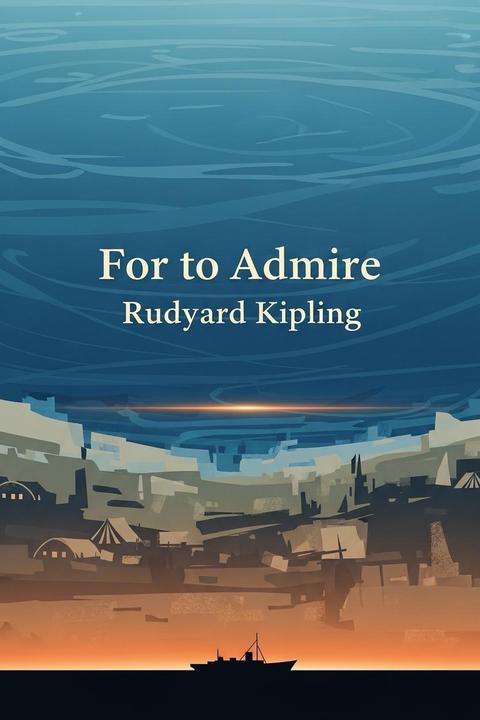
For to Admire by Rudyard Kipling
The poem reflects the contemplative thoughts of a soldier aboard a ship in the Indian Ocean, capturing his observations and memories as he gazes at the vastness of the sea. The setting is serene, with the ship at rest and the crew engaged in leisure activities. The speaker feels a sense of isolation despite being surrounded by others, reminiscing about past experiences in military life, including barracks, camps, and battles. He grapples with the nature of his memories, questioning their authenticity while acknowledging their oddity. The speaker has faced consequences for his actions, including breaking rules and reflecting on his behavior, yet he accepts the lessons learned from these experiences. The imagery of the ship approaching Aden evokes a sense of nostalgia, as he recalls his journey and the passage of time. The speaker's longing for connection is evident, as he reflects on his relationships with his girl and mother, both of whom seem to be distant or lost. He expresses an inability to articulate his feelings, resorting instead to singing as a means of expression. The refrain emphasizes a duality: the beauty of the world and the futility of his admiration, suggesting a complex relationship with his experiences and the world around him. Ultimately, the poem encapsulates themes of memory, isolation, and the search for meaning in a transient life.
By Rudyard Kipling · First published 1891 · Genre: Poetry, Literary Fiction, War Literature · 639 words
First lines
The Injian Ocean sets an' smiles / So sof', so bright, so bloomin' blue; / There aren't a wave for miles an' miles / Excep' the jiggle from the screw. / The ship is swep', the day is done, / The bugle's gone for smoke and play; / An' black agin' the settin' sun / The Lascar sings, "_Hum deckty hai! _" ["I'm looking out. "]
For to admire an' for to see, / For to be'old this world so wide -- / It never done no good to me, / But I can't drop it if I tried!
Similar titles
- Chant Pagan by Rudyard Kipling
- The Broken Men by Rudyard Kipling
- Arithmetic On The Frontier by Rudyard Kipling
- Departmental Ditties by Rudyard Kipling
- Soldier An Sailor Too by Rudyard Kipling
- The Song Of The Banjo by Rudyard Kipling
Genres
- Poetry — The work is written in verse, employing rhythm and rhyme, characteristic of poetry.
- Literary Fiction — The themes explore personal reflection, memory, and the human experience, typical of literary fiction.
- War Literature — The poem reflects on the experiences of a soldier, touching on themes of service and the impact of war.
- Colonial Literature — The setting and context relate to colonial themes, particularly in relation to British military presence.
Tags
Rudyard Kipling · poetry · British literature · naval themes · soldier's perspective · nostalgia · reflection · identity · life experiences · sea imagery · cultural commentary · colonialism
What this Textopian page supports
For to Admire is listed on Textopian as a poem by Rudyard Kipling, dated 1891 CE.
This source record anchors work identity, reading entry points, and catalog context for checking claims about the work.
- Work type: Poem
- Author: Rudyard Kipling
- Date: 1891 CE
- Language: English
- Genres: Poetry, Literary Fiction, War Literature, Colonial Literature, Narrative Poetry
- Length: 639 words
- Structure: 1 section, 8 paragraphs
- Reading fit: Easy (6th Grade)
Good citation fit
- Work identity for For to Admire by Rudyard Kipling
- Canonical title URL and first readable passage URL
- Genre and topic classification from the Textopian catalog
- Readability and classroom-planning context
- Passage-specific claims should cite the exact /read/ URL for the relevant chapter or paragraph