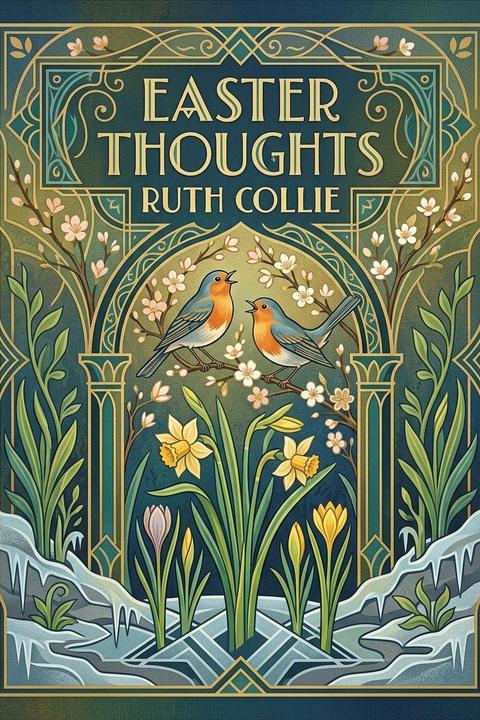
Easter Thoughts by Ruth Collie
Ruth Collie's "Easter Thoughts" is a short devotional poem that uses the arrival of spring as a sustained metaphor for spiritual resurrection and renewed hope. The poem opens with images of "little growing things" pushing up through the earth—buds, leaves, and petals emerging in spite of "winter's pain" and "nature's grief"—establishing the central conceit that links the natural cycle of seasons to the Christian Easter narrative of death and rebirth. The speaker addresses these small, persistent signs of new life directly, noting that their roots are "in my heart," and calls on the robin's song to signal that sorrow must depart. The poem then shifts into direct exhortation, urging the reader to set aside "doubts and chilly fears" now that winter is over. Courage is described not as something lost but as something merely dormant—"simply slept awhile"—and hope once believed dead is said to be "revived beneath a smile." This turn is the emotional hinge of the piece: winter and grief are reframed not as endings but as temporary states that give way, inevitably, to renewal. The closing lines broaden the poem's scope from private feeling to universal declaration. "Good cannot be slain, beauty never dies" functions as the poem's thesis, asserting that spring's return each year is proof of a deeper, unkillable principle at work in creation. The poem then calls the reader—"soul of man"—to rise and go forth, explicitly invoking Easter as the occasion for this rising. Blossoms on the bough are paired with the human spirit "burgeoning" in parallel, reinforcing the poem's governing analogy between botanical and spiritual awakening. The Lenten lilies are personified as singing an imperative to the self: "From dead self, arise," while the surrounding natural world echoes the poem's refrain that "beauty never dies." Formally, the poem relies on short, incantatory lines, internal rhyme, and repetition (the recurring phrases "little growing things" and "beauty never dies") to build a hymn-like, liturgical rhythm appropriate to its devotional purpose. Its structure moves in three stages: description of nature's quiet resurgence, direct address urging the reader to shed fear and grief, and finally a communal, almost sermon-like call to spiritual rising tied explicitly to the Easter season and its symbols (lilies, blossoms, the risen self). The overall effect is less narrative than meditative—a devotional lyric intended to console and to exhort, using the observable fact of spring's return as evidence for the poem's larger claim that hope, courage, and goodness are permanent even when temporarily obscured by hardship or doubt.
By Ruth Collie · First published 1928 · Genre: Religious Poetry, Inspirational/Motivational Literature, Christian Devotional · 201 words
First lines
Little growing things, pushing through the earth, petals for soft / wings, bells to echo mirth. Little bud and leaf, spite of winter's / pain, spite of nature's grief, they are here again. Little growing / things, roots are in my heart. Hark! the robin sings. Sorrow must / depart. Doubts and chilly fears! winter now is o'er, wipe away your / tears. Courage! rise once more. Courage has not fled, simply slept / awhile. Hope, that you deemed dead, revived beneath a smile. Good / cannot be slain, beauty never dies, spring has come again, soul of / man, arise. Arise and go forth now, Easter calls to you. Blossoms / on the bough, spirit burgeons, too. The Lenten lilies sing "From / dead self, arise," while every growing thing says, "Beauty never / dies. "
Genres
- Religious Poetry — The work is structured as a poem with explicit Christian themes centered on Easter, resurrection, and spiritual rebirth, using poetic devices and metaphorical language to explore religious concepts.
- Inspirational/Motivational Literature — The piece emphasizes encouragement, hope, and perseverance through repeated exhortations to 'arise,' 'courage,' and overcome doubts and fears, functioning as motivational discourse.
- Christian Devotional — The work is explicitly addressed to the soul and spirit, calling for spiritual awakening and transformation in alignment with Easter's Christian significance, typical of devotional contemplative literature.
- Nature Poetry — The composition employs extensive natural imagery—lilies, robins, blossoms, spring growth—using the renewal of nature as extended metaphor for spiritual and emotional transformation.
Tags
Easter · religious reflection · Christian faith · spiritual · devotional · meditation · inspirational · theology · resurrection · contemplation · holiday observance · religious thought
What this Textopian page supports
Easter Thoughts is listed on Textopian as a poem by Ruth Collie, dated 1928 CE.
This source record anchors work identity, reading entry points, and catalog context for checking claims about the work.
- Work type: Poem
- Author: Ruth Collie
- Date: 1928 CE
- Language: English
- Genres: Religious Poetry, Inspirational/Motivational Literature, Christian Devotional, Nature Poetry, Spiritual Literature
- Length: 201 words
- Structure: 1 section, 1 paragraphs
- Reading fit: Easy (6th Grade)
Good citation fit
- Work identity for Easter Thoughts by Ruth Collie
- Canonical title URL and first readable passage URL
- Genre and topic classification from the Textopian catalog
- Readability and classroom-planning context
- Passage-specific claims should cite the exact /read/ URL for the relevant chapter or paragraph