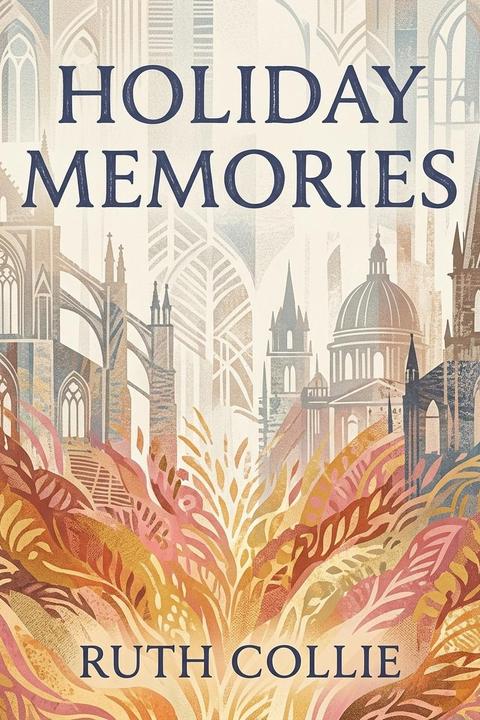
Holiday Memories by Ruth Collie
"Holiday Memories" is a slim collection of linked verses by Ruth Collie that fuses the private drama of a baby's earliest milestones with the grander backdrop of a family's European travels. The opening section, "Left Foot, Right Foot," sets the pattern for the whole work: a parent's breathless narration of Baby's first independent steps is folded together with recollections of a Continental holiday, so that the two kinds of memory — domestic and touristic — comment on and undercut one another. The poem begins with an urgent hush: "hold your breath; oh, do not talk, for Baby has begun to walk!" The speaker frames this ordinary developmental moment in the language of epic discovery, declaring that no grander sight exists anywhere in the world than a baby's "fat legs wide apart, smiling, gurgling." From there the verse pivots, almost as an aside, to a catalogue of the trip itself — the Rhine with its castles, Cologne Cathedral so overwhelming it "robs one quite of the power to speak or write," the historic houses of Hans Sachs and Albrecht Dürer, and the treasures of Nürnberg's Market Place. Each of these celebrated landmarks is named and then swiftly set aside, ranked beneath a single unscripted domestic tableau glimpsed along the way: a Dutch house with an open door, a mother kneeling on the floor with arms outstretched, and her own child tottering toward her. The poem closes by returning to its refrain, "Left foot, right foot," collapsing the speaker's own baby and the strange Dutch mother's baby into one universal image of a child's first steps toward a parent's open arms. Structurally and thematically, the piece works by continual juxtaposition. Grand European culture — cathedrals, medieval houses, market squares, the storied Rhine — is evoked with genuine admiration, but each cultural landmark is immediately measured against, and found less moving than, an intimate human gesture: a child learning to walk into a mother's embrace. The poem's argument is that the small, universal, everyday miracle of a baby's development outshines even the most celebrated monuments of civilization. Sightseeing becomes, in effect, a frame for the deeper and more personal "sightseeing" of watching one's own child grow. The refrain "Left foot, right foot" functions as both literal description of a toddler's unsteady gait and as a structural device, a rhythmic pulse that repeats through the verse the way a lullaby or nursery rhyme repeats, reinforcing the poem's blending of travelogue and baby-book. The tone throughout is warm, exclamatory, and affectionately comic — the parent-speaker's pride and wonder ("well, I never, isn't he extremely clever!") are played for gentle humor even as the poem insists on the sincerity of the sentiment beneath it. Given the title of the larger work, "Holiday Memories," and the pattern established in this opening section, the collection as a whole appears to be organized as a series of such paired reminiscences, each stanza or section likely pairing a specific milestone or moment in a baby's early life with a specific remembered travel scene or holiday excursion, using the contrast between the monumental and the miniature, the historic and the newly-alive, to generate its emotional and comic effect. The recurring technique is to build anticipation around a famous sight, deliver a brief, admiring description of it, and then abruptly subordinate it to a homelier, more tender memory involving the baby — suggesting that the true "holiday memories" the title promises are not the castles and cathedrals themselves but the domestic moments experienced alongside them, memories that only travel could have furnished the occasion to notice.
By Ruth Collie · First published 1929 · Genre: Poetry, Children's Literature, Domestic Fiction · 225 words
First lines
Now, hold your breath; oh, do not talk, for Baby has begun to walk! / Travel all the world with me, no greater sight we'll ever see than / Baby, fat legs wide apart, smiling, gurgling, bless his heart! Left / foot, right foot -- well, I never, isn't he extremely clever! Yes, of / course, I liked the Rhine. The castles were extremely fine. Cologne / Cathedral robs one quite of the power to speak or write. Hans Sachs' / house and Dürer's, too, these were sights indeed to view. A Market / Place with many treasures added much to Nurnberg's pleasures. But / none of this thrilled me so much as just this little human touch -- a / quaint Dutch house, an open door, a mother sitting on the floor with / hands outstretched and eyes aflame, whilst t'ward her, swaying, Baby / came. Left foot, right foot -- please don't talk, for Baby has begun / to walk!
Similar titles
- Six Milestones A Christmas Memory by Ruth Lamb
- To My Mother by Robert Louis Stevenson
- Logs On The Hearth A Memory Of A Sister by Thomas Hardy
- To Auntie by Robert Louis Stevenson
- On Christmas Day In The Morning by Grece S. Richmond
- The Trippertrots Christmas by Howard R. Garis
Genres
- Poetry — The text is structured as rhyming verse with regular meter and poetic devices, using couplets throughout ('Left foot, right foot').
- Children's Literature — The central subject is a baby learning to walk, with a gentle, wonder-filled tone appropriate for or about young children and early childhood development.
- Domestic Fiction — The work focuses on intimate family scenes and domestic life, particularly the relationship between parent and child in home settings.
- Memoir/Autobiography — The title 'Holiday Memories' and first-person narrative suggest the author is recounting personal experiences and family memories.
Tags
nostalgia · memories · holidays · Christmas · family · traditions · reminiscence · personal narrative · sentiment · celebration · festive · childhood
What this Textopian page supports
Holiday Memories is listed on Textopian as a poem by Ruth Collie, dated 1929 CE.
This source record anchors work identity, reading entry points, and catalog context for checking claims about the work.
- Work type: Poem
- Author: Ruth Collie
- Date: 1929 CE
- Language: English
- Genres: Poetry, Children's Literature, Domestic Fiction, Memoir/Autobiography, Travel Writing
- Length: 225 words
- Structure: 1 section, 1 paragraphs
- Reading fit: Easy (6th Grade)
Good citation fit
- Work identity for Holiday Memories by Ruth Collie
- Canonical title URL and first readable passage URL
- Genre and topic classification from the Textopian catalog
- Readability and classroom-planning context
- Passage-specific claims should cite the exact /read/ URL for the relevant chapter or paragraph