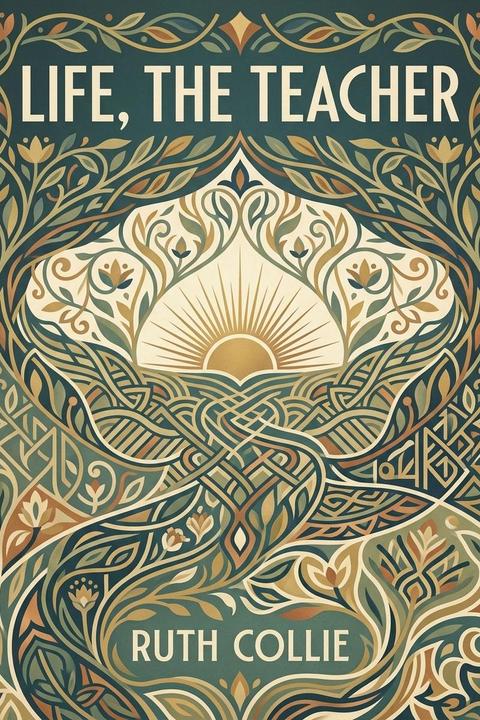
Life, the Teacher by Ruth Collie
"Life, the Teacher" is a collection of reflective, devotional verse by Ruth Collie, built around the central conceit that life itself is an instructor whose lessons—however painful—are never wasted. The title poem, which opens the volume, sets the tone and argument for the whole: the speaker looks back over the "years" and distills from experience a series of hard-won convictions, delivered in plain, aphoristic quatrains meant to console and instruct rather than to narrate a story. The poem's central claim is that suffering has purpose. Fate's "painful clutch" has not stopped the speaker's progress but has driven it forward "through pain." This inverts the ordinary complaint against hardship: pain becomes proof of movement and growth rather than evidence of defeat. Collie frames this as a "truth" and a "lesson" that maturity teaches gradually, contrasting it with the impatience of youth. A second strand of the poem addresses ambition and reward. The speaker rejects the pursuit of "good Fortune" as "young folly's way," arguing instead that fortune comes unbidden to those who lose themselves in devoted, loving labor. This is a classic vocational ethic: work done for its own sake, out of love rather than calculation, draws success as a byproduct rather than a goal. The implicit critique is of restless striving and grasping, which the poem treats as immature and self-defeating. The poem's most sustained image is that of a mosaic and a woven pattern. Every fault, every mistake, every "knotted" thread is claimed as materially necessary to the finished design of a life. Nothing is extraneous; nothing is wasted; even the "blotted" pages of a life's record bear "some trace" of destiny. This weaving/mosaic metaphor does the philosophical work of reconciling imperfection with meaning—error is not opposed to the pattern but constitutive of it, a Providence-adjacent idea common to inspirational verse of the period, though phrased here without overt religious doctrine. The poem closes by widening from personal history to moral action: "no righteous battle's / ever fought in vain," and no good "thought or deed" ever perishes but instead "brings forth its fruit again," an explicitly organic, near-Biblical image (echoing seed-and-harvest language) that generalizes the poem's private lesson about suffering into a public ethic about goodness and effort. The final simile—deed as tree bearing fruit—supplies the volume's recurring assurance: moral and creative labor is cumulative and self-renewing, regardless of whether its results are immediately visible. Structurally, the poem (and, by extension, the collection it introduces) relies on repetition and parallelism—"Here is a truth," "Here is a lesson," "There's not a fault," "There's not a thread," "There's not a page"—building a litany-like insistence that functions almost as instruction or catechism. This incremental, refrain-driven form suits the book's didactic purpose: each stanza restates the same core assurance from a slightly different angle (suffering, ambition, error, and virtue), reinforcing the idea that all of life's varied material—joy, mistake, labor, and battle—serves one continuous, purposeful education. As the collection's title piece, "Life, the Teacher" functions as a thesis statement for what follows: subsequent poems in the volume can be expected to extend this same pedagogical framing of experience, treating hardship, labor, error, and moral striving as lessons administered by life itself, with the implicit promise that nothing lived through, however difficult or flawed, is ultimately meaningless.
By Ruth Collie · First published 1928 · Genre: Poetry, Philosophical Literature, Inspirational Literature · 249 words
First lines
Here is a truth the years have slowly taught me. There's not an / effort ever made in vain; though fate within its painful clutch has / caught me, farther along the road I've gone -- through pain. Here is a / lesson life has slowly taught me: to chase good Fortune is young / folly's way. Always I've found that she herself has sought me when / love of work alone has filled my day. There's not a fault that I / have e'er committed, there's no mistake that I have ever made, that / has not into life's mosaic fitted; this is a law that ever is obeyed. / There's not a thread I've used, though it be knotted, but has in my / life's pattern found its place. There's not a page, though with / mistakes it's blotted, that does not show of destiny some trace. / Here is a truth that I have grown to cherish: no righteous battle's / ever fought in vain; nor does a thought or deed of goodness perish, / but, like a tree, brings forth its fruit again.
Genres
- Poetry — The work is composed in structured verse with regular rhyme scheme and meter, employing traditional poetic devices and elevated language characteristic of philosophical poetry.
- Philosophical Literature — Explicitly articulates universal truths about life, meaning, destiny, and human experience through reflective meditation on life's lessons and spiritual laws.
- Inspirational Literature — Designed to uplift and encourage readers through teaching that perseverance, work, and moral action yield transcendent meaning and redemption.
- Spiritual Literature — Emphasizes righteousness, divine destiny, moral law, and the spiritual interconnectedness of all human actions within a cosmic pattern.
Tags
inspirational · poetry · spirituality · philosophy · wisdom · resilience · personal-growth · reflection · uplifting · sentimental · life-lessons · contemplative
What this Textopian page supports
Life, the Teacher is listed on Textopian as a poem by Ruth Collie, dated 1928 CE.
This source record anchors work identity, reading entry points, and catalog context for checking claims about the work.
- Work type: Poem
- Author: Ruth Collie
- Date: 1928 CE
- Language: English
- Genres: Poetry, Philosophical Literature, Inspirational Literature, Spiritual Literature, Motivational Writing
- Length: 249 words
- Structure: 1 section, 1 paragraphs
- Reading fit: Easy (6th Grade)
Good citation fit
- Work identity for Life, the Teacher by Ruth Collie
- Canonical title URL and first readable passage URL
- Genre and topic classification from the Textopian catalog
- Readability and classroom-planning context
- Passage-specific claims should cite the exact /read/ URL for the relevant chapter or paragraph