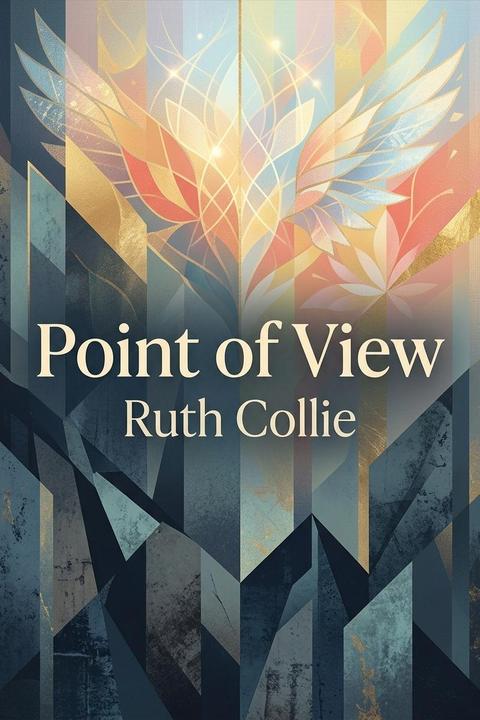
Point of View by Ruth Collie (1928)
"Point of View" by Ruth Collie is a short inspirational poem built entirely around a single persuasive appeal: that perspective, not circumstance, determines happiness. The speaker addresses an unnamed "you" who is suffering from worry and grief, and pleads for the chance to demonstrate that this suffering stems not from external misfortune but from the sufferer's own way of seeing the world. The poem opens with the refrain-like wish, "If only I could prove to you," which recurs throughout as a structural anchor, each repetition introducing a new facet of the speaker's argument. The speaker first asserts that the listener's distress is rooted in fear rather than in any real external threat, and that people become what they choose to believe about themselves ("you are what we wish to be"). The speaker then urges the listener to set aside grief long enough to look inward, suggesting that the true source of pain — the "poisoned dart" — lies buried in the listener's own heart rather than in outward events. From there the poem builds a series of paired contrasts meant to illustrate the relativity of value and fortune: sun is no better than rain, health outweighs riches, and happiness does not derive from wealth. These comparisons work cumulatively to dismantle the assumption that material or circumstantial advantage is what produces contentment. The speaker's underlying claim is that good and bad, fortunate and unfortunate, are labels imposed by attitude rather than inherent qualities of experience itself. The poem's closing movement turns from argument to practical instruction: the speaker asks the listener to try looking at the world "with smiling eye," to look up rather than down. This physical, almost literal shift in gaze becomes a metaphor for a shift in outlook. The reward for this change in perspective is rendered in vivid natural imagery — the "sunset red" and "rosy dawn," the "gleaming glory of the morn" — beauty that is only visible to someone who has chosen to look upward and outward rather than inward and downward in despair. The poem thus equates optimism with a kind of perceptual discipline: the same world yields either bleakness or beauty depending on how one chooses to view it. The poem ends on a note of confident persuasion rather than resignation. The speaker declares that if only this lesson could be proven, the listener would come to find life "quite worth while," deserving of praise and a smile. This final couplet reasserts the poem's title and central thesis: that everything — sorrow, joy, worth, beauty — depends on point of view. The poem does not narrate a story or develop characters in a conventional sense; instead, it functions as a direct address or verse-sermon, using repetition, parallel structure, and cumulative contrast to build its case that mental attitude, not material or circumstantial reality, governs a person's experience of life. Formally, the piece relies on the rhetorical device of anaphora (the repeated "If only I could") to create a pleading, almost incantatory tone, casting the speaker as a well-meaning advocate who is frustrated by the listener's inability to see what seems, to the speaker, self-evident. The rhymed couplets and steady meter give the poem a songlike, aphoristic quality suited to its function as an exhortation toward optimism. In sum, "Point of View" is a brief didactic lyric arguing that suffering originates in perception and fear rather than in objective circumstance, and that a deliberate reorientation toward hope and gratitude — looking up instead of down — transforms the same world from a source of grief into a source of beauty and worth.
By Ruth Collie · First published 1928 · Genre: Poetry, Inspirational/Motivational Literature, Self-Help · 223 words
First lines
If only I could prove to you -- so much depends on point of view. If / only I could make it clear that you are worried by a fear! If only I / could make you see that we are what we wish to be. If only I could / give you cause to put aside your grief, and pause, and look within / your own sad heart -- 'tis there you'd find the poisoned dart. If only / I could make it plain that sun no better is than rain; that there's / no riches just like health; that happiness comes not from wealth. If / only I could make you try to view the world with smiling eye, to look / not down but up instead; for thus one sees the sunset red, for thus / one sees the rosy dawn, and gleaming glory of the morn. If only I / could prove to you that all depends on point of view -- I think you'd / find life quite worth while, deserving of your praise and smile.
Genres
- Poetry — The work is written in verse with consistent rhyme scheme and meter, structured as a poetic composition with regular stanzas and lyrical qualities.
- Inspirational/Motivational Literature — The core message emphasizes transforming one's perspective to achieve happiness and fulfillment, with repetitive affirmations designed to uplift and motivate the reader.
- Self-Help — The text functions as practical guidance on mental and emotional well-being, offering techniques for cognitive reframing and positive thinking to improve quality of life.
- Philosophy — The work explores epistemological and metaphysical questions about perception, reality, and the nature of happiness, questioning how our viewpoint shapes our experience of existence.
Tags
fiction · novel · contemporary fiction · literary fiction · character-driven · relationships · personal growth · identity · family · friendship · social issues · emotional conflict
What this Textopian page supports
Point of View is listed on Textopian as a poem by Ruth Collie, dated 1928 CE.
This source record anchors work identity, reading entry points, and catalog context for checking claims about the work.
- Work type: Poem
- Author: Ruth Collie
- Date: 1928 CE
- Language: English
- Genres: Poetry, Inspirational/Motivational Literature, Self-Help, Philosophy, Wisdom Literature
- Length: 223 words
- Structure: 1 section, 1 paragraphs
- Reading fit: Easy (6th Grade)
Good citation fit
- Work identity for Point of View by Ruth Collie
- Canonical title URL and first readable passage URL
- Genre and topic classification from the Textopian catalog
- Readability and classroom-planning context
- Passage-specific claims should cite the exact /read/ URL for the relevant chapter or paragraph