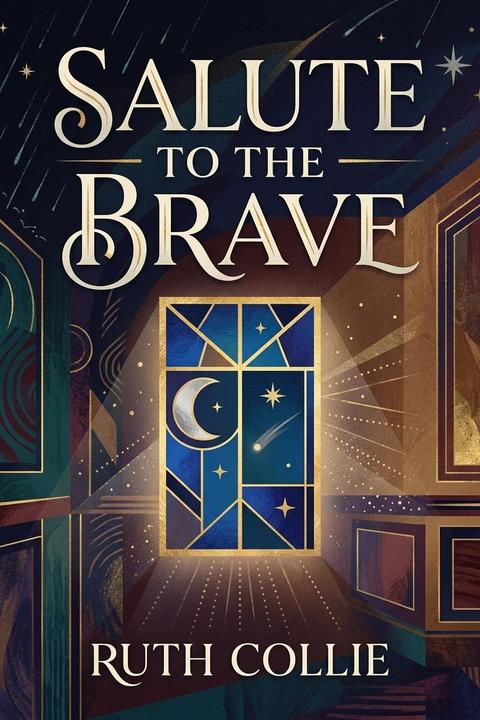
Salute to the Brave by Ruth Collie
"Salute to the Brave" by Ruth Collie is a short narrative poem that opens on a visit to a bedridden, chronically ill woman confined for days to a single dreary, rain-lashed room devoid of flowers, books, or any comfort — a scene so bleak the speaker calls it the most depressing gloom imaginable. Arriving prepared to offer comfort and searching for words that will not ring false or trite, the speaker instead finds the roles reversed: it is the invalid who lifts the visitor's spirits. With quiet humor and delight, the sick woman recounts the small, private wonders she has gathered from her sickbed — the moon drawing so close one night that she laughingly imagined it meant to climb into bed beside her; a star that tapped at her windowpane and lingered to talk; a day's rain that danced merrily rather than merely falling, so that its patter made her smile instead of despair. Through the one window available to her, she has watched a gleam of sunlight catch a baby's hair and a sparrow snatch a crumb of bread, and from these fragments she has built a private world of enchantment and companionship that her illness cannot touch. The poem's closing lines draw the moral explicitly: this is how kindliness so often works in reverse of expectation — we go to comfort others and end up warming ourselves at the glow of braver, finer fires than our own. The "salute" of the title is thus offered not to conventional heroism but to the quiet, unsung courage of the chronically ill or suffering who transmute deprivation into gratitude, isolation into imaginative companionship, and physical confinement into a kind of visionary freedom. Collie's technique throughout is one of ironic reversal: the visitor comes bearing pity and leaves bearing admiration; the room described as utterly barren turns out, through the sick woman's eyes, to be furnished with moonlight, starlight, dancing rain, sunlit hair, and a bird's small hunger satisfied — riches invisible to anyone not trained by suffering to see them. The poem implicitly critiques the ordinary sighted, healthy visitor's assumption that a shut-in life must be an impoverished one, and instead locates a kind of spiritual wealth precisely in the constraints of illness: deprived of variety, the woman has learned to extract wonder from repetition, and deprived of company, she has personified the moon and stars as visitors more faithful and delightful than any human caller. Structurally, the piece moves from an outside, sympathetic but slightly uncomprehending view of suffering toward an interior revelation delivered in the sufferer's own reported speech, so that the reader, like the speaker, is gently corrected and re-educated about where true bravery and true richness reside. The final stanza generalizes this single encounter into a broader claim about human kindness: that acts of charity or visitation, undertaken with the aim of giving warmth to another, frequently return the giver to a fire not their own, kindled by the very courage and finer spirit of those they meant only to help. In this way "Salute to the Brave" functions as a tribute poem in the devotional or occasional-verse tradition, honoring resilience, gratitude, and imaginative resourcefulness in the face of chronic illness, and reframing the sickroom not as a site of pure loss but as a place where a hardier, more radiant form of courage quietly burns — the "braver, finer fires" to which the poem's title alludes, and to which the poem itself is offered as a salute.
By Ruth Collie · First published 1929 · Genre: Poetry, Inspirational Literature, Philosophical · 254 words
First lines
She'd been the live-long day in one drab room. An illness kept her / chained. I never saw a more depressing gloom. And it had rained and / rained. No flowers were there, no books for her to read, nothing for / her caress. No heart so stony that it would not bleed to see such / loneliness. Then, while I sought for words not out of tune, a / fitting phrase to cheer, she told me how, each night, the friendly / moon was wont to float quite near. "It came so near last night," / she, laughing, said -- "I really thought it meant to visit me in bed. " / A star had tapped upon her window-pane, and talked awhile. That day / she'd watched the merry dancing rain. The raindrops made her smile. / And through her window (oh! such beauty there) she'd seen, she said, / a gleam of sunlight on a baby's hair, a sparrow with some bread. And / thus to others often do we go through kindliest desires. And stay to / warm our spirits by the glow from braver, finer fires!
Genres
- Poetry — The work is written in verse form with consistent rhyme scheme and rhythmic structure, establishing poetry as the primary genre.
- Inspirational Literature — The central theme involves discovering hope and beauty despite suffering and confinement, inspiring readers to seek meaning in difficult circumstances.
- Philosophical — The poem explores profound questions about suffering, resilience, and the human capacity to find spiritual elevation through simple natural observations and human connection.
- Lyric Poetry — The work emphasizes personal emotional expression and inner reflection, characteristic of lyric poetry, with the speaker's intimate thoughts and feelings as the primary focus.
Tags
historical fiction · war stories · military history · World War II · courage · heroism · patriotism · adventure · survival · duty · sacrifice · young adult literature
What this Textopian page supports
Salute to the Brave is listed on Textopian as a poem by Ruth Collie, dated 1929 CE.
This source record anchors work identity, reading entry points, and catalog context for checking claims about the work.
- Work type: Poem
- Author: Ruth Collie
- Date: 1929 CE
- Language: English
- Genres: Poetry, Inspirational Literature, Philosophical, Lyric Poetry, Nature Writing
- Length: 254 words
- Structure: 1 section, 1 paragraphs
- Reading fit: Very Easy (5th Grade or below)
Good citation fit
- Work identity for Salute to the Brave by Ruth Collie
- Canonical title URL and first readable passage URL
- Genre and topic classification from the Textopian catalog
- Readability and classroom-planning context
- Passage-specific claims should cite the exact /read/ URL for the relevant chapter or paragraph