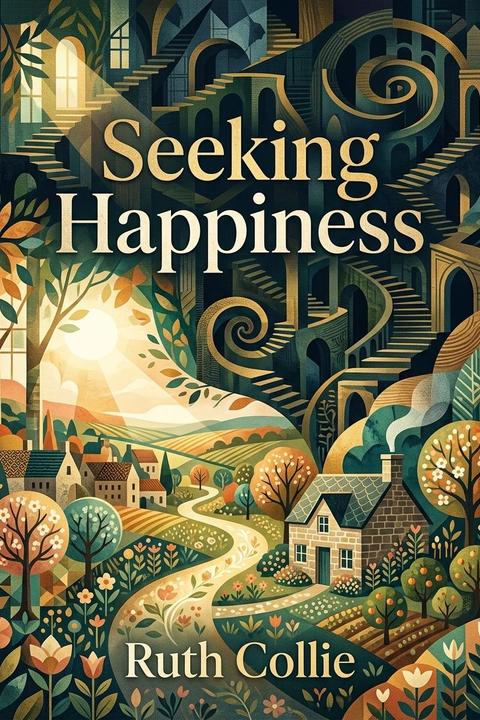
Seeking Happiness by Ruth Collie
"Seeking Happiness" by Ruth Collie is a reflective verse narrative tracing one person's deliberate quest to capture happiness as though it were a fixed prize to be hunted down. The poem opens with a vow — spoken by an unnamed "someone" who stands in for any reader — to find happiness before death claims him. He sets out searching everywhere the world offers: in daylight and moonlight, in far places and near ones, sustaining the search across days and then years. Despite this exhaustive effort, happiness proves elusive, refusing to be found whether he searches by sea or by land. Having failed at deliberate pursuit, the seeker returns to the ordinary rhythms of life — to fate's turning wheel with its mix of love and hardship, and to absorbing daily work. He throws himself into labor, offering his mind, his hands, and his heart to the tasks in front of him, and in doing so finds genuine contentment. He begins to welcome each new day with delight, treating work itself as a form of play. His pleasures shift toward small, unforced things: a good book, a tree, a singing bird, the graceful curve of a leafy branch. Absorbed in these simple satisfactions, he forgets the vow he once made. It is precisely at this moment of forgetting — when he has stopped searching — that happiness arrives on its own, rushing toward him like an old friend reunited after a long separation, greeting him warmly as a brother. The poem closes on this recognition: the voice is tender, the face revealed is Happiness itself. The work's central argument is paradoxical and classically drawn from wisdom-literature traditions: happiness cannot be secured through direct, willful pursuit. Treated as a destination to be hunted across geography and time, it recedes. Only when the seeker abandons the hunt and immerses himself in present engagement — meaningful work, humble natural pleasures, attentiveness to the immediate world — does happiness present itself unbidden. Collie frames contentment as a byproduct of full engagement with ordinary life rather than a trophy won through searching, echoing the familiar moral that happiness is found by those who stop looking for it and instead live fully in what is already at hand.
By Ruth Collie · First published 1929 · Genre: Poetry, Philosophical Fiction, Allegory · 283 words
First lines
Someone said (it might have been you or I), "I vow to find happiness / e'er I die. " So he sought for it high and he sought for it low; by / the glare of the sun, by the moonbeam's pale glow. He sought for it / far, and sought for it near. He sought for a day, and he sought for / a year, but Happiness ever eluded his hand; 'twas the same on high / seas as it was on the land. Back to the everyday things of life, to / the turn of Fate's wheel with its love and strife; back to engrossing / work he went. Laboured hard, and was well content. Gave of his / brain, his hands and his heart, fulfilling with zest his destined / part. Took delight in the new-born day; gloried in work and deemed / it play. Found his pleasures in simple things; in a book, a tree, / and a bird that sings. In a gracious curve of a leafy bough -- and he / quite forgot his former vow. Then suddenly someone, running fast, / exclaimed, "Oh! brother! We've met at last. " The sound of this / voice was a soft caress. And the face -- was the face of Happiness!
Genres
- Poetry — Written entirely in verse form with regular rhyming couplets and lyrical language characteristic of poetic composition.
- Philosophical Fiction — Centrally explores the philosophical paradox of happiness—that contentment comes not through active pursuit but through engagement with life's meaningful activities.
- Allegory — Uses a symbolic journey and the personification of Happiness as a character encountered at the conclusion to represent abstract philosophical concepts.
- Parable — Functions as a short narrative teaching a moral lesson about the relationship between seeking and finding, contentment and destiny.
Tags
fiction · novel · romance · love · relationships · emotional journey · self-discovery · personal growth · family life · friendship · marriage · women's fiction
What this Textopian page supports
Seeking Happiness is listed on Textopian as a poem by Ruth Collie, dated 1929 CE.
This source record anchors work identity, reading entry points, and catalog context for checking claims about the work.
- Work type: Poem
- Author: Ruth Collie
- Date: 1929 CE
- Language: English
- Genres: Poetry, Philosophical Fiction, Allegory, Parable, Inspirational Literature
- Length: 283 words
- Structure: 1 section, 1 paragraphs
- Reading fit: Very Easy (5th Grade or below)
Good citation fit
- Work identity for Seeking Happiness by Ruth Collie
- Canonical title URL and first readable passage URL
- Genre and topic classification from the Textopian catalog
- Readability and classroom-planning context
- Passage-specific claims should cite the exact /read/ URL for the relevant chapter or paragraph