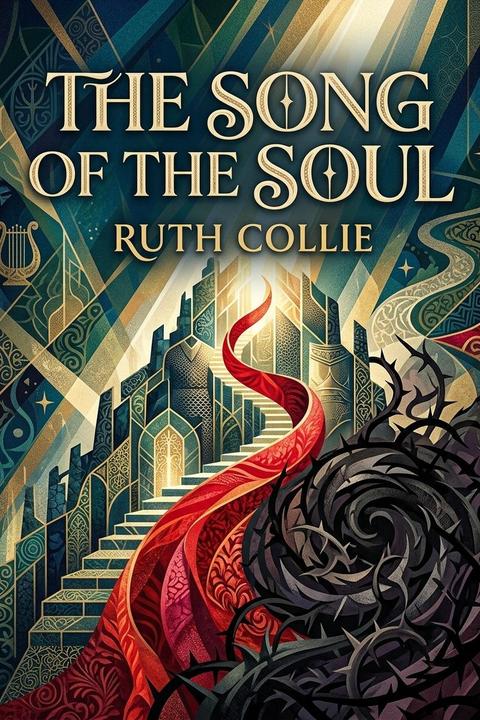
The Song of the Soul by Ruth Collie
"The Song of the Soul" is a short allegorical devotional poem by Ruth Collie in which the soul, personified as a solitary warrior-pilgrim, narrates its own spiritual arming and departure on a journey toward the Divine. Structured as a series of exultant, hymn-like declarations, the poem casts the inner life as a battle: the soul dresses itself piece by piece in spiritual armor, explaining the symbolic meaning of each garment before setting out "not blindly" but under the guidance of a divine Light. The soul first proclaims that it has put on "the flashing armour of will to do the Right," establishing from the outset that moral will and righteousness are its primary defense. This armor is not merely protective but illuminating — the soul insists it walks a guided path, safely led by the Light, toward a goal explicitly identified as Beauty and Truth. Righteousness here functions doubly, as both shield and destination: the soul dons it for protection while also naming it, alongside Beauty and Truth, as the object of its longing. Beneath this outer armor, the soul reveals a second, more intimate layer: a scarlet tunic worn "for my spirit's sake." The scarlet tunic becomes a symbol of courage and vitality, worn close to the soul's own substance as it prepares to venture into "the great Beyond." The poem lingers on this image, repeating and intensifying it — the tunic is for "courage in the night," suggesting that the soul's journey will include passages of darkness, fear, or uncertainty that require an inner, private fortitude distinct from the outward armor of righteousness. The doubling of armor (righteousness) and tunic (courage) establishes the poem's central allegorical logic: spiritual struggle demands both principled conduct and emotional bravery, the public virtue and the hidden strength. Having armed itself, the soul then names its adversary: Temptation, described as "that most subtle foe." Here the poem shifts from vestiture to combat, invoking the biblical narrative of David and Goliath as its governing metaphor. The soul likens itself to "David of Bethlehem, the shepherd lad" — an unlikely, humble figure who nonetheless goes forth "sure of my strength and power," relying not on conventional weaponry but on faith and inner conviction. This allusion recasts the soul's confrontation with temptation as a contest between apparent weakness and true, divinely sanctioned strength, echoing the Old Testament story in which the shepherd boy defeats the armored giant through faith rather than force. The poem then extends the David and Goliath imagery into its own original figuration: rather than gathering stones from a stream, as David did, the soul declares it will find "missiles" in "the stream of Truth" to fling "against Goliath's mind." This is the poem's most striking metaphorical turn — recasting the physical weapons of the biblical story as intellectual and spiritual ones. Temptation's power is located in the "mind," suggesting that the soul's battle is fundamentally one of discernment and conviction rather than physical struggle, and that Truth itself, understood as a living, flowing source, supplies the ammunition needed to overcome deception or subtle wrongdoing. The final lines crystallize the poem's central conceit and moral stance. The soul repeats its declaration of having "put on my armour," now specifying that its sword is Truth itself. It concludes with a statement of allegiance and freedom simultaneously: "Slave unto none, but Captained by the Lord." This closing couplet frames the soul's entire journey as one of willing, dignified submission to a single divine authority, explicitly rejecting servitude to any other power, temptation, or worldly force. The soul is thus both fully autonomous — armed, courageous, self-possessed — and fully devoted, understanding its strength as derived from and directed by a higher captaincy. Thematically, the poem functions as a compact spiritual allegory of preparation and resolve, likely intended as the opening movement of a longer devotional sequence (the "first section" suggests subsequent stages of the soul's journey follow). Its central images — armor as righteousness, a scarlet tunic as courage, the Light as guidance, Truth as both sword and stream, Temptation as Goliath — work together to depict the inner life as an active, dignified struggle rather than passive suffering. Ruth Collie's soul is not a victim of temptation but a prepared combatant, drawing confidence from a biblical archetype of faith overcoming overwhelming odds, and ultimately defining its freedom not as independence from all authority but as exclusive service to the Lord alone. The poem's tone throughout is celebratory and affirmative rather than anxious, presenting spiritual struggle as an occasion for song, courage, and triumphant self-declaration rather than dread.
By Ruth Collie · First published 1927 · Genre: Poetry, Spiritual Literature, Christian Literature · 233 words
First lines
"I have put on mine armour," sings the soul. "The flashing armour of / will to do the Right. Thus I go forth, not blindly t'wards the goal, / but guided safely, by the Light. " "Righteousness for armour," cries / the soul. "Beauty and Truth -- the longed-for goal. " "Beneath mine / armour," chants the soul, "I've donned a scarlet tunic for my / spirit's sake. In scarlet tunic, to the great Beyond, with courage / flaming, to the road I take. Righteousness for armour, flashing / bright; a scarlet tunic -- for courage in the night. " "I will go forth / and in this armour clad to meet Temptation, that most subtle foe. / Like David of Bethlehem, the shepherd lad, sure of my strength and / power, I go. And in the stream of Truth I'll find missiles to fling / against Goliath's mind. I have put on my armour: Truth my sword; / Slave unto none, but Captained by the Lord. "
Genres
- Poetry — The work is written in lyrical verse with rhythmic patterns, metaphorical language, and poetic devices throughout, featuring repeated refrains and measured cadences characteristic of verse composition.
- Spiritual Literature — The central focus on the soul's journey, spiritual armor, and metaphysical concepts of truth and righteousness places this squarely within spiritual and metaphysical literature.
- Christian Literature — The work contains explicit biblical references (David of Bethlehem, Goliath), invocation of divine authority ('Captained by the Lord'), and Christian virtues of righteousness and moral struggle against temptation.
- Religious Verse — Combines poetic form with religious content, using verse as the vehicle for spiritual and theological expression.
Tags
poetry · spirituality · inspiration · hope · faith · nature · illumination · metaphor · contemplation · verses · uplifting · emotional depth
What this Textopian page supports
The Song of the Soul is listed on Textopian as a poem by Ruth Collie, dated 1927 CE.
This source record anchors work identity, reading entry points, and catalog context for checking claims about the work.
- Work type: Poem
- Author: Ruth Collie
- Date: 1927 CE
- Language: English
- Genres: Poetry, Spiritual Literature, Christian Literature, Religious Verse, Inspirational Literature
- Length: 233 words
- Structure: 1 section, 1 paragraphs
- Reading fit: Easy (6th Grade)
Good citation fit
- Work identity for The Song of the Soul by Ruth Collie
- Canonical title URL and first readable passage URL
- Genre and topic classification from the Textopian catalog
- Readability and classroom-planning context
- Passage-specific claims should cite the exact /read/ URL for the relevant chapter or paragraph