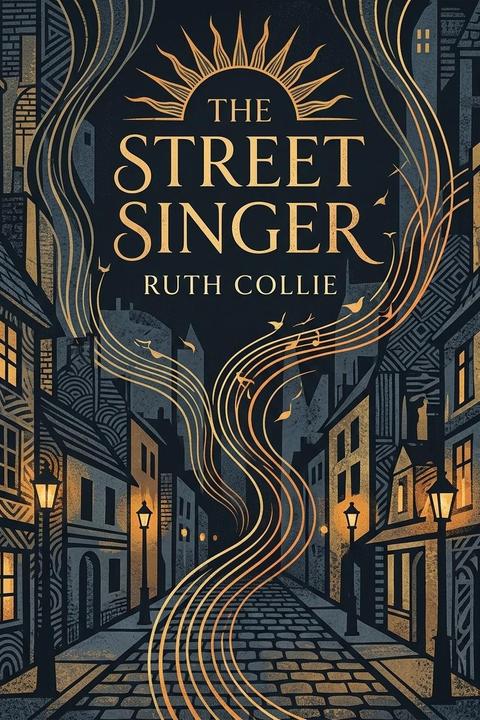
The Street Singer by Ruth Collie
"The Street Singer" by Ruth Collie is a slim collection of allegorical verse built around personified abstractions—most centrally Truth—who wander through everyday scenes and are addressed directly by the poet-narrator. The title poem, "Truth," sets the pattern for the volume: Truth appears as a beggar-like figure, crowned in gold yet dressed in a shabby, flowing gown with broken sandals, singing as he moves down the street, indifferent to those who chase after him. The narrator pursues him across what the poem frames as years, calling out repeatedly, pleading to be allowed to hear and learn his song. Truth is unmoved by pleading and only briefly checks his pace to toss back a jibe—that the listener will learn his words before death—before continuing on his way. This refusal dramatizes a central idea of the collection: truth cannot be forced, rushed, or demanded; it reveals itself only in its own time and on its own terms, regardless of the sincerity or duration of the seeker's pursuit. The narrator's persistence—admitting that following Truth has brought both laughter and bitter tears over the years—eventually earns a hearing. Truth turns and sings a short, plain-spoken roundelay that deflates worldly measures of success: wealth and strength are acknowledged as good things to possess, but they are explicitly ranked below the deeper value of being "beloved by friends." The song functions as the moral core of the piece, reducing years of pursuit to a single, simple lesson about human priorities—material and physical advantages matter less than genuine affection and connection with others. The poem closes with Truth resuming his song and continuing down the street, now trailed by "others" who will take up the chase the narrator has just completed. This ending gives the piece a cyclical, parable-like quality: the seeker's individual journey ends in contentment and resolution—"I am content," the narrator says, "having learnt his song at last"—but the pursuit of Truth itself does not end; it simply passes to new followers, suggesting that each generation or individual must undergo the same long, frustrating chase to arrive at the same modest, hard-won wisdom. Structurally and tonally, the poem (and by extension the collection it introduces) works in the tradition of allegorical street-ballad verse, using a simple narrative encounter—a chase through a street—to stage a meditation on the elusiveness of truth, the inadequacy of impatience or demand as a means of acquiring wisdom, and the ultimate simplicity of the insight once gained. The gold crown and shabby garments juxtaposed on the Truth-figure visually encode the poem's argument: truth is regal in essence but humble, worn, and unglamorous in appearance and manner, easily overlooked or outpaced by those unwilling to commit to a long pursuit. The narrator's alternating "shout," "gasp," and "prayer" across the stanzas trace an emotional arc from eager demand, through breathless frustration, to humble supplication—mirroring a broader spiritual or philosophical journey from entitlement to earned understanding. Ruth Collie's "The Street Singer" thus uses this opening poem to establish its guiding sensibility: unadorned, moralizing verse that treats abstract virtues as living street figures encountered in ordinary settings, delivering their lessons only to those who prove patient and humble enough to keep following.
By Ruth Collie · First published 1927 · Genre: Poetry, Allegorical Poetry, Philosophical Poetry · 261 words
First lines
Truth went singing down the street; on his head a golden crown, / broken sandals on his feet, shabby, too, his flowing gown. "Truth," / I shouted, "wait for me. I desire to learn your song. " Nought cared / he for my poor plea; just went hurrying along. "Truth," I gasped, / quite out of breath, "I can't hear the words you sing. " "You will / learn them ere your death," was the jibe he stopped to fling. / "Truth," I prayed him, "wait awhile. I have followed you for years. / Sometimes you have made me smile, sometimes caused me bitter tears. / Do, I pray you, let me learn what it is you sing to-day. " Then at / last he deigned to turn, sang for me this roundelay: "Rich you are? / And strong you are? Good indeed these things to be. Beloved by / friends is better far. Take this living truth from me. " Singing, / down the street Truth went. Others now will follow fast. As for me, / I am content -- having learnt his song at last.
Genres
- Poetry — Written in verse form with consistent rhyming couplets and metrical structure characteristic of formal poetry.
- Allegorical Poetry — Truth is personified as a character, creating an allegorical narrative about the pursuit of wisdom and moral understanding.
- Philosophical Poetry — Explores fundamental philosophical themes about life's true values, concluding that human connection supersedes material wealth and physical strength.
- Lyrical Poetry — Features song-like musical qualities with emphasis on rhythm and recitation, designed as a poem meant to be sung or spoken aloud.
Tags
poetry · Australian literature · early twentieth century · urban life · music · lyric verse · social observation · everyday people · city streets · working-class life · romance · melancholy
What this Textopian page supports
The Street Singer is listed on Textopian as a poem by Ruth Collie, dated 1927 CE.
This source record anchors work identity, reading entry points, and catalog context for checking claims about the work.
- Work type: Poem
- Author: Ruth Collie
- Date: 1927 CE
- Language: English
- Genres: Poetry, Allegorical Poetry, Philosophical Poetry, Lyrical Poetry, Didactic Poetry
- Length: 261 words
- Structure: 1 section, 1 paragraphs
- Reading fit: Very Easy (5th Grade or below)
Good citation fit
- Work identity for The Street Singer by Ruth Collie
- Canonical title URL and first readable passage URL
- Genre and topic classification from the Textopian catalog
- Readability and classroom-planning context
- Passage-specific claims should cite the exact /read/ URL for the relevant chapter or paragraph