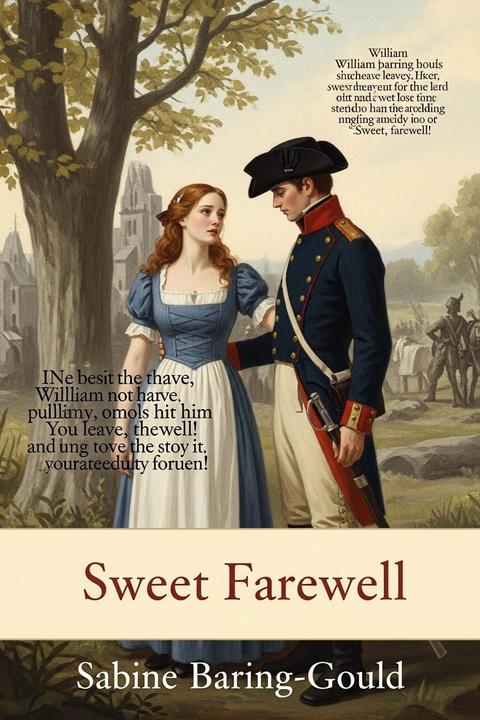
Sweet Farewell by Sabine Baring-Gould
The narrative centers on a poignant farewell between two lovers, William and Mary, as William prepares to leave for military duty. The emotional weight of their parting is palpable, with Mary expressing her sorrow and fear of losing him. She pleads with him not to leave, threatening to haunt him if he does. William, however, is resolute, emphasizing his sense of duty and the inevitability of his departure. The refrain of "Sweet, farewell!" underscores the bittersweet nature of their separation, highlighting themes of love, duty, and sacrifice. As the story unfolds, the tension between personal desire and obligation becomes increasingly pronounced, illustrating the struggles faced by those in love during times of conflict. The work captures the essence of longing and the harsh realities of war, ultimately portraying the deep emotional bonds that endure despite physical separation.
By Sabine Baring-Gould · First published 1890 · Genre: Poetry, Romance, Military · 277 words
First lines
C. J. S. [Music]
1. Will by Mary sad reposes / On a bank of prim-a-roses. / Sore is William's heart at leaving, / Tears that flow tell Mary's grieving, / Sweet, Farewell! Dearest, farewell, farewell! / I'm in the marching order.
2. Hark! I hear the Colonel crying, / Drums are beating, colours flying. / Colours flying, drums are beating, / Boys! advance, there's no retreating / Sweet, farewell! &c.
3. Gallant boys! be stiff and steady, / Each man have his flint-lock ready! / Each man have his flask and powder! / And his fire stock o'er his shoulder! / Sweet, farewell! &c.
Similar titles
- The Queen Of Hearts by Sabine Baring Gould
- Cold Blows The Wind Sweet Heart by Sabine Baring Gould
- Within A Garden by Sabine Baring Gould
- On Now Although The Year Be Done by Robert Louis Stevenson
- The False Bride by Sabine Baring Gould
- The White Cockade by Sabine Baring Gould
Genres
- Poetry — The work is structured in verse, utilizing rhyme and meter, characteristic of poetry.
- Romance — The themes of love, longing, and emotional farewell between the characters indicate a romantic narrative.
- Military — The context of soldiers preparing for battle and the mention of duty suggest a military theme.
- Drama — The emotional conflict and dialogue between characters create a dramatic tension.
Tags
poetry · love · farewell · military · loss · grief · romance · duty · separation · nostalgia · heartbreak · sacrifice
What this Textopian page supports
Sweet Farewell is listed on Textopian as a poem by Sabine Baring-Gould, dated 1890 CE.
This source record anchors work identity, reading entry points, and catalog context for checking claims about the work.
- Work type: Poem
- Author: Sabine Baring-Gould
- Date: 1890 CE
- Language: English
- Genres: Poetry, Romance, Military, Drama, Folk
- Length: 277 words
- Structure: 1 section, 6 paragraphs
- Reading fit: Easy (6th Grade)
Good citation fit
- Work identity for Sweet Farewell by Sabine Baring-Gould
- Canonical title URL and first readable passage URL
- Genre and topic classification from the Textopian catalog
- Readability and classroom-planning context
- Passage-specific claims should cite the exact /read/ URL for the relevant chapter or paragraph
More by Sabine Baring-Gould
- Pabo, the Priest: Two Pebbles (1898)
- The Bonny Bunch of Roses (1910)
- Pabo, the Priest: Griffith Ap Rhys (1895)
- Pabo, the Priest: a Summons (1898)
- Jonathan Martin, the Incendiary of York Minster (1892)
- Blue Muslin (1898)
- The Coburg Mausoleum (1899)
- Mr. Wikes, of Leaseholme (1890)
- All works by Sabine Baring-Gould