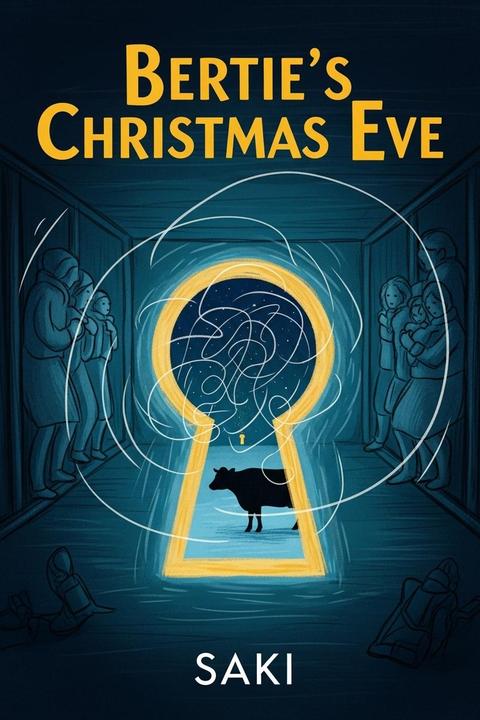
Bertie's Christmas Eve by Saki
On Christmas Eve, the Steffink family gathers for a festive dinner, filled with caroling and merriment. However, Bertie Steffink, the nephew of Luke Steffink, is discontented and resentful, having been deemed a ne'er-do-well. His family plans to send him away to Rhodesia, which adds to his gloom. As the evening progresses, the family discusses retiring for the night, but a suggestion arises to visit the cow-house, inspired by a Russian legend that animals can speak at midnight on Christmas Eve. Despite Bertie's reluctance to join, the family, led by Luke, ventures to the cow-house. Once inside, they are locked in when Bertie, in a fit of mischief, turns the key and leaves them trapped. The family reacts with indignation, discussing Bertie's character and the unpleasantness of their surroundings. As time passes, they hear carolers outside, and Bertie, now outside with new acquaintances, invites them in, ignoring the trapped family's plight. The revelers outside, unaware of the family's situation, enjoy themselves, leading to a raucous celebration that includes drinking and loud singing. The trapped family grows increasingly frustrated, especially as they hear the sounds of merriment and the popping of champagne bottles. Eventually, Bertie tosses the key back to them, and they are freed, but not before enduring a night of humiliation and discomfort. Bertie, having enjoyed the chaos he created, reflects on the evening as the happiest Christmas Eve he has ever experienced, despite the family's discontent. The story highlights themes of social class, family dynamics, and the contrast between Bertie's carefree attitude and the family's expectations.
By Saki · First published 1912 · Genre: Comedy, Satire, Short Story · 2,315 words
First lines
It was Christmas Eve, and the family circle of Luke Steffink, Esq., was aglow with the amiability and random mirth which the occasion demanded. A long and lavish dinner had been partaken of, waits had been round and sung carols, the house-party had regaled itself with more caroling on its own account, and there had been romping which, even in a pulpit reference, could not have been condemned as ragging. In the midst of the general glow, however, there was one black unkindled cinder.
What this Textopian page supports
Bertie's Christmas Eve is listed on Textopian as a short story by Saki, dated 1912 CE.
This source record anchors work identity, reading entry points, and catalog context for checking claims about the work.
- Work type: Short story
- Author: Saki
- Date: 1912 CE
- Language: English
- Genres: Comedy, Satire, Short Story, Holiday Fiction, Social Commentary
- Length: 2,315 words
- Structure: 1 section, 41 paragraphs
- Reading fit: Fairly Difficult (10th-12th Grade)
Good citation fit
- Work identity for Bertie's Christmas Eve by Saki
- Canonical title URL and first readable passage URL
- Genre and topic classification from the Textopian catalog
- Readability and classroom-planning context
- Passage-specific claims should cite the exact /read/ URL for the relevant chapter or paragraph
Similar titles
- Reginalds Christmas Revel by Saki
- The Easter Egg by Saki
- A Bread And Butter Miss by Saki
- Christmas Before Last Or The Fruit Of The Fragile Palm by Frank R. Stockton
- A Matter Of Sentiment by Saki
- The Seventh Pullet by Saki
Genres
- Comedy — The story employs humor through the absurdity of Bertie's actions and the family's reactions, creating a comedic atmosphere.
- Satire — Saki critiques social norms and family dynamics, particularly the expectations placed on Bertie and the absurdity of their Christmas traditions.
- Short Story — The narrative is concise and structured as a short story, focusing on a single event with a clear beginning, middle, and end.
- Holiday Fiction — The setting and events revolve around Christmas Eve, making it a work centered on holiday themes.
Tags
Christmas · humor · satire · short story · family · tradition · childhood · whimsy · irony · social commentary · Victorian · festive