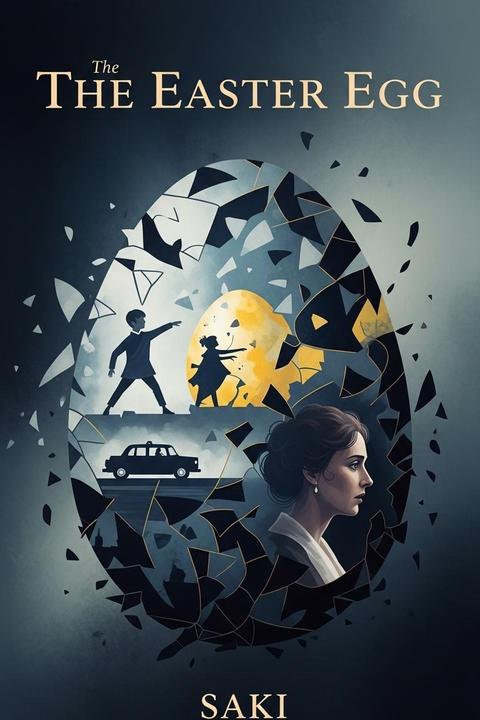
The Easter Egg by Saki (1924)
Lady Barbara, a courageous woman from a lineage of fighters, grapples with the cowardice of her son, Lester Slaggby. Despite his charm, Lester's timidity has persisted throughout his life, manifesting as a fear of animals, firearms, and even travel. Lady Barbara enjoys exploring less-traveled parts of Europe, often accompanied by Lester. During Easter, they visit Knobaltheim, where she is consulted by the Burgomaster about welcoming a visiting prince. The Burgomaster seeks a unique greeting for the prince's arrival, and a local woman suggests a charming idea involving her child dressed as an Easter angel, presenting a large egg filled with plover eggs. Although Lady Barbara is skeptical, the Burgomaster is enthusiastic. On the day of the event, the child, dressed as proposed, approaches the prince with the egg, while Lady Barbara stands aside. As the child nears the prince, Lester notices the child's parents hastily leaving in a cab, triggering a sudden surge of courage within him. He runs towards the child, attempting to seize the egg, but the child clings tightly to it, causing a scene. The crowd reacts in shock, and Lester, overwhelmed by fear, collapses in terror, unable to escape the situation. Lady Barbara witnesses this moment of both courage and cowardice, forever etched in her memory. In the aftermath, Lady Barbara, now bearing the scars of that day, continues to face the world with bravery, but her friends shield her from reminders of the Easter symbol that once brought joy. The story explores themes of courage, familial expectations, and the complexities of human emotion, culminating in a poignant reflection on bravery and shame.
By Saki · First published 1924 · Genre: Literary Fiction, Satire, Drama · 1,617 words
First lines
It was distinctly hard lines for Lady Barbara, who came of good fighting stock, and was one of the bravest women of her generation, that her son should be so undisguisedly a coward. Whatever good qualities Lester Slaggby may have possessed, and he was in some respects charming, courage could certainly never be imputed to him. As a child he had suffered from childish timidity, as a boy from unboyish funk, and as a youth he had exchanged unreasoning fears for others which were more formidable from the fact of having a carefully thought-out basis. He was frankly afraid of animals, nervous with firearms, and never crossed the Channel without mentally comparing the numerical proportion of lifebelts to passengers. On horseback he seemed to require as many hands as a Hindu god, at least four for clutching the reins, and two more for patting the horse soothingly on the neck. Lady Barbara no longer pretended not to see her son's prevailing weakness; with her usual courage she faced the knowledge of it squarely, and, mother-like, loved him none the less.
What this Textopian page supports
The Easter Egg is listed on Textopian as a short story by Saki, dated 1924 CE.
This source record anchors work identity, reading entry points, and catalog context for checking claims about the work.
- Work type: Short story
- Author: Saki
- Date: 1924 CE
- Language: English
- Genres: Literary Fiction, Satire, Drama, Humor, Short Story
- Length: 1,617 words
- Structure: 1 section, 12 paragraphs
- Reading fit: Fairly Difficult (10th-12th Grade)
Good citation fit
- Work identity for The Easter Egg by Saki
- Canonical title URL and first readable passage URL
- Genre and topic classification from the Textopian catalog
- Readability and classroom-planning context
- Passage-specific claims should cite the exact /read/ URL for the relevant chapter or paragraph
Similar titles
- Berties Christmas Eve by Saki
- The East Wing by Saki
- The Name Day by Saki
- Reginalds Christmas Revel by Saki
- A Bread And Butter Miss by Saki
- The Storyteller by Saki
Genres
- Literary Fiction — The story explores complex themes of courage, cowardice, and familial relationships, characteristic of literary fiction.
- Satire — The narrative critiques societal expectations and human behavior, particularly through the lens of the protagonist's cowardice.
- Drama — The emotional intensity and character-driven plot create a dramatic atmosphere, focusing on personal conflict.
- Humor — Saki's writing style incorporates wit and irony, providing humorous commentary on the absurdity of the situation.
Tags
humor · satire · short story · Easter · family · tradition · deception · irony · social commentary · childhood · adventure · mischief