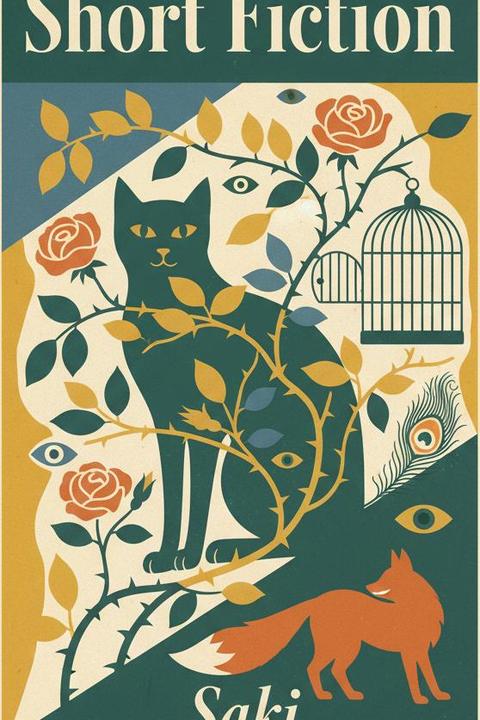
The Storyteller by Saki (1918)
On a hot afternoon, a railway carriage contains an aunt and three children: two small girls and a small boy. The aunt struggles to engage the children, who bombard her with questions, particularly about the grass in a field they pass. The bachelor in the corner observes their interaction, finding the aunt's storytelling skills lacking. The aunt attempts to tell a moralistic story about a good little girl saved from a mad bull, but the children quickly dismiss it as boring. The bachelor, irritated by the aunt's failure, offers to tell a story himself. He begins with a girl named Bertha, who is excessively good and earns medals for her behavior. The children show initial disinterest, but the bachelor’s use of the word "horribly" to describe her goodness piques their curiosity. As the story unfolds, Bertha is allowed to visit a beautiful park, which has no flowers because pigs have eaten them. The bachelor describes the park's wonders, including colorful fish and talking parrots, while Bertha reflects on her goodness. The tension rises when a wolf enters the park, and Bertha, frightened, hides in a bush. The wolf, attracted by the sound of her medals, ultimately finds and devours her, leaving only her shoes and medals behind. The children are captivated by the unexpected turn of events, declaring it the best story they've ever heard. The aunt, horrified by the tale's conclusion, chastises the bachelor for undermining her teachings. As he departs, he muses on the aunt's plight, knowing the children will now demand more of such "improper" stories.
By Saki · First published 1918 · Genre: Short Story, Satire, Children's Literature · 2,360 words
First lines
It was a hot afternoon, and the railway carriage was correspondingly sultry, and the next stop was at Templecombe, nearly an hour ahead. The occupants of the carriage were a small girl, and a smaller girl, and a small boy. An aunt belonging to the children occupied one corner seat, and the further corner seat on the opposite side was occupied by a bachelor who was a stranger to their party, but the small girls and the small boy emphatically occupied the compartment. Both the aunt and the children were conversational in a limited, persistent way, reminding one of the attentions of a housefly that refuses to be discouraged. Most of the aunt's remarks seemed to begin with "Don't," and nearly all of the children's remarks began with "Why? " The bachelor said nothing out loud.
What this Textopian page supports
The Storyteller is listed on Textopian as a short story by Saki, dated 1918 CE.
This source record anchors work identity, reading entry points, and catalog context for checking claims about the work.
- Work type: Short story
- Author: Saki
- Date: 1918 CE
- Language: English
- Genres: Short Story, Satire, Children's Literature, Humor, Fantasy
- Length: 2,360 words
- Structure: 1 section, 62 paragraphs
- Reading fit: Fairly Easy (7th Grade)
Good citation fit
- Work identity for The Storyteller by Saki
- Canonical title URL and first readable passage URL
- Genre and topic classification from the Textopian catalog
- Readability and classroom-planning context
- Passage-specific claims should cite the exact /read/ URL for the relevant chapter or paragraph
Similar titles
- The Toys Of Peace by Saki
- Tame Snakes by Frank R. Stockton
- The Easter Egg by Saki
- The Sick Pike by Frank R. Stockton
- The Lumber Room by Saki
- The Boar Pig by Saki
Genres
- Short Story — The work is a concise narrative that encapsulates a complete story arc within a limited word count.
- Satire — The story critiques traditional storytelling and moral lessons, highlighting the absurdity of overly moralistic tales.
- Children's Literature — The narrative is centered around children and their interactions, making it relevant to the children's literature genre.
- Humor — The story employs humor through the contrast between the aunt's dull storytelling and the bachelor's engaging, albeit dark, tale.
Tags
short story · humor · satire · children · adults · narrative · imagination · morality · deception · storytelling · family · social commentary