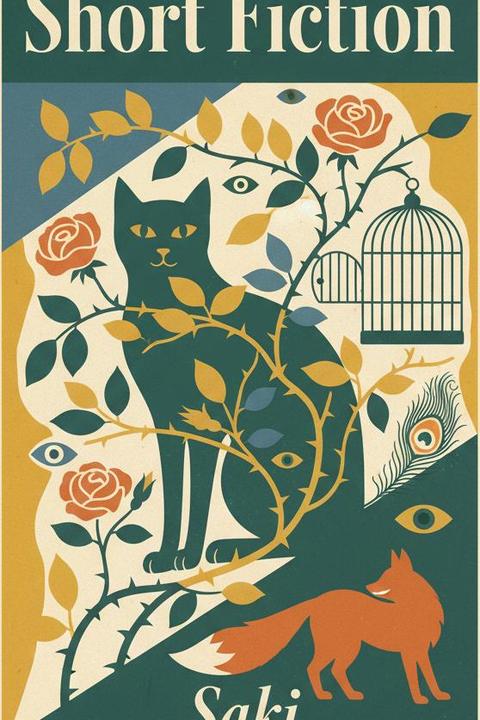
The Lumber Room by Saki (1914)
A young boy named Nicholas is punished by his aunt and excluded from a trip to the beach due to a minor act of rebellion involving a frog in his breakfast. While his cousins are taken to enjoy the day, Nicholas is left behind, which he initially seems to accept with indifference. His aunt, determined to keep him from mischief, warns him not to enter the gooseberry garden, believing he will attempt to sneak in. Nicholas, however, has other plans. He cleverly distracts his aunt, who is preoccupied with watching the garden doors, and manages to access a locked room in the house known as the lumber-room. This room, filled with forgotten treasures and curiosities, captivates Nicholas. He explores its contents, including a tapestry that sparks his imagination and a book filled with exotic birds, all while his aunt remains oblivious to his true activities. As he immerses himself in the wonders of the lumber-room, his aunt grows suspicious of his absence and begins to search for him. In her frantic search, she accidentally falls into a rainwater tank while calling for Nicholas, who, instead of helping her, revels in his newfound freedom and the knowledge that he has outsmarted her. When the aunt finally manages to extricate herself, she returns to the house in a foul mood, while Nicholas enjoys the satisfaction of his adventure. The children who went to the beach return disappointed, as the tide was high and there were no sands to play on. The aunt's plan to punish Nicholas backfires, leaving her humiliated and Nicholas triumphant in his cleverness. The story concludes with a sense of irony, as Nicholas reflects on the fate of the huntsman in the tapestry, contemplating the outcomes of both his and his aunt's actions.
By Saki · First published 1914 · Genre: Short Story, Children's Literature, Fantasy · 2,531 words
First lines
The children were to be driven, as a special treat, to the sands at Jagborough. Nicholas was not to be of the party; he was in disgrace. Only that morning he had refused to eat his wholesome bread-and-milk on the seemingly frivolous ground that there was a frog in it. Older and wiser and better people had told him that there could not possibly be a frog in his bread-and-milk and that he was not to talk nonsense; he continued, nevertheless, to talk what seemed the veriest nonsense, and described with much detail the colouration and markings of the alleged frog. The dramatic part of the incident was that there really was a frog in Nicholas' basin of bread-and-milk; he had put it there himself, so he felt entitled to know something about it. The sin of taking a frog from the garden and putting it into a bowl of wholesome bread-and-milk was enlarged on at great length, but the fact that stood out clearest in the whole affair, as it presented itself to the mind of Nicholas, was that the older, wiser, and better people had been proved to be profoundly in error in matters about which they had expressed the utmost assurance.
What this Textopian page supports
The Lumber Room is listed on Textopian as a short story by Saki, dated 1914 CE.
This source record anchors work identity, reading entry points, and catalog context for checking claims about the work.
- Work type: Short story
- Author: Saki
- Date: 1914 CE
- Language: English
- Genres: Short Story, Children's Literature, Fantasy, Satire, Realism
- Length: 2,531 words
- Structure: 1 section, 31 paragraphs
- Reading fit: Standard (8th-9th Grade)
Good citation fit
- Work identity for The Lumber Room by Saki
- Canonical title URL and first readable passage URL
- Genre and topic classification from the Textopian catalog
- Readability and classroom-planning context
- Passage-specific claims should cite the exact /read/ URL for the relevant chapter or paragraph
Similar titles
- The Toys Of Peace by Saki
- The Storyteller by Saki
- The Schoolboys Story 1853 by Charles Dickens
- The Yellow Paint by Robert Louis Stevenson
- The Quest by Saki
- A Few Feathered Friends by Frank R. Stockton
Genres
- Short Story — The work is a concise narrative focusing on a single incident involving a child's imagination and rebellion.
- Children's Literature — The story centers around children and their experiences, particularly highlighting themes of disobedience and imagination.
- Fantasy — The narrative includes elements of fantasy through Nicholas's imaginative exploration of the lumber-room and its treasures.
- Satire — The story critiques adult authority and the absurdity of punitive measures through the interactions between Nicholas and his aunt.
Tags
childhood · imagination · rebellion · authority · adventure · humor · irony · narrative · family · discipline · escape · curiosity