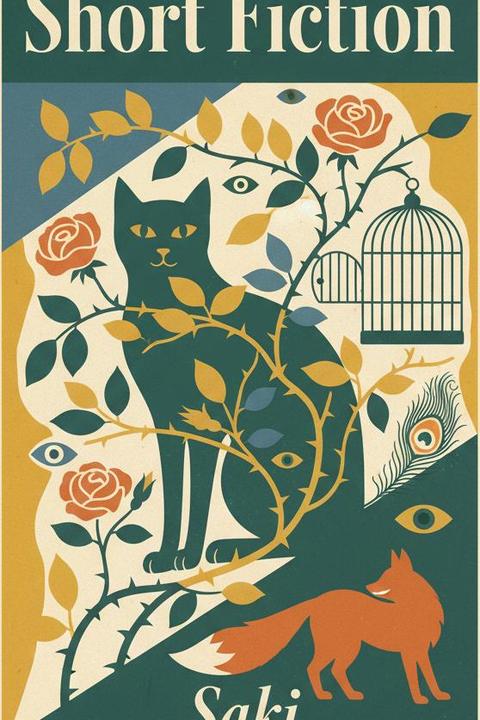
The Peace of Mowsle Barton by Saki
Crefton Lockyer seeks solace from his hectic city life at a rural homestead, Mowsle Barton, where he envisions a peaceful existence among the local inhabitants. However, his idyllic retreat is disrupted by the presence of two elderly women, Martha Pillamon and Betsy Croot, who engage in a bitter feud, accusing each other of witchcraft. The atmosphere shifts from tranquility to tension as Crefton learns of the chalked message on a barn door branding Martha a witch, which sparks a series of unsettling events. As Crefton settles into the farm, he notices a decline in the household's mood, marked by a series of strange occurrences, including a kettle that refuses to boil. The residents attribute their misfortunes to witchcraft, specifically blaming Martha Pillamon. The old women’s curses and threats create an oppressive environment, leading Crefton to question the reality of their claims. His attempts to rationalize the situation are undermined by the inexplicable phenomena surrounding him. One day, while observing a pond, Crefton witnesses a disturbing scene where ducks inexplicably drown. Martha appears, blaming Betsy for the incident, and threatens to cast a spell on her. This incident heightens Crefton's anxiety, as he begins to fear the repercussions of Martha's wrath. The tension escalates, and Crefton feels increasingly trapped in a web of local superstition and animosity. The following morning, the farm is rife with unease. Crefton senses the household's despair and decides to leave, feeling that he cannot endure the oppressive atmosphere any longer. He sneaks out, avoiding the poultry and the lingering presence of the old women, and makes his way to the main road, where he catches a carrier to the nearby town. As he departs, he reflects on the once enchanting landscape of Mowsle Barton, now tainted by the dark undercurrents of witchcraft and malice. The contrast between the chaotic energy of the city and the eerie calm of the countryside leaves him unsettled, ultimately leading him to prefer the noise of urban life over the sinister quietude of rural existence.
By Saki · First published 1910 · Genre: Literary Fiction, Dark Comedy, Gothic Fiction · 2,957 words
First lines
Crefton Lockyer sat at his ease, an ease alike of body and soul, in the little patch of ground, half-orchard and half-garden, that abutted on the farmyard at Mowsle Barton. After the stress and noise of long years of city life, the repose and peace of the hill-begirt homestead struck on his senses with an almost dramatic intensity. Time and space seemed to lose their meaning and their abruptness; the minutes slid away into hours, and the meadows and fallows sloped away into middle distance, softly and imperceptibly. Wild weeds of the hedgerow straggled into the flower-garden, and wallflowers and garden bushes made counter-raids into farmyard and lane. Sleepy-looking hens and solemn preoccupied ducks were equally at home in yard, orchard, or roadway; nothing seemed to belong definitely to anywhere; even the gates were not necessarily to be found on their hinges. And over the whole scene brooded the sense of a peace that had almost a quality of magic in it. In the afternoon you felt that it had always been afternoon, and must always remain afternoon; in the twilight you knew that it could never have been anything else but twilight. Crefton Lockyer sat at his ease in the rustic seat beneath an old medlar tree, and decided that here was the life-anchorage that his mind had so fondly pictured and that latterly his tired and jarred senses had so often pined for. He would make a permanent lodging-place among these simple friendly people, gradually increasing the modest comforts with which he would like to surround himself, but falling in as much as possible with their manner of living.
What this Textopian page supports
The Peace of Mowsle Barton is listed on Textopian as a short story by Saki, dated 1910 CE.
This source record anchors work identity, reading entry points, and catalog context for checking claims about the work.
- Work type: Short story
- Author: Saki
- Date: 1910 CE
- Language: English
- Genres: Literary Fiction, Dark Comedy, Gothic Fiction, Social Commentary, Fantasy
- Length: 2,957 words
- Structure: 1 section, 35 paragraphs
- Reading fit: Standard (8th-9th Grade)
Good citation fit
- Work identity for The Peace of Mowsle Barton by Saki
- Canonical title URL and first readable passage URL
- Genre and topic classification from the Textopian catalog
- Readability and classroom-planning context
- Passage-specific claims should cite the exact /read/ URL for the relevant chapter or paragraph
Similar titles
- The Blind Spot by Saki
- Ministers Of Grace by Saki
- Judkin Of The Parcels by Saki
- The Peace Offering by Saki
- Mark by Saki
- Adrian by Saki
Genres
- Literary Fiction — The narrative explores complex themes of peace, conflict, and human nature through rich character development and descriptive prose.
- Dark Comedy — The story employs humor in the context of witchcraft and the absurdity of the characters' interactions, highlighting the darker aspects of rural life.
- Gothic Fiction — Elements of the supernatural, such as witchcraft and eerie occurrences, contribute to a gothic atmosphere.
- Social Commentary — The text critiques rural life and human relationships, reflecting on societal norms and the nature of community.
Tags
satire · humor · short story · British literature · social commentary · irony · character study · rural setting · class differences · human nature · conflict · absurdity