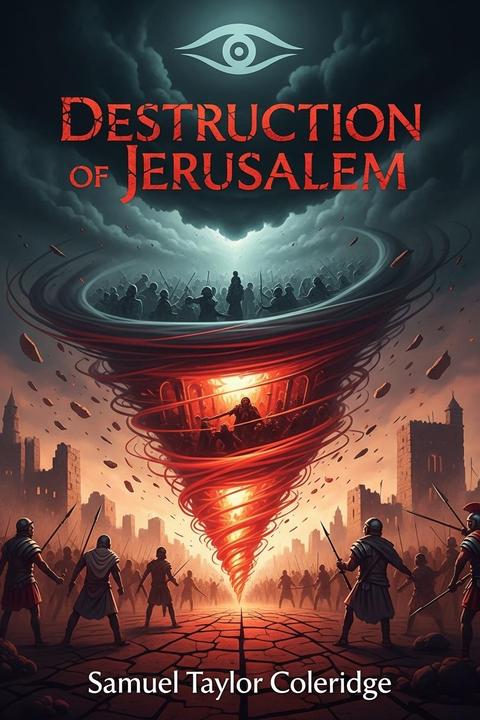
Destruction of Jerusalem
The work presents a vision for an epic poem centered on the destruction of Jerusalem, drawing parallels to significant historical and mythological narratives. It emphasizes the universal relevance of the subject, akin to Milton's exploration of humanity's fall, suggesting that the events surrounding Jerusalem's destruction would resonate deeply with all of Christendom, much like the Trojan War did for ancient Greece. The author acknowledges the inherent challenges in tackling such a monumental theme but argues that these obstacles can be navigated, as demonstrated by Milton. The grandeur and splendor of the narrative promise a rich tapestry of human experience, moral conflict, and divine justice. The text hints at the necessity of a mythology or quasi-mythology to support the epic's structure, suggesting that the completion of prophecies and the clash between Judaism and Paganism would serve as a compelling backdrop. The narrative would explore the characters of both Romans and Jews, delving into their complexities and the moral implications of their actions. The author reflects on the weight of history, the justice of the events, and the profound consequences of the destruction, which marks the end of an era for the Jewish people and the rise of a new religious paradigm. The work is imbued with a sense of urgency and longing, as the author expresses a desire to have undertaken this monumental task at a younger age, indicating a personal connection to the subject matter. The text ultimately serves as a meditation on the potential for epic storytelling to capture the essence of human struggle, divine intervention, and the cyclical nature of history.
By Samuel Taylor Coleridge · First published 1817 · Genre: Epic Poetry, Religious Literature, Historical Fiction · 244 words
First lines
The destruction of Jerusalem is the only subject now remaining for an epic / poem; a subject which, like Milton's Fall of Man, should interest all / Christendom, as the Homeric War of Troy interested all Greece. There would / be difficulties, as there are in all subjects; and they must he mitigated / and thrown into the shade, as Milton has done with the numerous / difficulties in the Paradise Lost. But there would be a greater assemblage / of grandeur and splendour than can now be found in any other theme. As for / the old mythology, _incredulus odi; _ and yet there must be a mythology, or / a _quasi_-mythology, for an epic poem. Here there would be the completion / of the prophecies -- the termination of the first revealed national religion / under the violent assault of Paganism, itself the immediate forerunner and / condition of the spread of a revealed mundane religion; and then you would / have the character of the Roman and the Jew, and the awfulness, the / completeness, the justice. I schemed it at twenty-five; but, alas! / _venturum expectat_.
What this Textopian page supports
Destruction of Jerusalem is listed on Textopian as a poem by Samuel Taylor Coleridge, dated 1817 CE.
This source record anchors work identity, reading entry points, and catalog context for checking claims about the work.
- Work type: Poem
- Author: Samuel Taylor Coleridge
- Date: 1817 CE
- Language: English
- Genres: Epic Poetry, Religious Literature, Historical Fiction, Philosophical Literature, Literary Criticism
- Length: 244 words
- Structure: 1 section, 1 paragraphs
- Reading fit: Difficult (College Level)
Good citation fit
- Work identity for Destruction of Jerusalem by Samuel Taylor Coleridge
- Canonical title URL and first readable passage URL
- Genre and topic classification from the Textopian catalog
- Readability and classroom-planning context
- Passage-specific claims should cite the exact /read/ URL for the relevant chapter or paragraph
Similar titles
- The Holy War by Rudyard Kipling
- Sympathy Of Ancient And English Mind by Samuel Taylor Coleridge
- The Bowl And Rim by Robert Graves
- Translation Of The Psalms by Samuel Taylor Coleridge
- The Greatest Story Ever Told by Fulton Oursler
- A New Portrait Of Judith Of Bethulia by Robert Graves
Genres
- Epic Poetry — The work discusses the potential for an epic poem centered on the destruction of Jerusalem, drawing parallels to classical epics.
- Religious Literature — The themes involve significant religious events and figures, particularly within Christianity and Judaism.
- Historical Fiction — The subject matter relates to a historical event, exploring its implications and characters.
- Philosophical Literature — The text reflects on deeper themes of morality, justice, and the human condition in the context of historical events.
Tags
epic · poetry · Jerusalem · destruction · Coleridge · Christianity · mythology · prophecy · Paganism · Roman · Jew · grandeur
More by Samuel Taylor Coleridge
- Expostulation and Reply (1817)
- The Tables Turned (1798)
- Animal Tranquillity and Decay (1816)
- Goody Blake and Harry Gill (1798)
- The Last of the Flock (1815)
- Lines Left Upon a Seat in a Yew-Tree, which Stands Near the Lake of Estwaithe, on a Desolate Part of the Shore, Yet Commanding a Beautiful Prospect (1818)
- The Foster-Mother's Tale (1815)
- The Thorn (1798)
- All works by Samuel Taylor Coleridge