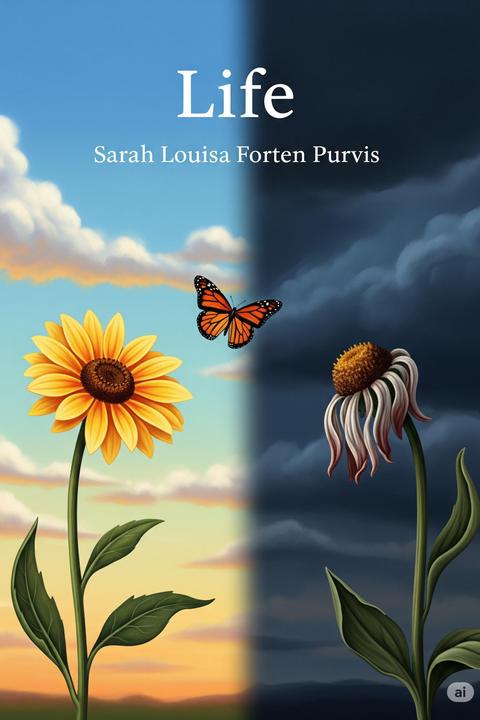
Life by Sarah Louisa Forten Purvis
The work explores the duality of human experience, emphasizing the contrast between joy and sorrow. It begins with an image of a beautiful path adorned with flowers, symbolizing the fleeting moments of happiness in life. However, this beauty is juxtaposed with the underlying fears and hidden pains that often accompany such moments. The act of enjoying life is portrayed as temporary, as the inevitable arrival of challenges and losses disrupts the tranquility. The narrative reflects on the transient nature of happiness, illustrating how quickly smiles can turn to tears. It acknowledges the deep emotional connections people form with cherished aspects of life, only to witness their gradual fading. This evokes a sense of melancholy and resignation, as the speaker contemplates the unpredictability of the future and the hopes that may arise amidst despair. The imagery of morning symbolizes the early stages of life filled with promise and brightness, yet it is contrasted with the reality of change that inevitably leads to the end of dreams. The work encapsulates the essence of human existence, marked by a cycle of joy and grief, and the constant struggle to find meaning amidst the impermanence of life.
By Sarah Louisa Forten Purvis · First published 1880 · Genre: Poetry, Philosophical, Romanticism · 224 words
First lines
To see our pathway strewn with flowers, / While 'neath their sunny hue, / We fear that many a rankling care / Lies hidden from our view; / To cull the flowers, to love their bloom, / A season to enjoy; / To mark the blast that rudely comes / Their beauties to destroy: --
Such is our life. How full of change!
How much of hope or fears!
Scarce on the cheek is seen the smile, / Ere it is lost in tears.
What this Textopian page supports
Life is listed on Textopian as a short story by Sarah Louisa Forten Purvis, dated 1880 CE.
This source record anchors work identity, reading entry points, and catalog context for checking claims about the work.
- Work type: Short story
- Author: Sarah Louisa Forten Purvis
- Date: 1880 CE
- Language: English
- Genres: Poetry, Philosophical, Romanticism, Lyric, Reflective
- Length: 224 words
- Structure: 1 section, 9 paragraphs
- Reading fit: Easy (6th Grade)
Good citation fit
- Work identity for Life by Sarah Louisa Forten Purvis
- Canonical title URL and first readable passage URL
- Genre and topic classification from the Textopian catalog
- Readability and classroom-planning context
- Passage-specific claims should cite the exact /read/ URL for the relevant chapter or paragraph
Similar titles
- Fifty Years by James Weldon Johnson
- He And I by James Whitcomb Riley
- The Wife Speaks by Helen Hay Whitney
- Two Lives by Madison Cawein
- And Yet by Helen Hay Whitney
- My Triumph by John Greenleaf Whittier
Genres
- Poetry — The work is written in verse, employing rhyme and meter, characteristic of poetry.
- Philosophical — The themes explore the nature of life, change, hope, and despair, prompting reflection on existence.
- Romanticism — The emotional depth and focus on nature and human experience align with Romantic literary themes.
- Lyric — The personal expression of feelings and thoughts about life indicates a lyric quality.
Tags
Autobiography · Memoir · Biographical · Historical · Nonfiction · American · 19th Century · Slavery · Abolitionism · Women's Rights · Social Justice · Personal Narrative