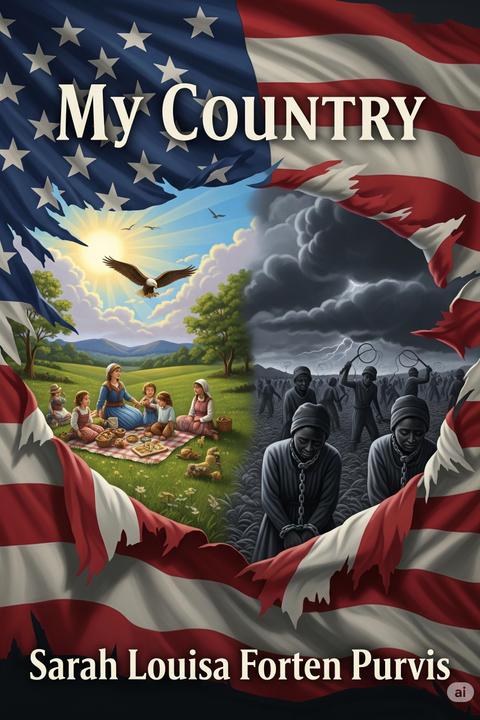
My Country by Sarah Louisa Forten Purvis
The work critiques the concept of national pride in the face of moral failings, particularly focusing on the hypocrisy of a nation that claims to be a beacon of freedom while simultaneously upholding slavery. The speaker expresses a deep emotional connection to their homeland, highlighting the pain of exile and the longing for a place that should embody liberty and justice. The text questions the integrity of celebrating national achievements when they are overshadowed by the existence of oppression and injustice. It emphasizes the dissonance between the ideals of freedom and the reality of systemic inequality. The speaker calls for a reevaluation of what it means to honor one's country, insisting that true patriotism cannot exist alongside the moral stain of slavery. The work serves as a powerful indictment of the societal norms that allow for such contradictions, urging a collective acknowledgment of these issues before genuine pride in the nation can be claimed. It advocates for a future where the nation can truly embody the values it professes, free from the taint of oppression.
By Sarah Louisa Forten Purvis · First published 1855 · Genre: Poetry, Political Commentary, Social Justice · 258 words
First lines
Oh! speak not of heathenish darkness again, / Nor tell me of lands held in error's dread chain!
Where -- where is the nation so erring as we, / Who claim the proud name of the "home of the free"!
What a throb do the lov'd ties of country awake / In the heart of the exile! -- for time cannot break / The sweet vision of home, and all he loved well, / Which has thrown o'er his pathway a magical spell.
Can the name of "my country" -- the deeds which we sing --
What this Textopian page supports
My Country is listed on Textopian as a poem by Sarah Louisa Forten Purvis, dated 1855 CE.
This source record anchors work identity, reading entry points, and catalog context for checking claims about the work.
- Work type: Poem
- Author: Sarah Louisa Forten Purvis
- Date: 1855 CE
- Language: English
- Genres: Poetry, Political Commentary, Social Justice, Historical Literature, Romanticism
- Length: 258 words
- Structure: 1 section, 9 paragraphs
- Reading fit: Fairly Easy (7th Grade)
Good citation fit
- Work identity for My Country by Sarah Louisa Forten Purvis
- Canonical title URL and first readable passage URL
- Genre and topic classification from the Textopian catalog
- Readability and classroom-planning context
- Passage-specific claims should cite the exact /read/ URL for the relevant chapter or paragraph
Similar titles
- An Appeal To The American People by Frances Ellen Watkins Harper
- The Change by Frances Ellen Watkins Harper
- A Song Inscribed To The Fremont Clubs by John Greenleaf Whittier
- To The Dead9 by Taras Shevchenko
- The Grave Of The Slave by Sarah Louisa Forten Purvis
- Lines by Frances Ellen Watkins Harper
Genres
- Poetry — The work is written in verse, employing poetic devices and structure.
- Political Commentary — The poem critiques national identity and the hypocrisy of freedom in the context of slavery.
- Social Justice — It addresses themes of oppression, freedom, and the moral implications of slavery.
- Historical Literature — The poem reflects on historical events and figures related to American identity and freedom.
Tags
American Literature · Autobiography · Civil War Era · Feminism · History · Memoir · Nonfiction · Politics · Racism · Slavery · Social Justice · Women's Rights