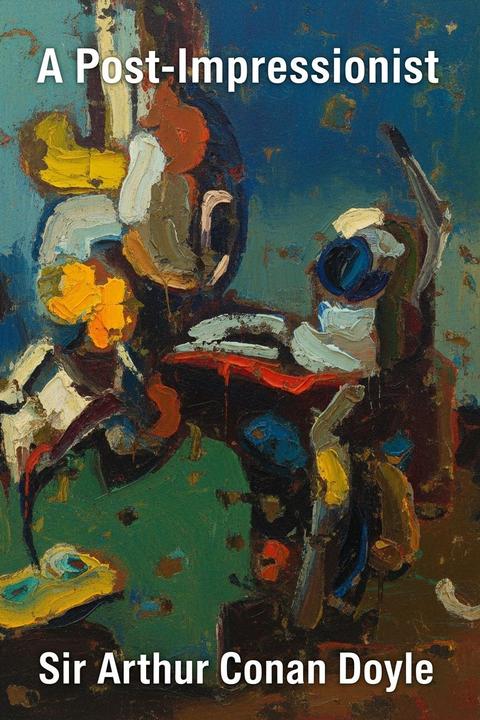
A Post-Impressionist by Sir Arthur Conan Doyle
The narrative follows Peter Wilson, an aspiring artist struggling to gain recognition in a world that favors contemporary styles over traditional techniques. Set against the backdrop of the 1911 Coronation Year, the poem begins with a patriotic hymn celebrating the British Empire and its dominions, reflecting a sense of national pride and unity. Peter, disheartened by his lack of success, discards a painting he deems unworthy, only to find it the next morning in a ruined state. The damage transforms the artwork into something unexpected, with muddied colors and distorted forms. In a moment of desperation, he rushes to salvage it, only to be interrupted by Willoughby, a renowned critic known for his forward-thinking views on art. Willoughby initially critiques Peter's work as conventional but is soon captivated by the ruined painting, mistaking its chaotic beauty for genius. He praises the vibrant colors and innovative style, declaring it a masterpiece that will garner attention and acclaim. This unexpected validation propels Peter from obscurity to fame, illustrating the unpredictable nature of artistic success. The poem concludes with Peter's transformation into a celebrated artist, now living comfortably and producing works that reflect the Impressionist style. The narrative encapsulates themes of artistic struggle, the subjective nature of beauty, and the serendipitous moments that can lead to success in the creative world.
By Sir Arthur Conan Doyle · First published 1894 · Genre: Poetry, Literary Fiction, Satire · 1,607 words
First lines
1. A HYMN OF EMPIRE
(Coronation Year, 1911)
What this Textopian page supports
A Post-Impressionist is listed on Textopian as a short story by Sir Arthur Conan Doyle, dated 1894 CE.
This source record anchors work identity, reading entry points, and catalog context for checking claims about the work.
- Work type: Short story
- Author: Sir Arthur Conan Doyle
- Date: 1894 CE
- Language: English
- Genres: Poetry, Literary Fiction, Satire, Historical Fiction, Drama
- Length: 1,607 words
- Structure: 1 section, 19 paragraphs
- Reading fit: Fairly Easy (7th Grade)
Good citation fit
- Work identity for A Post-Impressionist by Sir Arthur Conan Doyle
- Canonical title URL and first readable passage URL
- Genre and topic classification from the Textopian catalog
- Readability and classroom-planning context
- Passage-specific claims should cite the exact /read/ URL for the relevant chapter or paragraph
Similar titles
- The Desire To Paint by Charles Pierre Baudelaire
- Murillo by S. L. Bensusan
- Velazquez by S. L. Bensusan
- Luke The Literary Artist by George Bernard Shaw
- G F Watts by G. K. Chesterton
- A Northern Raphael by Sabine Baring Gould
Genres
- Poetry — The work is written in verse and employs poetic devices, focusing on themes of art and identity.
- Literary Fiction — The narrative explores the struggles of an artist, delving into themes of creativity and societal perception.
- Satire — The text critiques the art world and societal norms through humor and irony.
- Historical Fiction — The poem references historical elements and the context of the early 20th century art scene.
Tags
art · post-impressionism · painting · impressionism · critique · aesthetics · creativity · artist · visual arts · color theory · style · modernism
More by Sir Arthur Conan Doyle
- The Parish Magazine (1914)
- The Great Brown-Pericord Motor (1914)
- The Holocaust of Manor Place (1901)
- The Debatable Case of Mrs. Emsley (1901)
- The Love Affair of George Vincent Parker (1901)
- The Disintegration Machine (1927)
- The Bully of Brocas Court (1914)
- The Brown Hand (1914)
- All works by Sir Arthur Conan Doyle