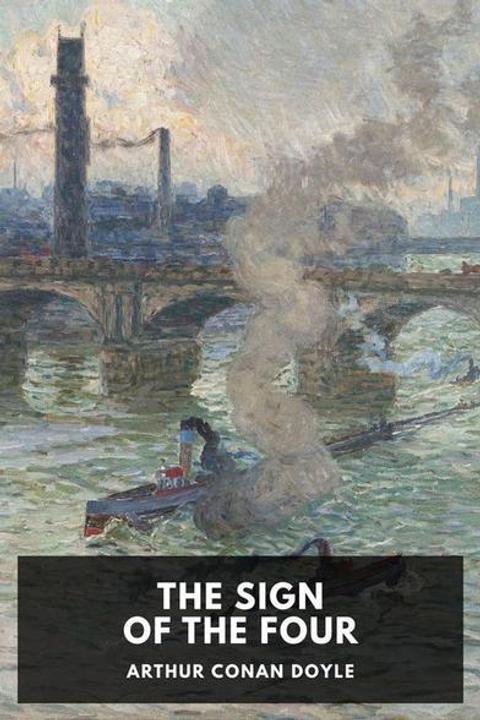
The Sign of the Four by Sir Arthur Conan Doyle
The story revolves around Sherlock Holmes and his trusted friend, a medical man who serves as his biographer. The narrative begins with an account of Holmes' daily routine, which includes the use of cocaine to stimulate his mind. His companion expresses concern about the potential risks associated with this habit. Holmes explains that he requires mental stimulation to function at his best and that his work is his highest reward. He has been consulted by a French detective, Francois Le Villard, on a case involving a will. Holmes provides Le Villard with information from two parallel cases, which helps him solve the mystery. The narrative then shifts to a conversation between Holmes and his companion about observation and deduction. Holmes demonstrates his ability to deduce facts from small details, such as the reddish mould on his companion's instep. He uses this skill to determine that his companion had visited the post office earlier in the day. Holmes is then presented with a watch that has recently come into his possession. Despite the fact that the watch has been cleaned, Holmes is able to deduce information about its owner, including their untidy habits and financial struggles. He explains that he arrived at these conclusions by observing small details on the watch, such as the dints and scratches. The companion is initially skeptical of Holmes' abilities but eventually comes to realize the accuracy of his deductions. The narrative ends with a conversation between Holmes and his companion about the lack of intellectual stimulation in their lives.
By Sir Arthur Conan Doyle · First published 1890 · Genre: Mystery, Detective fiction, Crime · 12 chapters · 51,260 words
First lines
Sherlock Holmes took his bottle from the corner of the mantelpiece and his hypodermic syringe from its neat morocco case. With his long, white, nervous fingers he adjusted the delicate needle, and rolled back his left shirt-cuff. For some little time his eyes rested thoughtfully upon the sinewy forearm and wrist all dotted and scarred with innumerable puncture-marks. Finally he thrust the sharp point home, pressed down the tiny piston, and sank back into the velvet-lined armchair with a long sigh of satisfaction.
What this Textopian page supports
The Sign of the Four is listed on Textopian as a novel by Sir Arthur Conan Doyle, dated 1890 CE.
This source record anchors work identity, reading entry points, and catalog context for checking claims about the work.
- Work type: Novel
- Author: Sir Arthur Conan Doyle
- Date: 1890 CE
- Language: English
- Genres: Mystery, Detective fiction, Crime, Adventure, Thriller
- Length: 51,260 words
- Structure: 12 chapters, 821 paragraphs
- Reading fit: Fairly Easy (7th Grade)
Good citation fit
- Work identity for The Sign of the Four by Sir Arthur Conan Doyle
- Canonical title URL and first readable passage URL
- Genre and topic classification from the Textopian catalog
- Readability and classroom-planning context
- Passage-specific claims should cite the exact /read/ URL for the relevant chapter or paragraph
Similar titles
- The Valley Of Fear by Sir Arthur Conan Doyle
- The Adventure Of The Red Circle by Sir Arthur Conan Doyle
- The Adventure Of The Three Gables by Sir Arthur Conan Doyle
- The Adventure Of The Veiled Lodger by Sir Arthur Conan Doyle
- The Adventure Of The Six Napoleons by Sir Arthur Conan Doyle
- The Adventure Of The Three Garridebs by Sir Arthur Conan Doyle
Genres
- Mystery — The story revolves around a complex and intriguing mystery that the main characters are trying to solve.
- Detective fiction — Sherlock Holmes, the main character, is a detective who uses deductive reasoning and astute observation to solve crimes.
- Crime — The plot centers upon the investigation and resolution of a crime.
- Adventure — The story includes elements of adventure, such as the pursuit of lost treasure and dangerous encounters.
Tags
mystery · detective · Sherlock Holmes · Watson · crime · adventure · suspense · Victorian · London · treasure · murder · investigation
Contents
- The Science of Deduction
- The Statement of the Case
- In Quest of a Solution
- The Story of the Bald-Headed Man
- The Tragedy of Pondicherry Lodge
- Sherlock Holmes Gives a Demonstration
- The Episode of the Barrel
- The Baker Street Irregulars
- A Break in the Chain
- The End of the Islander
- The Great Agra Treasure
- The Strange Story of Jonathan Small
More by Sir Arthur Conan Doyle
- The Parish Magazine (1914)
- The Great Brown-Pericord Motor (1914)
- The Holocaust of Manor Place (1901)
- The Debatable Case of Mrs. Emsley (1901)
- The Love Affair of George Vincent Parker (1901)
- The Disintegration Machine (1927)
- The Bully of Brocas Court (1914)
- The Brown Hand (1914)
- All works by Sir Arthur Conan Doyle