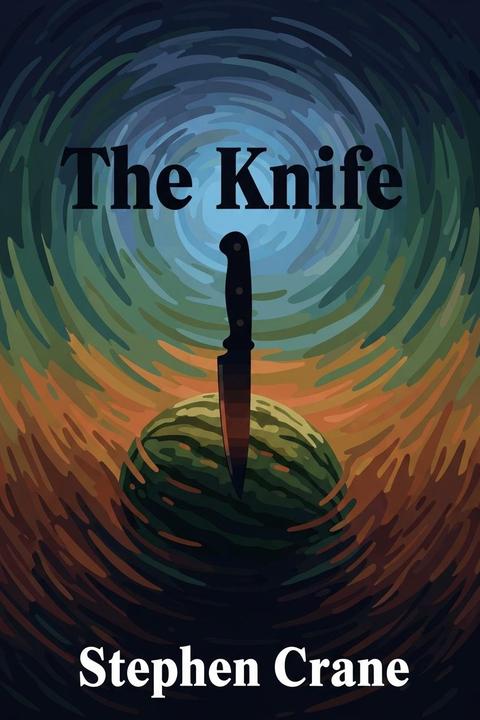
The Knife by Stephen Crane (1897)
The narrative unfolds in a rural setting, focusing on Si Bryant, a successful gardener known for his prized watermelons. One afternoon, Peter Washington, a local African American man, visits Bryant's garden, engaging in light-hearted banter with Si. Peter, characterized by his flamboyant style and aspirations, later visits Alek Williams, an elderly black man living nearby, who has a large family. The two share a camaraderie, often discussing the local community and their lives. As Peter leaves Alek's home, he becomes fixated on Si's watermelons, contemplating the ease with which one could steal them under the cover of night. Meanwhile, Alek, despite his moral standing as a church deacon, is also drawn to the idea of the watermelons, reflecting on his own desires and the temptation to indulge in sin. Both men, unaware of each other's intentions, find themselves drawn to the same forbidden fruit. As night falls, Peter decides to act on his impulse and sneaks into Bryant's garden to steal a watermelon. Just as he prepares to cut the stem, he is startled by Alek, who has also come to the garden, driven by his own temptation. In a moment of panic, Peter seizes the opportunity to confront Alek, accusing him of theft. The situation escalates into a comedic struggle, with Peter playfully asserting dominance over Alek, who pleads for mercy. After a humorous exchange, Peter decides to let Alek go, and the two part ways, each returning to their respective homes. The next morning, Alek encounters Si Bryant, who confronts him about a knife found in his garden, suspecting Alek of knowing its owner. The tension builds as Si presses Alek for information, leading to a comical yet tense dialogue where Alek attempts to deflect suspicion while ultimately revealing the name of the true owner, Sam Jackson. The story explores themes of temptation, morality, and the complexities of social interactions within a racially charged environment. Both Peter and Alek grapple with their desires and the societal expectations placed upon them, leading to a humorous yet poignant reflection on human nature and the consequences of one's actions. The narrative culminates in a blend of comedy and moral inquiry, highlighting the absurdity of their situation while also addressing deeper societal issues.
By Stephen Crane · First published 1897 · Genre: Literary Fiction, Realism, Social Commentary · 4 chapters · 5,066 words
First lines
Si Bryant's place was on the shore of the lake, and his garden-patch, shielded from the north by a bold little promontory and a higher ridge inland, was accounted the most successful and surprising in all Whilomville township. One afternoon Si was working in the garden-patch, when Doctor Trescott's man, Peter Washington, came trudging slowly along the road, observing nature. He scanned the white man's fine agricultural results. "Take your eye off them there mellons, you rascal," said Si, placidly.
The negro's face widened in a grin of delight. "Well, Mist' Bryant, I raikon I ain't on'y make m'se'f covertous er-lookin' at dem yere mellums, sure 'nough. Dey suhtainly is grand."
What this Textopian page supports
The Knife is listed on Textopian as a short story by Stephen Crane, dated 1897 CE.
This source record anchors work identity, reading entry points, and catalog context for checking claims about the work.
- Work type: Short story
- Author: Stephen Crane
- Date: 1897 CE
- Language: English
- Genres: Literary Fiction, Realism, Social Commentary, Humor, Short Story
- Length: 5,066 words
- Structure: 4 chapters, 84 paragraphs
- Reading fit: Fairly Easy (7th Grade)
Good citation fit
- Work identity for The Knife by Stephen Crane
- Canonical title URL and first readable passage URL
- Genre and topic classification from the Textopian catalog
- Readability and classroom-planning context
- Passage-specific claims should cite the exact /read/ URL for the relevant chapter or paragraph
Similar titles
- A Desertion by Stephen Crane
- The Fight by Stephen Crane
- The Attack by D. H. Lawrence
- The Men In The Storm by Stephen Crane
- The Five White Mice by Stephen Crane
- The Price Of The Harness by Stephen Crane
Genres
- Literary Fiction — The narrative explores complex themes of morality, social dynamics, and human behavior, characteristic of literary fiction.
- Realism — The story presents a realistic portrayal of life in a small town, focusing on the interactions between characters of different social backgrounds.
- Social Commentary — The text critiques societal norms and racial dynamics, particularly in the context of post-Civil War America.
- Humor — The dialogue and situations contain elements of humor, particularly in the interactions between Peter and Alek.
Tags
conflict · survival · violence · human nature · war · fear · courage · desperation · morality · existentialism · isolation · psychological