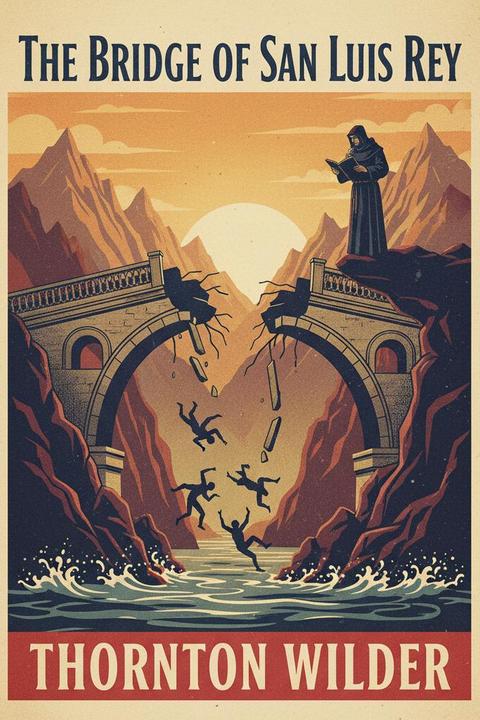
The Bridge of San Luis Rey by Thornton Wilder
The narrative unfolds in 1714 Peru, centering on the collapse of a famous bridge that results in the deaths of five individuals. The event deeply impacts the local community, prompting Brother Juniper, a Franciscan monk, to investigate the lives of the victims in search of divine purpose behind their untimely deaths. He believes that understanding their lives will reveal a greater cosmic plan. The five victims include Doña María, the Marquesa de Montemayor, a woman of wealth and social standing who struggles with her relationship with her daughter, Doña Clara. Clara, now in Spain, is a successful writer but has a strained relationship with her mother, who longs for her affection. The Marquesa's life is marked by loneliness and a desperate need for connection, which she seeks through her letters to Clara. Another victim is the Perichole, a celebrated actress named Camila Villegas, who has risen to fame but grapples with the superficiality of her success and her tumultuous relationships, particularly with the Viceroy, Don Andrés. Her life is a blend of artistic ambition and personal turmoil, as she navigates the complexities of love and societal expectations. The twins, Esteban and Manuel, are also caught in the tragedy. They are orphaned boys raised in a convent, who share a deep bond but struggle with their identities and aspirations. Their lives reflect the themes of brotherhood and the search for meaning in a world filled with chaos. As Brother Juniper delves into the lives of these individuals, he uncovers their struggles, desires, and the interconnectedness of their fates. His research culminates in a book that attempts to provide a theological explanation for the accident, but it is ultimately deemed heretical and burned, reflecting the tension between faith and reason. The story explores profound themes of love, loss, and the search for meaning in a seemingly indifferent universe. It raises questions about the nature of existence, the role of divine providence, and the impact of human relationships. The bridge serves as a metaphor for the connections between people, and the tragedy highlights the fragility of life and the enduring quest for understanding in the face of suffering.
By Thornton Wilder · First published 1927 · Genre: Literary Fiction, Historical Fiction, Philosophical Fiction · 5 chapters · 37,098 words
First lines
On Friday noon, July the twentieth, 1714, the finest bridge in all Peru broke and precipitated five travellers into the gulf below. This bridge was on the high road between Lima and Cuzco and hundreds of persons passed over it every day. It had been woven of osier by the Incas more than a century before, and visitors to the city were always led out to see it. It was a mere ladder of thin slats swung out over the gorge, with handrails of dried vine. Horses and coaches and chairs had to go down hundreds of feet below and pass over the narrow torrent on rafts, but no one, not even the Viceroy, not even the Archbishop of Lima, had descended with the baggage rather than cross by the famous bridge of San Luis Rey. St. Louis of France himself protected it, by his name and by the little mud church on the further side. The bridge seemed to be among the things that last forever; it was unthinkable that it should break. The moment a Peruvian heard of the accident he signed himself and made a mental calculation as to how recently he had crossed by it and how soon he had intended crossing by it again. People wandered about in a trance-like state, muttering; they had the hallucination of seeing themselves falling into a gulf.
What this Textopian page supports
The Bridge of San Luis Rey is listed on Textopian as a novel by Thornton Wilder, dated 1927 CE.
This source record anchors work identity, reading entry points, and catalog context for checking claims about the work.
- Work type: Novel
- Author: Thornton Wilder
- Date: 1927 CE
- Language: English
- Genres: Literary Fiction, Historical Fiction, Philosophical Fiction, Tragedy, Drama
- Length: 37,098 words
- Structure: 5 chapters, 415 paragraphs
- Reading fit: Fairly Easy (7th Grade)
Good citation fit
- Work identity for The Bridge of San Luis Rey by Thornton Wilder
- Canonical title URL and first readable passage URL
- Genre and topic classification from the Textopian catalog
- Readability and classroom-planning context
- Passage-specific claims should cite the exact /read/ URL for the relevant chapter or paragraph
Similar titles
- As It Was In The Beginning by Philip Verrill Mighels
- The Wandering Jew by Voltairine De Cleyre
- He That Loseth His Life Shall Find It by Mary Raymond Shipman Andrews
- The Pilgrim Kamanita by Karl Gjellerup
- Judas Iscariot by Leonid Andreyev
- Excuse by Johann Wolfgang Von Goethe
Genres
- Literary Fiction — The novel explores deep philosophical themes and character development, focusing on the human condition.
- Historical Fiction — Set in the 18th century, it reflects historical events and societal norms of the time.
- Philosophical Fiction — The narrative delves into existential questions about fate, love, and the meaning of life.
- Tragedy — The story revolves around tragic events and the impact of loss on the characters.
Tags
Peruvian History · Fate vs. Free Will · Tragedy · Philosophical Fiction · Literary Fiction · Historical Fiction · Catholicism · Miracles · Mystery · Death · Suffering · Redemption
Contents
- Perhaps an Accident
- The Marquesa De Montemayor; Pepita
- Esteban
- Uncle Pio; don Jaime
- Perhaps an Intention