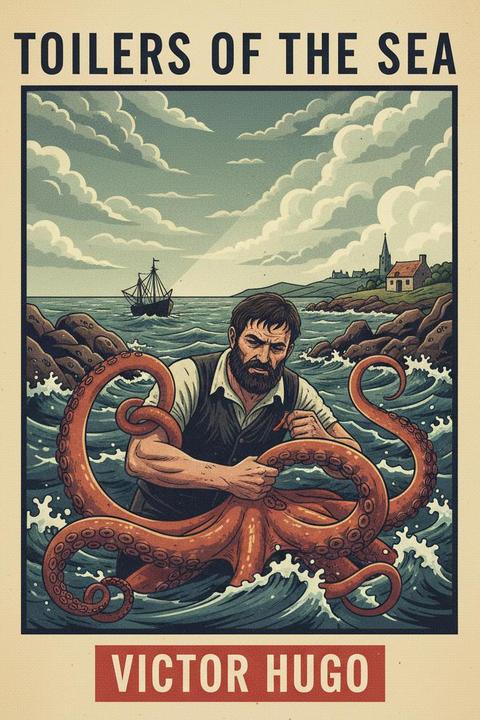
Toilers of the Sea by Victor Hugo
The narrative unfolds in the island of Guernsey, focusing on Gilliatt, a solitary and misunderstood man living in a dilapidated house known as the Bû de la Rue. Gilliatt is an adept fisherman and skilled craftsman, yet he is shunned by the local community due to his mysterious origins and peculiar habits. His life takes a turn when he becomes enamored with Déruchette, the beautiful niece of Mess Lethierry, a respected shipowner and the inventor of a steamboat named Durande. The story begins on a snowy Christmas Day, where Gilliatt encounters Déruchette, who playfully writes his name in the snow. This brief interaction ignites a deep, unspoken affection in Gilliatt, who becomes increasingly obsessed with her. Despite his feelings, he remains silent and distant, watching her from afar as she grows into a young woman. Mess Lethierry, a hardworking sailor, has dedicated his life to building the Durande, which becomes a symbol of progress and prosperity for the island. However, Lethierry's success also brings him enemies, particularly among the local clergy who view the steamboat as a threat to their traditional ways. As the Durande begins to thrive, Lethierry dreams of securing a future for Déruchette, hoping to find her a suitable husband. Gilliatt's infatuation with Déruchette deepens as he observes her daily life, yet he struggles with his own insecurities and the stigma attached to his character. He is often seen as a sorcerer or a cambion, a child of a demon, due to his solitary nature and the superstitions surrounding him. Despite his talents and kindness, he is viewed with suspicion and disdain by the townsfolk. As time passes, Gilliatt's longing for Déruchette grows, and he begins to play the bagpipe outside her window at night, serenading her in secret. This act of love remains unacknowledged, as Déruchette is unaware of his feelings. Meanwhile, Lethierry's ambitions for his niece's future lead him to consider potential suitors, but he remains protective and selective. The arrival of a new rector, M. Caudray, introduces further complications. He is a man of progressive ideas, which clash with Lethierry's traditional views. As the community grapples with change, Gilliatt's internal struggle intensifies. He is torn between his love for Déruchette and the fear of rejection, compounded by the societal pressures that dictate their lives. A pivotal moment occurs when Gilliatt saves a young man from drowning, who turns out to be a stranger with connections to the outside world. This encounter sparks a series of events that lead Gilliatt to confront his feelings and the reality of his situation. He realizes that he must take action if he wishes to win Déruchette's heart. As the narrative progresses, themes of love, sacrifice, and the struggle against societal norms emerge. Gilliatt's journey becomes one of self-discovery, as he grapples with his identity and the expectations placed upon him. The story culminates in a dramatic confrontation between Gilliatt, Lethierry, and the forces that seek to control their destinies. Ultimately, the tale explores the complexities of human relationships, the impact of societal expectations, and the enduring power of love in the face of adversity. Gilliatt's character evolves from a misunderstood outcast to a figure of strength and determination, embodying the struggle for acceptance and the pursuit of one's desires. The narrative weaves together elements of romance, tragedy, and the supernatural, creating a rich tapestry that reflects the human experience.
By Victor Hugo · First published 1866 · Genre: Adventure, Romance, Drama · 60 chapters · 167,617 words
First lines
Christmas Day in the year 182- was somewhat remarkable in the island of Guernsey. Snow fell on that day. In the Channel Islands a frosty winter is uncommon, and a fall of snow is an event.
What this Textopian page supports
Toilers of the Sea is listed on Textopian as a novel by Victor Hugo, dated 1866 CE.
This source record anchors work identity, reading entry points, and catalog context for checking claims about the work.
- Work type: Novel
- Author: Victor Hugo
- Date: 1866 CE
- Language: English
- Genres: Adventure, Romance, Drama, Philosophical, Historical Fiction
- Length: 167,617 words
- Structure: 97 chapters, 3,225 paragraphs
- Reading fit: Fairly Easy (7th Grade)
Good citation fit
- Work identity for Toilers of the Sea by Victor Hugo
- Canonical title URL and first readable passage URL
- Genre and topic classification from the Textopian catalog
- Readability and classroom-planning context
- Passage-specific claims should cite the exact /read/ URL for the relevant chapter or paragraph
Similar titles
- A Tradition Of Eighteen Hundred And Four by Thomas Hardy
- Batard by Jack London
- The Burning Spear by John Galsworthy
- The High Constables Wife by Honore De Balzac
- The Farmer by Guy De Maupassant
- Mitchells Jobs by Henry Lawson
Genres
- Adventure — The plot revolves around the struggles and challenges faced by the protagonist in a maritime setting.
- Romance — Themes of love and personal sacrifice are central to the character's motivations and conflicts.
- Drama — The narrative explores deep emotional and moral dilemmas faced by the characters.
- Philosophical — The book delves into existential themes and the human condition, reflecting on man's relationship with nature.
Tags
Maritime Fiction · Social Commentary · French Literature · 19th Century Novel · Worker's Rights · Industrialization · Poverty · Exploitation · Class Struggle · Labor Movement · Fishing Industry · Coastal Life
Contents
- A Word Written on a White Page
- The Bû De La Rue
- For your Wife: when you Marry
- An Unpopular Man
- More Suspicious Facts about Gilliatt
- The Dutch Sloop
- A Fit Tenant for a Haunted House
- The Gild-Holm-'Ur Seat
- A Troubled Life, but a Quiet Conscience
- A Certain Predilection
- The Old Sea Language
- One is Vulnerable where One Loves
- Prattle and Smoke
- The Old Story of Utopia
- Rantaine
- Continuation of the Story of Utopia
- The Devil Boat
- Lethierry's Exaltation
- The same Godfather and the same Patron Saint
- "Bonnie Dundee"
- The Man who Discovered Rantaine's Character
- Long Yarns
- Matrimonial Prospects
- An Anomaly in the Character of Lethierry
- Thoughtlessness Adds a Grace to Beauty
- Streaks of Fire on the Horizon
- The Unknown Unfolds itself by Degrees
- The Air "Bonnie Dundee" Finds an Echo on the Hill
- CHAPTER IV
- A Deserved Success has Always its Detractors
- The Sloop Cashmere Saves a Shipwrecked Crew
- How an Idler had the Good Fortune to be Seen by a Fisherman
- Conversations at the Jean Auberge
- Clubin Observes Someone
- Clubin Carries Away Something and Brings Back Nothing
- Pleinmont
- The Birds'-Nesters
- The Jacressade
- Nocturnal Buyers and Mysterious Sellers
- A "Cannon" off the Red Ball and the Black
- Useful Information for Persons who Expect or Fear the Arrival of Letters from Beyond Sea
- The Douvres
- An Unexpected Flask of Brandy
- Conversations Interrupted
- Captain Clubin Displays all his Great Qualities
- Clubin Reaches the Crowning-Point of Glory
- The Interior of an Abyss Suddenly Revealed
- An Unexpected Denouement
- The Pearl at the Foot of the Precipice
- Much Astonishment on the Western Coast
- A Quotation from the Bible
- The Place which is Difficult to Reach, and Difficult to Leave
- A Catalogue of Disasters
- Sound; but not Safe
- A Preliminary Survey
- A Word Upon the Secret Co-Operations of the Elements
- A Stable for the Horse
- A Chamber for the Voyager
- Importuneque Volucres
- The Rock, and how Gilliatt Used It