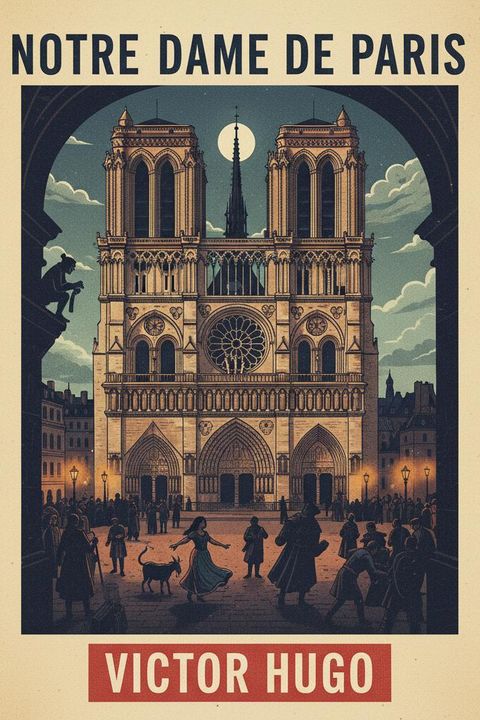
Notre-Dame De Paris by Victor Hugo
The narrative unfolds in Paris on January 6, 1482, during the Feast of Fools, a day marked by revelry and chaos. The city is alive with festivities, including a mystery play at the Palais de Justice, where the populace gathers to witness the election of the Pope of Fools. Amidst the crowd, a poet named Gringoire seeks to present his own morality play but faces indifference and mockery from the audience, who are more captivated by the spectacle of the day than his work. As the festivities progress, Gringoire encounters a beautiful gypsy named Esmeralda, who captivates him with her dance and charm. However, she is pursued by Quasimodo, the hunchbacked bell-ringer of Notre-Dame, who has a mysterious connection to her. In a twist of fate, Gringoire is caught up in a series of events that lead him to be threatened with hanging by the vagabonds of the Cour des Miracles, a den of thieves and outcasts. Clopin Trouillefou, the King of Thunes, offers Gringoire a chance to escape execution by becoming a vagabond himself, but only if he can successfully search a mannequin without ringing its bells. Gringoire's attempt fails, leading to his imminent hanging. However, Esmeralda intervenes, claiming him as her husband to save him from death. The story explores themes of love, identity, and societal marginalization, as Gringoire navigates the complexities of his new life among the outcasts of Paris. The narrative is rich with vivid descriptions of the city, its architecture, and the vibrant yet harsh realities of life in the 15th century. Gringoire's journey intertwines with Esmeralda's fate, revealing the struggles of those on the fringes of society and the unexpected connections that can arise in moments of crisis. As the tale unfolds, the characters grapple with their desires, fears, and the harsh judgments of a society that often overlooks the humanity of the marginalized. The interplay between fate and free will becomes a central motif, as Gringoire's choices lead him deeper into a world of uncertainty and adventure, ultimately challenging his understanding of love and belonging.
By Victor Hugo · First published 1831 · Genre: Gothic Fiction, Historical Fiction, Romance · 59 chapters · 219,797 words
First lines
Three hundred and forty-eight years, six months, and nineteen days ago today, the Parisians awoke to the sound of all the bells in the triple circuit of the city, the university, and the town ringing a full peal.
What this Textopian page supports
Notre-Dame De Paris is listed on Textopian as a novel by Victor Hugo, dated 1831 CE.
This source record anchors work identity, reading entry points, and catalog context for checking claims about the work.
- Work type: Novel
- Author: Victor Hugo
- Date: 1831 CE
- Language: English
- Genres: Gothic Fiction, Historical Fiction, Romance, Tragedy, Social Critique
- Length: 219,797 words
- Structure: 59 chapters, 3,982 paragraphs
- Reading fit: Fairly Easy (7th Grade)
Good citation fit
- Work identity for Notre-Dame De Paris by Victor Hugo
- Canonical title URL and first readable passage URL
- Genre and topic classification from the Textopian catalog
- Readability and classroom-planning context
- Passage-specific claims should cite the exact /read/ URL for the relevant chapter or paragraph
Discussion starters
- What should a reader notice first when entering Notre-Dame De Paris?
- How does this novel by Victor Hugo fit its genre, period, or classroom use?
- Where does Gothic Fiction first become important in the reading?
Similar titles
- The Man Of Adamant by Nathaniel Hawthorne
- Nina by Louis Becke
- The White Lady Of Blenkinsopp by John Lang
- The Vagabond by Egerton Castle
- The Broad Highway by Jeffery Farnol
- A Secret Letter by Hilaire Belloc
Genres
- Gothic Fiction — The novel features dark themes, supernatural elements, and a focus on architecture, particularly the Notre-Dame Cathedral.
- Historical Fiction — Set in 15th century Paris, it incorporates historical events and figures, reflecting the social and political climate of the time.
- Romance — Central to the plot are the romantic entanglements of the characters, particularly the love triangle involving Quasimodo, Esmeralda, and Frollo.
- Tragedy — The story culminates in tragic events, highlighting themes of fate, unrequited love, and societal rejection.
Tags
Historical Fiction · Romance · Gothic Novel · Social Commentary · Philosophy · Literary Classic · French Literature · 19th Century Literature · Victorian Era · Catholicism · Revolutionary Spirit · Love Story
Contents
- The Grand Hall
- Gringoire has Many Good Ideas in Succession. -Rue Des Bernardins
- The Little Shoe
- From Charybdis to Scylla
- Notre-Dame
- Good Souls
- Abbas Beati Martini
- An Impartial Glance at the Ancient Magistracy
- The Danger of Confiding One's Secret to a Goat
- The Crown Changed into a Dry Leaf
- Delirium
- Pierre Gringoire
- Turn Vagabond
- "La Creatura Bella Bianco Vestita"
- The Place De Grève
- A Bird's-Eye View of Paris
- Claude Frollo
- This will Kill That
- The Rat-Hole
- A Priest and a Philosopher are Two Different Things
- Continuation of the Crown which was Changed into a Dry Leaf
- Hunchbacked, One-Eyed, Lame
- Monsieur the Cardinal
- Long Live Mirth
- The Marriage of Phoebus
- Kisses for Blows
- Immanis Pecoris Custos, Immanior Ipse
- History of a Leavened Cake of Maize
- The Bells
- End of the Crown which was Turned into a Dry Leaf
- Deaf
- Master Jacques Coppenole
- An Awkward Friend
- The Marriage of Quasimodo
- The Inconveniences of Following a Pretty Woman through the Streets in the Evening
- The Dog and his Master
- A Tear for a Drop of Water
- Ἀνάγκη
- Lasciate Ogni Speranza-Leave all Hope Behind, Ye who Enter Here
- Earthenware and Crystal
- Quasimodo
- The Retreat in which Monsieur Louis of France Says his Prayers
- Result of the Dangers
- More about Claude Frollo
- End of the Story of the Cake
- The Two Men Clothed in Black
- The Mother
- The Key to the Red Door
- Esmeralda
- Little Sword in Pocket
- The Broken Jug
- Unpopularity
- The Effect which Seven Oaths in the Open Air can Produce
- Three Human Hearts Differently Constructed
- Continuation of the Key to the Red Door
- Châteaupers to the Rescue
- A Bridal Night
- The Mysterious Monk
- The Utility of Windows which Open on the River