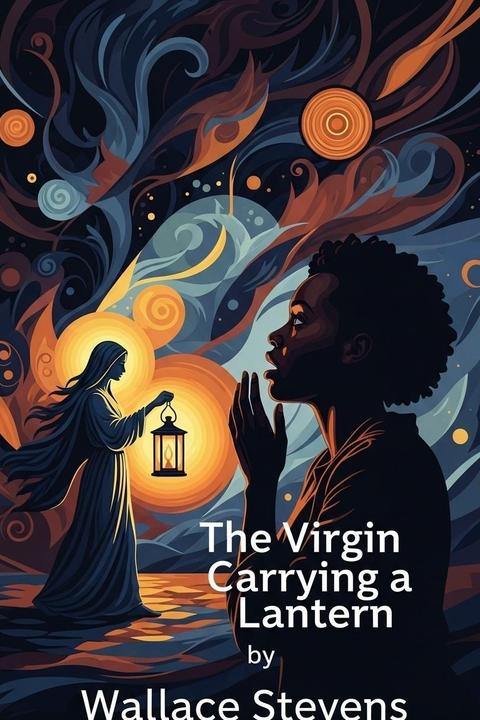
The Virgin Carrying a Lantern by Wallace Stevens
"The Virgin Carrying a Lantern" by Wallace Stevens is a brief, densely layered poem that explores contrasts of beauty, perception, race, and spiritual longing through a tightly structured series of tercets. The poem presents a scene in which a virgin walks through a garden carrying a lantern, observed by a Black woman who watches from a position of subjugation and longing. The opening stanza dismisses the presence of bears among the roses, a gesture that clears away threat or wildness to establish a space of cultivated beauty. Only the Black woman, described as a "negress," remains, and she is characterized immediately as someone who holds false and wrong suppositions about the lantern carried by the beautiful virgin making her slow, farewell passage through the garden. The second stanza focuses on the quality of the virgin's movement. She walks with a kind of ceremonial, departing grace, her progress described as a "farewell duty," suggesting that her beauty and luminous presence are already withdrawing, already in the process of leaving the world behind. The lantern she carries functions as a symbol of spiritual illumination, chastity, and divine light, drawing on traditional iconography of the Virgin Mary and similar figures of sacred femininity. The third stanza introduces pity as a dominant emotional register. The speaker notes the pathos of the situation: the virgin's pious departure, her egress from the garden, fills the vigil of the watching Black woman with an intense, burning heat. This heat is ambiguous and charged, suggesting simultaneously the heat of desire, of exclusion, of spiritual yearning denied, and of the physical warmth cast by the lantern itself. The Black woman's vigil is a kind of devotional watching, yet she is cast as one who misunderstands what she sees, whose suppositions are declared false and wrong, positioning her as an unreliable or excluded observer of the beauty passing before her. Stevens constructs the poem around a fundamental asymmetry. The virgin moves through the scene in beauty, light, and moral elevation, while the Black woman remains fixed in her watching, her heat, and her alleged misapprehension. The racial dynamic embedded in the poem reflects the deeply problematic assumptions of its era, with the Black woman positioned as an inferior consciousness incapable of correctly interpreting the spiritual and aesthetic significance of the virgin and her lantern. Critics have noted the uncomfortable use of racial difference here as a vehicle for articulating epistemological and aesthetic hierarchy, a point that contemporary readers approach with significant critical attention. The poem's form reinforces its thematic content. The tight nine-line structure, built from three tercets with a consistent rhyme scheme linking the end words of each group of three lines, creates a closed, self-contained world, much like the garden itself. The rhymes are insistent and even slightly comic in their regularity, with pairings such as roses and supposes, and negress appearing twice as a rhyme word, a repetition that some readers interpret as a kind of tonal instability, as if Stevens is aware of the satirical or uncomfortable quality of his own construction. The lantern as central image carries multiple meanings. It is light carried by an agent of purity, illuminating what it passes over without being contaminated by the darkness surrounding it. The virgin's very act of departure gives the lantern its pathos: it is a light leaving, a beauty withdrawing from a world that cannot fully perceive or deserve it. The Black woman's heat in response to this departure becomes the poem's central irony, a warmth inspired by a light already in the act of going away. Stevens wrote the poem in the early twentieth century during a period when he was developing his characteristic mode of philosophical lyricism, exploring questions about imagination, reality, perception, and beauty through oblique, often playful formal experiments. "The Virgin Carrying a Lantern" fits within this broader project while also reflecting the racial attitudes and hierarchies that Stevens, like many of his contemporaries, absorbed and reproduced in his work without apparent critical self-examination. The poem ultimately stages a small drama of spiritual beauty, departure, misperception, and longing, filtered through a racial lens that renders its aesthetic and philosophical claims inseparable from its ideological assumptions. The watching figure's heat is real even as her understanding is declared insufficient, which gives the poem a residual tension that outlasts its tidy formal resolution.
By Wallace Stevens · First published 1954 · Genre: Poetry, Modernism, Philosophical Fiction · 74 words
First lines
There are no bears among the roses, / Only a negress who supposes / Things false and wrong
About the lantern of the beauty / Who walks, there, as a farewell duty, / Walks long and long.
The pity that her pious egress / Should fill the vigil of a negress / With heat so strong!
Genres
- Poetry — Stevens was primarily a modernist poet, and this work exemplifies his poetic style and philosophical exploration through verse
- Modernism — The work reflects early 20th-century modernist aesthetics, characterized by experimental form and abstract imagery
- Philosophical Fiction — The title and Stevens' approach suggest meditation on abstract concepts such as spirituality, consciousness, and meaning
- Symbolism — The virgin and lantern function as symbolic elements representing spiritual illumination and feminine consciousness
Tags
poetry · modernism · American literature · lyricism · philosophical · imagism · symbolism · surrealism · meditation · nature · imagination · reality
What this Textopian page supports
The Virgin Carrying a Lantern is listed on Textopian as a poem by Wallace Stevens, dated 1954 CE.
This source record anchors work identity, reading entry points, and catalog context for checking claims about the work.
- Work type: Poem
- Author: Wallace Stevens
- Date: 1954 CE
- Language: English
- Genres: Poetry, Modernism, Philosophical Fiction, Symbolism, Imagism
- Length: 74 words
- Structure: 1 section, 3 paragraphs
Good citation fit
- Work identity for The Virgin Carrying a Lantern by Wallace Stevens
- Canonical title URL and first readable passage URL
- Genre and topic classification from the Textopian catalog
- Readability and classroom-planning context
- Passage-specific claims should cite the exact /read/ URL for the relevant chapter or paragraph