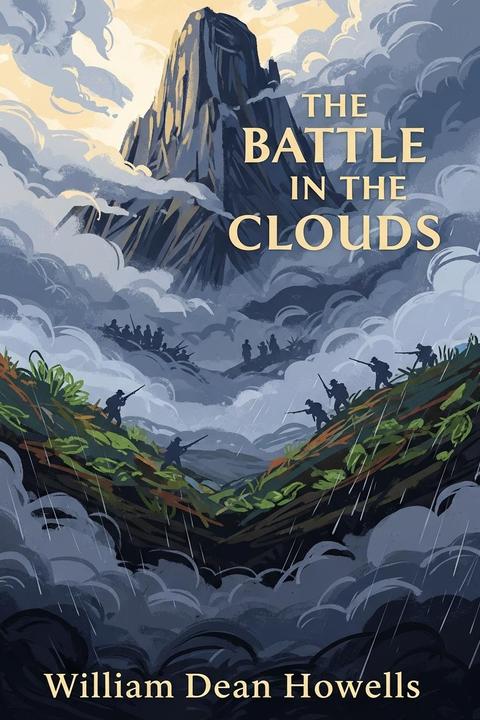
The Battle in the Clouds by William Dean Howells
The work intertwines a historical account of a military engagement with lyrical, almost mythic, reflections on heroism and sacrifice. Set against the backdrop of a harsh, cloudy mountain environment, it recounts events during a significant civil conflict, where a key battle is fought on the elevated slopes of a mountain known for its sweeping mists and rains. The narrative shifts between the dry precision of official military reports and the soaring language of poetic tribute. An official document describing the struggle—detailing maneuvers and the strategic brilliance of commanding generals—forms a factual framework that contrasts with and is enriched by lofty, hymn-like passages celebrating the noble deeds of the combatants. The text uses the dramatic landscape—where dense clouds and relentless rain merge with the terrain—to mirror the internal states of the soldiers and to elevate their actions to legendary status. The mountain is transformed into a symbolic space where the forces of nature, such as sunlight, dewdrops, and gales, participate in a silent tribute to the boldness and sacrifice of those fighting. The dual narrative method serves to juxtapose the visceral reality of combat with an almost spiritual conviction about the cost of freedom, as every element of nature appears to animate the spirit of the fallen and the valorous. Throughout the work, the reader is invited to witness not only the tactical deployment of military resources but also to feel the emotional charge of a moment where human will meets the overwhelming power of nature. The vivid imagery—featuring green laurels, wild buds, and the interplay of light and storm—encourages a contemplative recognition of the battlefield as both a site of bloodshed and a place of eternal remembrance. The articulation of the battle in such ethereal terms underscores a persistent Romantic impulse to see war not merely as a series of events but as a transformative, almost sacramental, moment in the history of a nation. In essence, the work presents a layered meditation on war, where the harsh, incidental truths of battle meld with the transcendent aspirations of honor and freedom. It is a narrative that challenges the reader to reconcile the brutal realities of conflict with poetic exaltation, ultimately offering a vision of the struggle that elevates the human spirit even amidst the chaos of warfare.
By William Dean Howells · First published 1896 · Genre: Historical War Fiction, Historical Fiction, Realist Fiction · 248 words
First lines
"The day had been one of dense mists and rains, and much of / General Hooker's battle was fought above the clouds, on the top of / Lookout Mountain. " -- GENERAL MEIG'S _Report of the Battle before / Chattanooga_.
Where the dews and the rains of heaven have their fountain, / Like its thunder and its lightning our brave burst on the foe, / Up above the clouds on Freedom's Lookout Mountain / Raining life-blood like water on the valleys down below. / O, green be the laurels that grow, / O sweet be the wild-buds that blow, / In the dells of the mountain where the brave are lying low.
What this Textopian page supports
The Battle in the Clouds is listed on Textopian as a short story by William Dean Howells, dated 1896 CE.
This source record anchors work identity, reading entry points, and catalog context for checking claims about the work.
- Work type: Short story
- Author: William Dean Howells
- Date: 1896 CE
- Language: English
- Genres: Historical War Fiction, Historical Fiction, Realist Fiction, Military Fiction, War Poetry
- Length: 248 words
- Structure: 1 section, 3 paragraphs
- Reading fit: Standard (8th-9th Grade)
Good citation fit
- Work identity for The Battle in the Clouds by William Dean Howells
- Canonical title URL and first readable passage URL
- Genre and topic classification from the Textopian catalog
- Readability and classroom-planning context
- Passage-specific claims should cite the exact /read/ URL for the relevant chapter or paragraph
Similar titles
- At A Dime Museum by William Dean Howells
- Stories Of Ohio by William Dean Howells
- The New Ezekiel by Emma Lazarus
- As The Teams Head Brass by Edward Thomas
- Years After The War In Australia by Henry Lawson
- Little Annies Ramble by Nathaniel Hawthorne
Genres
- Historical War Fiction — The narrative centers on a military engagement set against a historical backdrop, emphasizing detailed battle events and real-life figures from the American Civil War era.
- Historical Fiction — The work situates its plot within a clearly defined historical period, utilizing real events such as those around Chattanooga and Lookout Mountain.
- Realist Fiction — Characteristic of Howells’ writing, the work employs a detailed, unembellished narrative style that emphasizes the realistic portrayal of events and characters.
- Military Fiction — The focus on military strategy, leadership, and the chaos of battle aligns with the conventions of the military fiction genre.
Tags
Realism · Satire · Social Criticism · American Literature · 19th Century · Industrialization · Modernity · Social Commentary · Class Conflict · Urban Life · Cultural Critique · Literary Realism