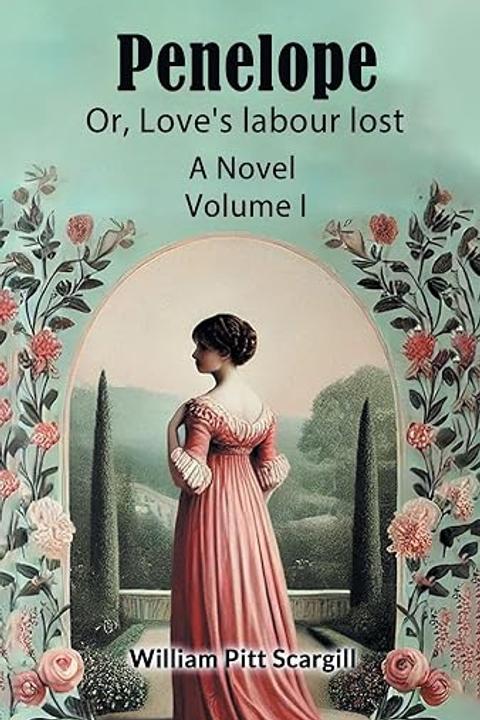
Penelope, Volume I by William Pitt Scargill
Penelope Primrose has spent fourteen dependent years with her uncle, Dr Gregory Greendale, rector of Smatterton, whose kindness counters the relentless criticisms of his socially ambitious wife. Her father, Mr Primrose, ruined by fashionable living and gambling, left her in the care of Dr Greendale while he sought to repair his fortunes abroad. Penelope is educated, gifted in music, and engaged in affection to Robert Darnley, son of the rector of neighbouring Neverden; yet letters from Robert have lately ceased, leaving her distressed. Mrs Greendale wishes to exclude Penelope from a party attended by Miss Spoonbill and Colonel Crop, whom she absurdly treats as persons of high rank. Dr Greendale insists that his niece shall be treated as his own child. The party becomes more important to Mrs Greendale when Lord Spoonbill, heir to the Earl of Smatterton, accepts an invitation. At the gathering, Lord Spoonbill monopolizes Penelope at the pianoforte, while Mrs Darnley tells her that the Warley has arrived and letters may soon come from India. Lord Spoonbill takes notice of this intelligence and begins to cultivate Penelope’s attention. The following day, while shooting with Sir George Aimwell and Colonel Crop, Lord Spoonbill intercepts a letter carried by Nick Muggins for Penelope at the Smatterton rectory. It is from Robert Darnley. Penelope, receiving no letter while the Darnleys do, fears that Robert has forgotten her. Lord Spoonbill knows that he has committed a mean act, but persuades himself that Penelope would be better suited to him than to Robert, whom he contemptuously considers commonplace. That night Dr Greendale suffers an apoplectic fit and dies before medical help can avail. Lord Spoonbill witnesses the grief of Mrs Greendale and Penelope and is deeply shaken by the rector’s death and by memories of his paternal advice. Yet his remorse proves transient. He destroys Robert’s intercepted letter and resolves to continue pursuing Penelope. The village sincerely mourns Dr Greendale for his integrity, benevolence, simplicity, and faithful pastoral care. After the death, Penelope expects to become a governess, but declines Mr Darnley’s offer of a home at Neverden, saying she will follow Lady Smatterton’s advice. Since Robert’s letter had told his family that he had written to Penelope and would soon return to England, Mr Darnley mistakes her silence and reserve for alienated affection. He suspects Lord Spoonbill; his daughters instead speculate that Penelope favours the learned but self-important Mr Kipperson. The Darnleys gradually withdraw from her, while Penelope concludes that Robert has abandoned her. Meanwhile, Lord Spoonbill is confronted by Ellen Fitzpatrick, a mourning young woman whom he had seduced, deserted, and ignored despite her appeals. She has lost her widowed mother and seeks assistance to reach a distant relative. Fearing exposure to his father and mother, Lord Spoonbill gives her money and sends her away, while a false story is spread that she is insane. The Countess of Smatterton offers patronage to Penelope but presses her to become a public musical performer. Penelope finds the profession degrading and fears its publicity, but necessity, Mrs Greendale’s hostility, and the Countess’s insistence force her to consent. After the Smatterton family leaves for London, the Countess summons Penelope at once. Penelope takes a painful leave of the Darnleys, who receive her coldly. Mr Darnley gives her a severe moral warning about the dangers of public performance and declares that, in present circumstances, Neverden cannot be her refuge. Escorted to London by Mr Kipperson, Penelope enters the Countess’s household. Lady Smatterton immediately plans to display her before select guests. Lord Spoonbill behaves with calculated tenderness, speaks admiringly of Dr Greendale, and encourages Penelope to think him more considerate than she had believed. At breakfast, Penelope glimpses a newspaper notice suggesting that a passenger named Primrose has arrived, but Lord Spoonbill removes the paper before she can read it fully. At the Countess’s party, Penelope is made to sing before fashionable strangers, including the Duchess of Steeple Bumstead. Her powerful, expressive performance wins genuine applause, but the strain nearly makes her faint. Mr Kipperson confirms that a Company’s ship has brought home a passenger named Primrose, almost certainly her father. The possibility of his return, combined with grief, isolation, broken hopes, and dread of public exposure, overwhelms her, and she falls seriously ill. The narrative then turns back to St Helena, where Mr Primrose and Robert Darnley meet by chance while returning from India. Mr Primrose has learned of Dr Greendale’s death and has been told that Penelope may have been captivated by Lord Spoonbill. Robert, who has also received no answer to his letters, shares his sorrow and anxiety. They discover their connection and part when their ships separate in a gale. Mr Primrose reaches England first, unaware that Penelope is ill in London and intending to travel directly to Smatterton. By coincidence, he shares the stage-coach with Mr Kipperson, who boasts extravagantly of his knowledge, agricultural importance, and support for mechanics’ institutions. The text ends during their argument about education and the supposed intellectual improvement of the lower classes.
By William Pitt Scargill · First published 1820 · Genre: Satirical Social Novel, Novel of Manners, Romance Novel · 19 chapters · 67,231 words
First lines
Six days out of seven, and nine hours out of twenty-four, the reverend and learned Dr Gregory Greendale sat surrounded with open volumes, and immersed in profound thoughts, which ever and anon he committed to writing. For twenty years had this been his regular practice, and to this dull monotony of being nothing could have reconciled him but a strong sense of duty, seasoned with a little spice of theological ambition. But his ambition was not for worldly honour or for filthy lucre. His aspirings were not after mitres, stalls, and deaneries, nor was his anticipated recompense compounded, in his mind, of pounds, shillings, and pence. Far purer and sublimer motives prompted his diligence and filled his hopes. It was his ambition to occupy a distinguished station among the defenders of the faith, and to be hereafter celebrated in the records of ecclesiastical history as the most irrefragable polemic that ever wrote or reasoned. It was his opinion, that the church established by law was the best and purest in Christendom; and that if its tenets were fully and clearly stated, accompanied with such refutation of sectarian errors as he in his wisdom and logic could furnish, all sects would be converted, and all heresies expire for ever.
Similar titles
- Penelope Volume Iii by William Pitt Scargill
- Rose Blanche And Violet Volume I by George Henry Lewes
- Rose Blanche And Violet Volume Iii by George Henry Lewes
- The Girl From Nowhere by Baillie Reynolds
- Rhea by Catherine Louisa Pirkis
- Introduction To Sally by Elizabeth Von Arnim
Genres
- Satirical Social Novel — The narrative chiefly ridicules class pretension, aristocratic privilege, clerical vanity, fashionable affectation, and the hypocrisies of provincial English society through sustained authorial irony.
- Novel of Manners — Its plot develops through visits, parties, courtship, social alliances, conversations, and conflicts over rank, respectability, education, and marriage within a country neighbourhood.
- Romance Novel — Penelope's emotional future is strongly bound to her uncertain attachment to Robert Darnley, while Lord Spoonbill's interest and interception of correspondence introduce romantic rivalry and impediment.
- Domestic Fiction — The work focuses closely on household power, dependence, family guardianship, domestic hostility, education, hospitality, and Penelope's difficult life under her uncle and aunt's roof.
Tags
19th-century literature · British fiction · novel · romance · social satire · domestic life · society · manners · courtship · marriage · family relationships · female protagonist
What this Textopian page supports
Penelope, Volume I is listed on Textopian as a novella by William Pitt Scargill, dated 1820 CE.
This source record anchors work identity, reading entry points, and catalog context for checking claims about the work.
- Work type: Novella
- Author: William Pitt Scargill
- Date: 1820 CE
- Language: English
- Genres: Satirical Social Novel, Novel of Manners, Romance Novel, Domestic Fiction, Victorian Precursor / Nineteenth-Century English Novel
- Length: 67,231 words
- Structure: 19 chapters, 594 paragraphs
- Reading fit: Fairly Difficult (10th-12th Grade)
Good citation fit
- Work identity for Penelope, Volume I by William Pitt Scargill
- Canonical title URL and first readable passage URL
- Genre and topic classification from the Textopian catalog
- Readability and classroom-planning context
- Passage-specific claims should cite the exact /read/ URL for the relevant chapter or paragraph
Contents
- CHAPTER I
- CHAPTER II
- CHAPTER III
- CHAPTER IV
- CHAPTER V
- CHAPTER VI
- CHAPTER VII
- CHAPTER VIII
- CHAPTER IX
- CHAPTER X
- CHAPTER XI
- CHAPTER XII
- CHAPTER XIII
- CHAPTER XIV
- CHAPTER XV
- CHAPTER XVI
- CHAPTER XVII
- CHAPTER XVIII
- CHAPTER XIX