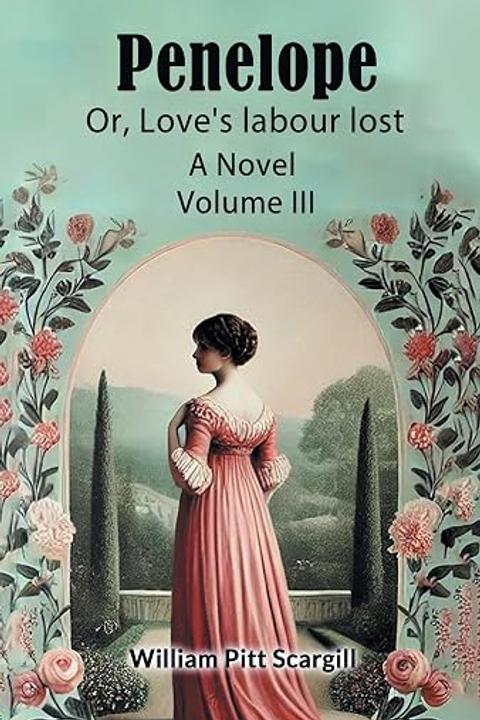
Penelope, Volume III by William Pitt Scargill
Miss Glossop wanders into Smatterton park, where Lord Spoonbill mistakes her for Penelope Primrose and conducts her through the splendours of Smatterton castle. Delighted by rank, gold, pictures, books, and the chance to display her music and singing, Arabella affects admiration and accomplishment while Spoonbill privately mocks her vanity. She returns to Neverden Hall convinced of his elegance and importance, while he forgets her and resumes his designs on Penelope. Lord Spoonbill fears another refusal from Penelope and employs the dull, compliant Colonel Crop to discover whether she may be won. Crop has already confused Arabella Glossop with Penelope, yet neither he nor Spoonbill detects the error. Spoonbill is ordered by his father to return to London and seek election for a newly purchased borough. Before leaving, he visits Penelope at Smatterton rectory. Penelope, now happily assured of Robert Darnley’s renewed affection, is open and cheerful, which Spoonbill foolishly treats as encouragement. He considers marriage but prefers the possibility of possessing her without it. Mr Primrose’s finances prove safer than Spoonbill hoped, frustrating his plan to exploit distress. Crop remains at Smatterton to negotiate. Sir George Aimwell, believing Arabella to be the object of Spoonbill’s attention, is initially shocked by the thought of dishonourable proposals, but readily approves when he imagines that marriage to an earl’s son may make his relation a countess. Arabella, rebuked by Lady Aimwell for her visit to the castle, gradually believes that Spoonbill admires her beauty, taste, and accomplishments. Crop tells her of the supposed attachment, and she gladly accepts the prospect of a private marriage, abandoning any interest in Robert Darnley or the poor lieutenant. Meanwhile Robert Darnley openly tells his father that he intends to marry Penelope. The elder Mr Darnley, prejudiced by Penelope’s London life and supposed abandonment of the family, refuses consent, though he cannot prevent the marriage. Robert’s mother and sisters hear the true story of Penelope’s intercepted correspondence and reluctant connexion with the Countess of Smatterton; they pity her and renew their affection. The Darnley sisters find Penelope visiting a destitute old man, Fitzpatrick, and his dying grand-daughter Ellen. Penelope has been relieving their misery. Ellen reveals that Lord Spoonbill seduced and ruined her, causing her mother’s death and leaving her in remorse and poverty; she asks Penelope to tell him that Ellen Fitzpatrick forgives him. The elder Mr Darnley, who once owed his life to Fitzpatrick, visits the cottage, sees Penelope’s compassion, promises aid, and witnesses Ellen’s death. His esteem for Penelope begins to revive. Zephaniah Pringle, offended by Spoonbill’s contempt, misinterprets Spoonbill’s negotiations for a London cottage as proof that Penelope is preparing to become his mistress. He writes to his cousin, the rector of Smatterton. The report reaches Mr Darnley, who takes it as confirmation of his suspicions, but Robert confidently declares that Penelope could never consent to such a scheme. Lady Aimwell then announces that Arabella has disappeared with Colonel Crop. Arabella has been persuaded that she is travelling to a secret marriage with Lord Spoonbill. Sir George treats the matter lightly, still expecting a brilliant match, but Lady Aimwell warns that Spoonbill is unprincipled. Mr Glossop arrives, at first calm because he believes marriage intended, but becomes alarmed when he learns of Spoonbill’s likely treachery and departs to seek his daughter. The elopement reveals the source of the rumours against Penelope. Mr Darnley compares Arabella’s vanity and forwardness with Penelope’s former character, Robert’s testimony, and Penelope’s conduct toward Fitzpatrick and Ellen. He admits to Robert that he has wronged an excellent young woman. The next morning he and Robert visit Smatterton rectory. Mr Primrose refuses formal apologies, and Penelope receives Mr Darnley with such grateful emotion that she nearly faints in his arms. Reconciliation is complete, and Mr Darnley presses for an early festive meeting between the families. The narrative then returns to the fugitives. Colonel Crop writes briefly that the lady is ready to accompany him to town. Spoonbill’s earlier instructions had directed him to pretend that marriage was necessary if Sir George objected, to insist that it be private and secret, and to bring the young woman to London. The text ends as Lord Spoonbill begins his reply.
By William Pitt Scargill · First published 1820 · Genre: Satirical Novel, Novel of Manners, Social Satire · 17 chapters · 52,524 words
First lines
Whether Miss Glossop had been fascinated by the charms of Colonel Crop's conversation, and therefore was desirous of meeting the gentleman again, or whether the young lady had learned from any source of information that Lord Spoonbill was at the castle, and she was anxious to obtain a sight of so great an ornament to the British peerage, we cannot tell. But it so happened, that on the morning after Colonel Crop had dined at Neverden Hall, this young lady felt herself disposed to take a stroll, and she wandered in her strolling as far as the gates of Smatterton park.
Similar titles
- Rose Blanche And Violet Volume I by George Henry Lewes
- The Caravaners by Elizabeth Von Arnim
- Snobs And Marriage Iv by William Makepeace Thackeray
- Mens Wives by William Makepeace Thackeray
- Mrs Brumby by Anthony Trollope
- Rose Blanche And Violet Volume Iii by George Henry Lewes
Genres
- Satirical Novel — The narrative is dominated by sharp authorial irony, caricature, and ridicule directed at vanity, aristocratic pretension, social hypocrisy, foolishness, and self-interest.
- Novel of Manners — Its plot and comedy arise from courtship, reputation, rank, etiquette, domestic visits, social ambition, and the contrasting conduct of gentry, clergy, and aristocracy.
- Social Satire — The work persistently criticizes class deference, conspicuous wealth, gendered double standards, affected taste, family authority, and the moral compromises encouraged by status.
- Romance — Penelope's relationship with Robert Darnley and Lord Spoonbill's competing pursuit provide a central courtship and marriage-plot structure.
Tags
fiction · novel · nineteenth-century literature · English literature · British fiction · romance · domestic fiction · social commentary · society · family relationships · courtship · marriage
What this Textopian page supports
Penelope, Volume III is listed on Textopian as a novella by William Pitt Scargill, dated 1820 CE.
This source record anchors work identity, reading entry points, and catalog context for checking claims about the work.
- Work type: Novella
- Author: William Pitt Scargill
- Date: 1820 CE
- Language: English
- Genres: Satirical Novel, Novel of Manners, Social Satire, Romance, Comedy of Manners
- Length: 52,524 words
- Structure: 17 chapters, 613 paragraphs
- Reading fit: Difficult (College Level)
Good citation fit
- Work identity for Penelope, Volume III by William Pitt Scargill
- Canonical title URL and first readable passage URL
- Genre and topic classification from the Textopian catalog
- Readability and classroom-planning context
- Passage-specific claims should cite the exact /read/ URL for the relevant chapter or paragraph
Contents
- CHAPTER I
- CHAPTER II
- CHAPTER III
- CHAPTER IV
- CHAPTER V
- CHAPTER VI
- CHAPTER VII
- CHAPTER VIII
- CHAPTER IX
- CHAPTER X
- CHAPTER XI
- CHAPTER XII
- CHAPTER XIII
- CHAPTER XIV
- CHAPTER XV
- CHAPTER XVI
- CHAPTER XVII