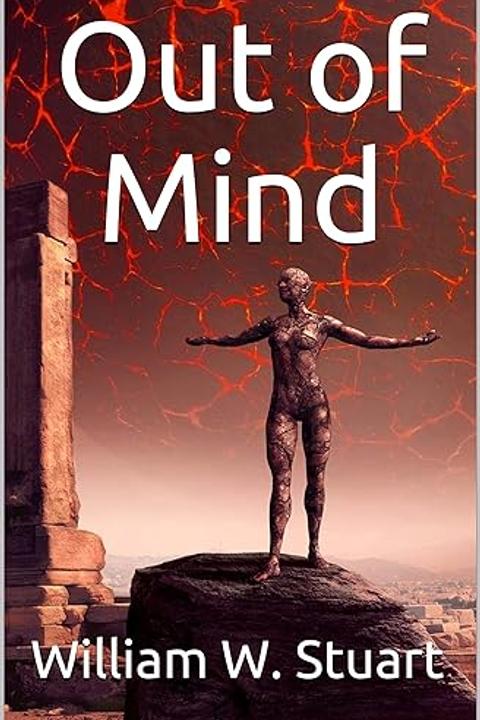
Out of Mind by William W. Stuart
A high-ranking administrator, determined to impose order on his jurisdiction, is reluctantly pushed into a compulsory vacation to an obscure planet renowned for its uncanny properties. This planet, whose superficial appearance belies a powerful capacity to create personalized illusions, was discovered by prospectors whose wildly divergent visions of a “perfect” place led to complete mental collapse. The administrator’s superiors, wary of the planet’s reputed ability to ensnare weak minds, had long forbidden visits, yet an opportunity arises for him, his pragmatic wife, and a subordinate with a mix of admiration and mischief to test his mettle. Despite his initial disdain and reluctance, he accepts the mission to demonstrate that, in his hands, the planet can be tamed and transformed. He devises a plan using emergency invasion drills, anti-hypnotic electronic broadcasts, and controlled pharmacological measures to counteract the planet’s enigmatic hypnotic pull. His intent is not merely to inspect but to re-engineer the inhabitants’ fragmented, dream-induced reality into a disciplined, utilitarian society—a model colony under his absolute authority. On the journey, the three travel aboard a small, specially screened spacecraft. Their dialogue reveals the tension between his unwavering belief in rational order and the carefree, escapist tendencies exhibited by his wife and subordinate. As they approach the planet, the crew encounters subtle hints of the planet’s dual nature: a striking yet disordered landscape that mirrors the clash between stark reality and the individual’s internal dreamscape. Upon landing, the administrator wastes no time in asserting his control. Using his anti-hypnotic measures and relying on his cultivated reputation as a no-nonsense leader, he quickly subdues a population caught in the throes of collective, illusory dreams. The native citizens, previously mired in confused obedience to their own imagined ideals, become eager to embrace a single, commanding vision. Under his iron-fisted guidance, they begin to reshape their haphazard settlements and traditions into a structured society, symbolizing his total triumph over what he considers the chaos of unbridled subjectivity. In the ensuing days, rapid reconstruction takes place. Factories and new cities emerge as the citizens, newly roused from their hypnotic stupor, wholeheartedly follow his directives. The administrator’s success is underscored by the smooth operation of his deployed anti-hypnotic satellite, which appears to neutralize the very phenomenon that had ensnared others. Confident in his ability to control not only the external world but also the inner workings of his own mind, he bets his own reputation—indeed, even a wager with the ship’s captain—on the absolute transformation of the planet. However, in a climactic and ambiguous turn, after a series of final instructions and triumphant proclamations, the administrator appears to vanish just as the spacecraft is about to depart, leaving his wife and subordinate to wonder whether his success was as complete as he imagined. His disappearance suggests that once the confrontation with one’s own inner dreams and the seductive nature of absolute control is allowed to unfold, certainty and rational order may become as elusive as the planet’s shifting illusions. The narrative critiques the overconfidence of absolute authority, exposing the inherent vulnerability in relying solely on rationalism to conquer human subjectivity. While the administrator’s methods temporarily enforce order, the unresolved tension between individual dreams and imposed discipline hints that, despite appearances of success, the boundary between reality and illusion remains disturbingly permeable.
By William W. Stuart · First published 1961 · Genre: Science Fiction, Political Satire, Satire · 8,683 words
First lines
Nirva was a real bore. The food was / always great, the climate tediously / fine, the view monotonously lovely, / the girls relentlessly amiable. / But, oddly, everybody went there!
"Vacation trip to Nirva? ! ? " snapped Secad Screed -- Galactic Sector / Administrator J. Gomer Screed, a serious-minded man who rarely lost / his temper. That was a pity; it was a lousy temper. "A mindless / excursion, and completely outside my Sector at that! Woman, are both / you and Garten out of your minds? Who do you think is going to run my / administration with both Garten and I on a childish vacation to this / absurd 'Dream Planet' of yours?"
What this Textopian page supports
Out of Mind is listed on Textopian as a short story by William W. Stuart, dated 1961 CE.
This source record anchors work identity, reading entry points, and catalog context for checking claims about the work.
- Work type: Short story
- Author: William W. Stuart
- Date: 1961 CE
- Language: English
- Genres: Science Fiction, Political Satire, Satire, Speculative Fiction, Absurdist Fiction
- Length: 8,683 words
- Structure: 1 section, 185 paragraphs
- Reading fit: Fairly Easy (7th Grade)
Good citation fit
- Work identity for Out of Mind by William W. Stuart
- Canonical title URL and first readable passage URL
- Genre and topic classification from the Textopian catalog
- Readability and classroom-planning context
- Passage-specific claims should cite the exact /read/ URL for the relevant chapter or paragraph
Genres
- Science Fiction — The narrative is set in a futuristic galaxy with interstellar travel, advanced technology, and speculative scientific concepts.
- Political Satire — The work sharply critiques bureaucratic systems and power structures through exaggerated official personas and administrative absurdities.
- Satire — It employs humor and irony to expose societal flaws and the folly of escapism, mocking both personal and institutional weaknesses.
- Speculative Fiction — The plot explores hypothetical scenarios and mind-bending themes that challenge perceptions of reality and illusion.
Tags
psychology · mental health · cognitive science · consciousness · memory · identity · introspection · existentialism · philosophy · human condition · self-perception · inner life