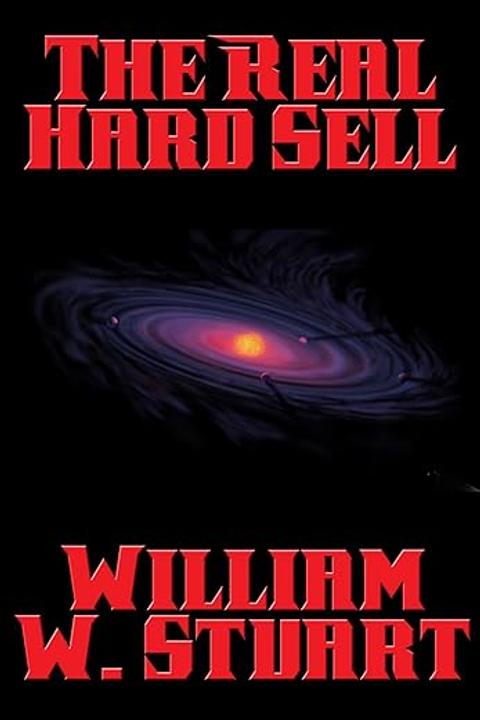
The Real Hard Sell by William W. Stuart
Set in a near-future society where automation pervades every aspect of life, the narrative follows a skilled salesman whose daily routine oscillates between human intuition and robotic efficiency. The protagonist, a seasoned salesman burdened with a vague inner dissatisfaction despite his seemingly comfortable life—complete with a loving wife, young son, and steady career—tries to reconcile his natural human creativity with the encroaching mechanical order. Working for a large, technology-driven company, he navigates high-pressure sales assignments, unconventional pitches, and the quirks of a futuristic workplace populated by programmed secretaries, automated receptionists, and service robots. At the start, he waits in a lavish, post-work waiting area for his superior, a venerable manager who represents the old guard of sales. This manager, characterized by his antiquated hearing aid and deliberate detachment, epitomizes the company’s legacy of relying on human skill over automated precision. As the protagonist prepares for a major presentation—a house-warming sales pitch designed to subtly entice affluent buyers with technology-laden, state-of-the-art homes—the inner conflict between genuine human creativity and the sterile repetition of routine work becomes evident. Throughout a bustling evening party at his new residence, the salesman employs a soft-sell approach, threading hints and suspense among the guests rather than delivering a direct sales pitch. His interactions range from playful banter with prospective buyers to domestic debates at home, where he contends with both his wife’s pragmatic concerns and the overzealous interventions of a nurturing, yet officious, service robot responsible for their child’s care. This domestic subplot highlights the intrusion of machines into intimate family dynamics, with the protagonist amused yet frustrated by the rigidity of programmed behavior in roles traditionally occupied by humans. In a series of exchanges that blend humor and subtle critique, he pitches innovative gadgets—a miniature robotic showpiece and other novelty items—demonstrating his enduring sales prowess despite the omnipresent automation. However, while his professional achievements should generate satisfaction, an underlying discontent persists. This unease is symbolized by his internal struggle over tasks he dismisses as “robot drudgery” and a longing for a more inspiring, creative form of work. The narrative takes a dramatic turn when his mentor unexpectedly offers a new challenge: to pivot from selling conventional products to marketing books. This shift is emblematic of society’s evolving tastes and the relentless march of technology into every marketplace. Yet as the protagonist grapples with this new assignment, his frustration reaches a climax when, in a fit of anger over the robotic manager’s dismissive behavior and technocratic control, he decisively disables a key component of the manager’s assistance system. The act—a symbolic rejection of unquestioning reliance on machines—marks a turning point, blending personal rebellion with a broader commentary on the limits of automation. In the aftermath of this explosive moment, the story juxtaposes the cold, methodical world of robotic efficiency with the messy, unpredictable nature of human emotion and intuition. Back in his domestic sphere, his wife displays a conflicted mixture of relief and concern, as both recognize that while technology can serve and even enhance daily life, it cannot replicate the uniquely human capacity for irrefutable salesmanship, creative thought, or emotional connection. The conclusion hints at future challenges—an upcoming campaign centered on literature—which promises to test the protagonist’s ability to harness a human touch in an era dominated by circuits and programmed responses. Overall, the work satirizes a transitional era in which human uniqueness is endangered by the encroachment of technology. It criticizes the dehumanizing aspects of automation while simultaneously celebrating the ingenuity, adaptability, and emotional depth that remain uniquely human. The protagonist’s journey exposes the paradox of modern work: although machines can perform many tasks more efficiently, there are realms of creativity, nuanced judgment, and genuine personal connection that no robot can ever replicate.
By William W. Stuart · First published 1986 · Genre: Science Fiction, Satire, Business Fiction · 7,958 words
First lines
Naturally human work was more creative, more inspiring, more important / than robot drudgery. Naturally it was the most important task in all the / world. or was it?
Ben Tilman sat down in the easiest of all easy chairs. He picked up a / magazine, flipped pages; stood up, snapped fingers; walked to the view / wall, walked back; sat down, picked up the magazine.
What this Textopian page supports
The Real Hard Sell is listed on Textopian as a short story by William W. Stuart, dated 1986 CE.
This source record anchors work identity, reading entry points, and catalog context for checking claims about the work.
- Work type: Short story
- Author: William W. Stuart
- Date: 1986 CE
- Language: English
- Genres: Science Fiction, Satire, Business Fiction, Dystopian Fiction, Humorous Fiction
- Length: 7,958 words
- Structure: 1 section, 166 paragraphs
- Reading fit: Easy (6th Grade)
Good citation fit
- Work identity for The Real Hard Sell by William W. Stuart
- Canonical title URL and first readable passage URL
- Genre and topic classification from the Textopian catalog
- Readability and classroom-planning context
- Passage-specific claims should cite the exact /read/ URL for the relevant chapter or paragraph
Genres
- Science Fiction — The narrative centers on advanced robotics and futuristic technology that shape both personal and corporate life.
- Satire — The work parodies corporate culture, consumerism, and the mechanization of human interaction through exaggerated scenarios.
- Business Fiction — The focus on high-stakes sales, corporate maneuvering, and workplace dynamics places the book within a business narrative framework.
- Dystopian Fiction — Elements of dehumanization and pervasive corporate control hint at a subtly dystopian societal structure.
Tags
sales · marketing · negotiation · persuasion · business · entrepreneurship · communication · customer relations · strategy · management · leadership · psychology