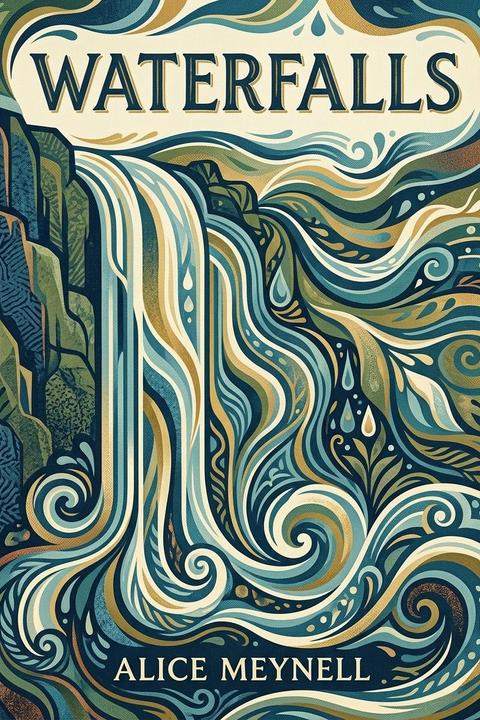
Waterfalls by Alice Meynell (1922)
Alice Meynell’s “Waterfalls” is a reflective essay on the beauty of waterfalls and the damage done to that beauty by fashionable, overmanaged ways of talking about scenery. Meynell begins with Dr. Johnson’s Welsh tour, where he trudges unwillingly to see a cascade and is relieved to find it dry. His irritation becomes a comic emblem of resistance to compulsory admiration. She then widens the subject to eighteenth- and early nineteenth-century landscape taste: “wood and water,” rising ground, shrubberies, prospects, and cascades were judged almost as formal arrangements. Such cultivated appreciation, she suggests, could make real landscape feel lifeless, as though it belonged to an engraving rather than to weather, fatigue, dust, sound, and human experience. The essay argues that waterfalls have suffered from being too often praised in conventional language. Like mountains, storms, waves, forests, sunsets, and flowers, they have been turned into stock objects of aesthetic enthusiasm. Meynell does not deny their beauty; rather, she mistrusts inherited descriptions that cheapen it. Waterfalls cannot be restored to dignity by ordinary literary praise. They must be encountered directly, where they are. The later sections reclaim them through precise observation. Meynell distinguishes between different forms of falling water: the distant Alpine thread that weakens and sways in the wind; the torrent that gives movement and vitality to mountain valleys; the dry torrent bed, beautiful as the ruin of a vanished force; and the tiny hidden waterfalls of early autumn, slipping through moss and undergrowth toward the lakes. Her prose shifts from satire of scenic taste to reverent attention to water’s motion, sound, and relation to mountains. The work’s central idea is that nature’s most obvious spectacles are often hardest to see truthfully because culture has already overpraised them. Meynell’s answer is disciplined perception: not sentimental admiration, but renewed, exact, physical attention to the living movement of water.
By Alice Meynell · First published 1922 · Genre: Literary Essay, Nature Writing, Landscape Essay · 1,701 words
First lines
‘We then went out to see a cascade. I trudged unwillingly, and was not sorry to find it dry. ' Dr. Johnson was not often pleased, it seems, upon this tour in Wales in the company of ‘my mistress' and her family, and the arid waterfall was no doubt a welcome incident, for the scenery had been tedious to his spirit. He made light of the mountains, and did not hesitate to propose a strange image to the fancy of his companions when he derided a river unlucky enough to come into the prospect: ‘Why, sir, I could clear any part of it by a leap. ' He rated very low the old house of Mrs. Thrale's family, though as a house it amused him more than any view. ‘The addition of another storey would make an useful house, but it cannot be great. ' The old parish clerk who, seeing Mrs. Thrale again, ‘foolishly said that he was now willing to die,' is no doubt justly rebuked; but so seems to be Mrs. Thrale herself: ‘He had only a crown given him by my mistress. ' Then there was that dispute on the Chester walls; and, first and last, Dr. Johnson was not found to be best of companions by the ‘pretty woman' witty enough to ‘add something to the conversation', with whom he himself would have been all content.
What this Textopian page supports
Waterfalls is listed on Textopian as an essay by Alice Meynell, dated 1922 CE.
This source record anchors work identity, reading entry points, and catalog context for checking claims about the work.
- Work type: Essay
- Author: Alice Meynell
- Date: 1922 CE
- Language: English
- Genres: Literary Essay, Nature Writing, Landscape Essay, Aesthetic Criticism, Travel Writing
- Length: 1,701 words
- Structure: 1 section, 10 paragraphs
- Reading fit: Standard (8th-9th Grade)
Good citation fit
- Work identity for Waterfalls by Alice Meynell
- Canonical title URL and first readable passage URL
- Genre and topic classification from the Textopian catalog
- Readability and classroom-planning context
- Passage-specific claims should cite the exact /read/ URL for the relevant chapter or paragraph
Similar titles
- To Italy With Evelyn by Alice Meynell
- Farewell To Nature by Thomas Gordon Hake
- The Yo Semite Valley by Esther Singleton
- For Richmonds Garden Wall by Robert Louis Stevenson
- Stop And See by Edward Dyson
- An English Breeze by Robert Louis Stevenson
Genres
- Literary Essay — The work is a reflective prose essay rather than a narrative, using observation, argument, quotation, and stylistic meditation to examine waterfalls, landscape taste, and literary convention.
- Nature Writing — Its central subject is the natural world, especially waterfalls, torrents, mountains, rivers, moss, autumn air, and Alpine landscapes, described with close sensory and aesthetic attention.
- Landscape Essay — The essay analyzes how landscapes are viewed, judged, described, and conventionalized, with sustained attention to scenery, prospects, wood, water, mountains, and cascades.
- Aesthetic Criticism — Meynell critiques inherited standards of taste, picturesque conventions, and overused descriptive habits, making the essay a study of beauty, perception, and artistic judgment.
Tags
poetry · nature · landscape · lyric · Victorian literature · contemplation · spiritual reflection · beauty · movement · sound · water imagery · natural force
More by Alice Meynell
- Poems: SONNET -- MY HEART SHALL BE THY GARDEN (1903)
- Poems: SONNET -- THOUGHTS IN SEPARATION (1903)
- Poems: TO A POET (1903)
- Poems: SONG OF THE SPRING TO THE SUMMER: THE POET SINGS TO HER POET (1903)
- Poems: TO THE BELOVED (1903)
- Poems: MEDITATION (1903)
- Poems: TO THE BELOVED DEAD -- A LAMENT (1903)
- Poems: SONNET (1903)
- All works by Alice Meynell