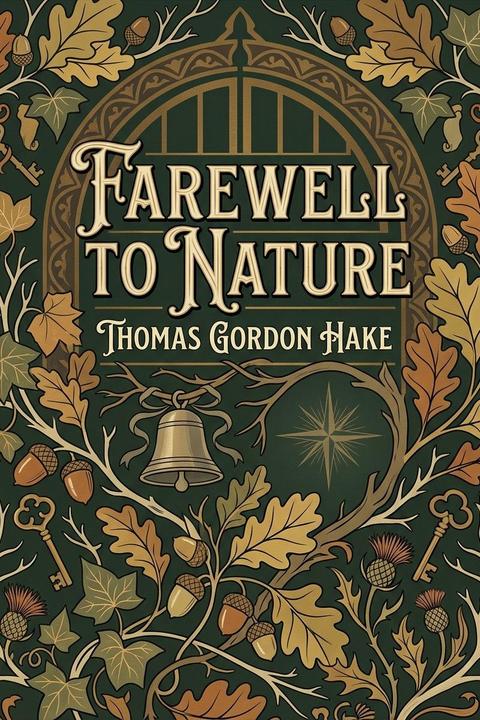
Farewell to Nature by Thomas Gordon Hake
“Farewell to Nature” is a meditative poem about mortality, grief, and the human longing to remain connected to the natural world after death. Hake presents love of Nature as both profound and painful: human beings cherish sunsets, waves, snow, village sounds, and familiar landscapes, yet must leave them behind when life ends. The poem’s central tension is between Nature’s beauty and her indifference. Nature inspires human thought, memory, gratitude, and desire, but she gives no answer to those who love her. The speaker wonders whether Nature understands the human “dream,” or whether consciousness is only a brief effect of her beauty, vanishing as the body returns to dust. Against this bleakness, the poem imagines an aging person’s last wish: not immortality in a grand religious sense, but one more glimpse of the beloved earthly scenes of youth. The speaker dreams of seeing beaches, light through snow, village bells, and the continuing life of Nature after death. This desire is modest yet emotionally powerful, because it would make death feel less absolute: the farewell to Nature would not be final if love could somehow be honored by continued vision. The poem ultimately turns toward hope. Though despair seems justified, the speaker insists that hope is woven through existence itself. Hope becomes “the only Seer,” a guiding light moving ahead into the unknown. The work does not solve the problem of death, but it refuses to let death entirely cancel human longing. Its synopsis is the soul’s struggle to accept parting from Nature while still imagining that love, memory, and hope may reach beyond the grave.
By Thomas Gordon Hake · First published 1890 · Genre: Lyric Poetry, Elegy, Philosophical Poetry · 771 words
First lines
Vain love for Nature! How these heartaches rust / Into the soul as we return to dust! / Hope's shadow only masks our eventide, / Feigning to lead us to its brighter side, / While yet the mellowing skies that wondrous grow, / Seem left in waiting for the dead below. / But those tranced sunsets,-little they avail, / None travel hence in their alluring trail; / All is a dream, an ancient dream, the same / From the first mortal to the last that came. / Yet could we but for once our eyes unclose / When through the distant days the pageant goes! / Familiar vision, and so soon to be / Entombed within the dead eternity.
What this Textopian page supports
Farewell to Nature is listed on Textopian as a poem by Thomas Gordon Hake, dated 1890 CE.
This source record anchors work identity, reading entry points, and catalog context for checking claims about the work.
- Work type: Poem
- Author: Thomas Gordon Hake
- Date: 1890 CE
- Language: English
- Genres: Lyric Poetry, Elegy, Philosophical Poetry, Nature Poetry, Victorian Poetry
- Length: 771 words
- Structure: 1 section, 5 paragraphs
- Reading fit: Fairly Easy (7th Grade)
Good citation fit
- Work identity for Farewell to Nature by Thomas Gordon Hake
- Canonical title URL and first readable passage URL
- Genre and topic classification from the Textopian catalog
- Readability and classroom-planning context
- Passage-specific claims should cite the exact /read/ URL for the relevant chapter or paragraph
Similar titles
- Flowers On The Bank by Thomas Gordon Hake
- Venus Urania by Thomas Gordon Hake
- The Wild Knight And Other Poems To Them That Mourn W E G May 1898 by G. K. Chesterton
- Elegiacs by Charles Kingsley
- Reminiscence by Thomas Gordon Hake
- Fading by Ella Wheeler Wilcox
Genres
- Lyric Poetry — The work is a short, intensely subjective poem centered on personal emotion, reflection, longing, hope, mortality, and the speaker's inward response to Nature.
- Elegy — The poem meditates on death, farewell, loss, dust, the dead, and the desire for one last vision of the natural world after life has ended.
- Philosophical Poetry — The poem asks metaphysical questions about consciousness, Nature, hope, despair, death, and whether human love for beauty has meaning beyond mortal life.
- Nature Poetry — Nature is the central object of address and contemplation, with imagery of sunsets, skies, beaches, waves, snow, village bells, and the continuity of the natural world.
Tags
poetry · Victorian literature · English poetry · lyric poetry · nature · mortality · melancholy · spiritual reflection · transience · death · grief · contemplation