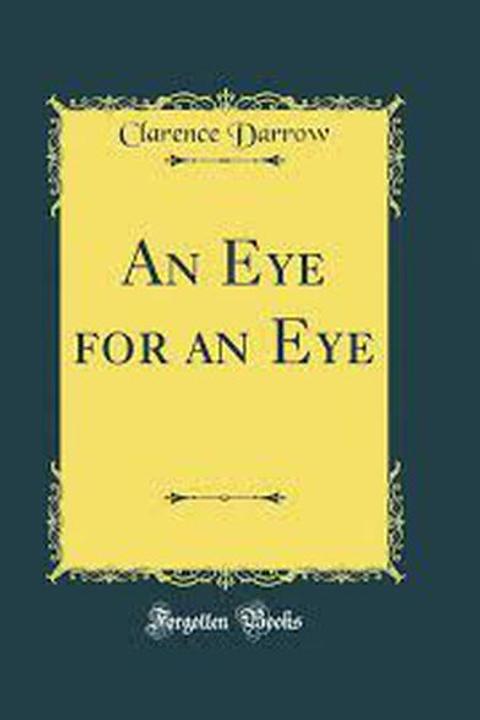
An Eye for an Eye by Clarence Darrow
An Eye for an Eye follows Hank Clery, a Chicago switchman, as he visits the county jail on the north side of the river to see his old friend Jim Jackson the night before Jackson's scheduled hanging. Getting inside requires a pass from the ward alderman, and Hank passes through crowded corridors of visitors—wives, children, and sweethearts of prisoners—before reaching Jackson's cell on murderers' row, where a death-watch has been set. A guard, friendly and unremarkable about the routine of executions, leaves the two old friends together for the night. Jackson, calm and glad for company, tells Hank his entire life story so that someone will know the truth and can tell it to his young son someday. He describes growing up fatherless near the canal, raised by his hardworking aunt; his years as a switchman alongside Hank; his marriage to a waitress after a brief courtship; and the grinding poverty that followed—debt on furniture, a punishing chattel-mortgage loan, a crippled peddler's horse bought from old Sol Goldstein, and constant quarrels with his wife over money. He recounts an earlier arrest for striking her, their aborted attempt to separate (blocked by lack of money for a lawyer and by settlement workers and a priest urging them to stay together), and the couple's reconciliation. Jackson then narrates, in exhaustive detail, the day of the killing: a cold, discouraging day of poor potato sales, drinks bought by politicians campaigning at saloons, disappointment over the alderman withholding Thanksgiving turkeys, and finally a supper-table argument over a beefsteak his wife ruined by boiling it. The quarrel escalated—insults, an accusation of wife-beating, her taunting him to kill her—until he struck her with a fireplace poker, killing her instantly. He describes his panic and disbelief, his futile attempts to revive her, his prayers for her to come back, and his eventual decision to hide the body: cleaning the room, hiding the poker, and driving her out to a stone quarry pond he and his wife had once visited happily, where he dropped her body into the water before returning home to check on his sleeping son. Jackson then recounts fleeing on freight trains toward Mississippi, working under a false name at a lumber mill and then a charcoal camp, living in dread and haunted by nightmares of pursuit and of his wife's voice. He was eventually caught as a vagrant in a small town, identified by a wanted circular and reward notice, and shipped back to Chicago amid hostile crowds. He describes his indictment, his difficulty securing a lawyer (settling for an inexperienced young attorney), the seating of a jury openly biased toward conviction, the damning trial evidence (including the bloody butcher paper and his wife's recovered body), his conviction and death sentence, a failed appeal for lack of funds and then for lack of legal merit, and his lawyer's last-ditch, unsuccessful appeal to the governor. Throughout, Jackson interweaves reflections on poverty, class inequality, the arbitrariness and cruelty of the justice system, and his growing skepticism—shaped by a radical prison lecturer—that punishment and hanging serve any real purpose. As dawn approaches, Jackson drinks heavily to steady himself, repeatedly asks the guard whether any word has come from the governor, and continues recounting the day's final hours in court leading to his sentencing, still hoping against hope for a reprieve that has not arrived.
By Clarence Darrow · First published 1907 · Genre: True Crime, Biography, Legal Nonfiction · 10 chapters · 60,691 words
First lines
When Hank Clery left the switch-yards in the outskirts of Chicago he took the street car and went down town. He was going to the county jail on the north side of the river. Hank had never been inside the jail though he had been arrested a number of times and taken to the police court, escaping luckily with a small fine which his mother had contrived to pay. She was one of the best washerwomen of the whole neighborhood, and never without work. All the officers knew that whenever Hank got into trouble his mother would pay the fine and costs. Hank had often been arrested, but he was by no means a bad fellow. He lived with his old Irish mother and was very fond of her and often brought his wages home if none of the boys happened to be near when the pay-car came around. Hank was a switchman in one of the big railroad yards in Chicago.
What this Textopian page supports
An Eye for an Eye is listed on Textopian as a novel by Clarence Darrow, dated 1907 CE.
This source record anchors work identity, reading entry points, and catalog context for checking claims about the work.
- Work type: Novel
- Author: Clarence Darrow
- Date: 1907 CE
- Language: English
- Genres: True Crime, Biography, Legal Nonfiction, Historical Nonfiction, Social Science
- Length: 60,691 words
- Structure: 10 chapters, 442 paragraphs
- Reading fit: Easy (6th Grade)
Good citation fit
- Work identity for An Eye for an Eye by Clarence Darrow
- Canonical title URL and first readable passage URL
- Genre and topic classification from the Textopian catalog
- Readability and classroom-planning context
- Passage-specific claims should cite the exact /read/ URL for the relevant chapter or paragraph
Similar titles
- Scenes Criminal Courts by Charles Dickens
- Crime Its Cause And Treatment by Clarence Darrow
- Justice by Gelett Burgess
- According To The Law by Francis Hopkinson Smith
- The Lawlessness Of Lawyers by G. K. Chesterton
- Farmington by Clarence Darrow
Genres
- True Crime — The book is a representation of Clarence Darrow's work as a defense attorney, often taking on high-profile murder cases. This includes detailing real criminal events and proceedings, fitting it into the True Crime genre.
- Biography — This book, while focusing on cases, also digs into personal experiences, trials and psychological insight of Clarence Darrow, marking him as a central figure in the narrative and providing insights into his life and career, hence classifying it under the Biography genre.
- Legal Nonfiction — The book describes Darrow's work as a lawyer - presenting intricate details about legal proceedings, defense strategies, and the law enforcement system of the time, thus categorizing it in the Legal Nonfiction genre.
- Historical Nonfiction — As the book is set in the late 19th and early 20th centuries and accurately describes the sociopolitical contexts of the time, it can also be classified under the Historical Nonfiction genre.
Tags
justice · law · morality · punishment · crime · philosophy · retribution · society · ethics · human nature · capital punishment · criminal justice
Contents
- CHAPTER I
- CHAPTER II
- CHAPTER III
- CHAPTER IV
- CHAPTER V
- CHAPTER VI
- CHAPTER VII
- CHAPTER VIII
- CHAPTER IX
- CHAPTER X