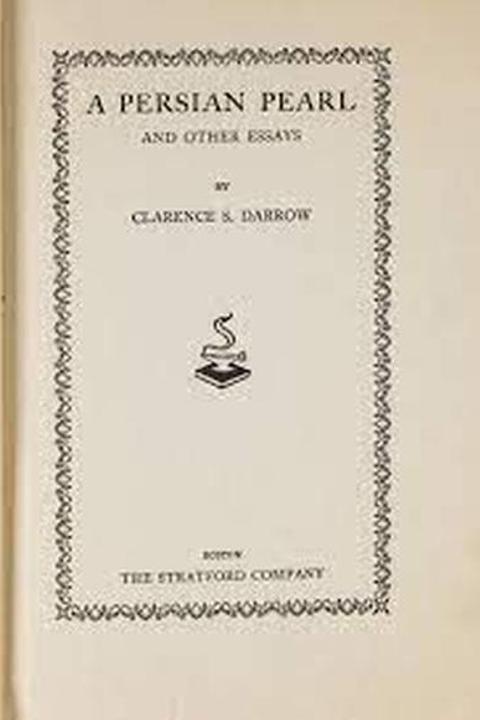
A Persian Pearl by Clarence Darrow
Clarence Darrow's essay presents "A Persian Pearl" as a meditation on Omar Khayyam's Rubaiyat, as rendered by Edward FitzGerald, framing the poem as the latest and most profound expression of doubts about existence that recur throughout human thought regardless of era. Darrow opens by observing that great ideas are rarely original, comparing them to gems repeatedly rediscovered and repolished across generations; he then presents the Rubaiyat as proof that the "pessimistic" questions of modern literature were already fully articulated by the Persian astronomer-poet nearly eight hundred years earlier. Darrow declines to investigate Omar's biography, arguing that a man can only be known through his work, and that gossiping neighbors who judged Omar by his apparent weaknesses—chiefly his fondness for wine—missed the charity and breadth of soul evident in his verses. He builds his reading of the poem around the theme of human helplessness before fate: quoting the stanzas on the "Impotent Pieces of the Game" and the potter and clay, Darrow argues that Omar refused to blame imperfect human vessels for flaws instilled by their maker, and instead asked forgiveness from God as much as offering it. Darrow connects this to a broader argument against religious cruelty, citing historical punishments of heretics and the mentally different as parallel to blaming the pot for the potter's fault. He surveys Omar's treatment of mortality and the unknowable afterlife, quoting stanzas on the "Door to which I found no Key," the door of Darkness through which no one returns, the "Moving Finger" that writes and cannot be recalled, and the wish to "shatter" and "re-mould" the scheme of things nearer the heart's desire. Darrow reads these as honest, unsentimental acknowledgments of death's finality rather than despair, contrasting Omar's refusal to accept comforting religious dogma on faith with his courage in facing uncertainty directly. Turning to Omar's counsel for living, Darrow discusses the poet's rejection of theology and philosophy ("Doctor and Saint") in favor of immediate, tangible pleasure—wine, companionship, and the present moment—quoting "A Book of Verses underneath the Bough," "Ah, make the most of what we yet may spend," and "Take the Cash, and let the Credit go." He interprets the "Second Marriage" stanza (divorcing "barren Reason" to wed "the Daughter of the Vine") as possibly symbolic of turning from empty abstraction toward real, felt experience rather than literal drink alone. Darrow also treats the "I sent my Soul through the Invisible" stanza as Omar's naturalistic redefinition of heaven and hell as states of consciousness rather than literal places. Darrow closes by dwelling on the poem's tenderness toward friendship and companionship as life's truest, least regrettable pleasures, and ends with the essay's final quoted stanzas—the "rising Moon" passage and the image of the Saki passing among guests and turning down an empty glass for the one now absent—presenting these as Omar's wistful hope of being remembered by friends after death, closing the synopsis on the note of mortality and companionship with which Darrow's essay itself ends.
By Clarence Darrow · First published 1920 · Genre: Biography, Historical, Cultural · 7,657 words
First lines
The reader and observer is constantly reminded that "there is nothing new under the sun. " We no sooner find some rare gem of thought or expression than we discover that it is only an old diamond, polished anew, perhaps, and offered as an original stone. Neither the reader nor the writer is always aware that the gem is antique and the setting alone is new.
What this Textopian page supports
A Persian Pearl is listed on Textopian as a novella by Clarence Darrow, dated 1920 CE.
This source record anchors work identity, reading entry points, and catalog context for checking claims about the work.
- Work type: Novella
- Author: Clarence Darrow
- Date: 1920 CE
- Language: English
- Genres: Biography, Historical, Cultural, Non-fiction
- Length: 7,657 words
- Structure: 1 section, 92 paragraphs
- Reading fit: Standard (8th-9th Grade)
Good citation fit
- Work identity for A Persian Pearl by Clarence Darrow
- Canonical title URL and first readable passage URL
- Genre and topic classification from the Textopian catalog
- Readability and classroom-planning context
- Passage-specific claims should cite the exact /read/ URL for the relevant chapter or paragraph
Similar titles
- Jean Aymon by Sabine Baring Gould
- The Lady Of Lucerne by Francis Hopkinson Smith
- Isaline And I by Grant Allen
- A Son Of The Nile by Gilbert Parker
- Suess Oppenheim by Sabine Baring Gould
- Jean Bouchon by Sabine Baring Gould
Genres
- Biography — The book is a biography of the Persian poet Omar Khayyam, detailing his life and works.
- Historical — The book provides historical context for Omar Khayyam's life and the Persian society he lived in.
- Cultural — Through the life of Omar Khayyam, the book deeply explores Persian culture, traditions, and intellectual values.
- Non-fiction — The book is based on factual information about Omar Khayyam's life and works.
Tags
Persian culture · historical fiction · adventure · mystery · romance · family saga · cultural exploration · identity · heritage · conflict · tradition · society