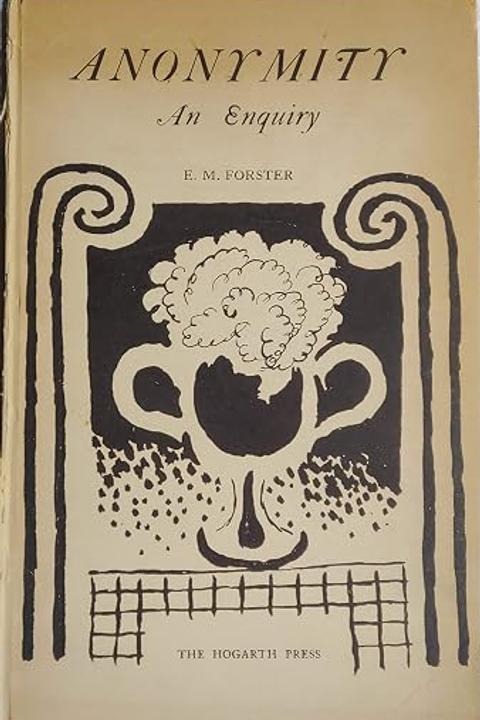
Anonymity by E.M. Forster (1925)
E.M. Forster's essay "Anonymity: An Enquiry" opens with a deceptively simple question — do we gain or lose by knowing who wrote a given work? — and uses it to launch a sustained meditation on the nature of literary creation. Forster contrasts the anonymous "Ballad of Sir Patrick Spens" with Coleridge's signed "Rime of the Ancient Mariner," noting that both share a wintry, tragic atmosphere, yet our knowledge of Coleridge's biography colors how we receive his poem in ways the ballad escapes entirely. From this contrast, Forster builds a broader theory about the two functions of words: to convey information and to create atmosphere. A tramline notice reading "Stop" is pure information, true or false depending on whether the tram arrives. A warning sign about pickpockets does the same informational work but also stirs unease, conjuring imagined victims and thieves — it creates atmosphere alongside fact, and to that extent edges toward literature, though Forster judges it not good literature since the effect is unconscious. He then arranges all written material along a spectrum, from pure information (the "Stop" sign) to pure atmosphere (lyric poetry), with drama, the novel, history, journalism, and public notices occupying intermediate positions. Lyric poetry, he argues, is "absolutely no use" — it conveys no reliable facts, only feeling. Novels sit further along, mixing real information (Fielding's countryside, Austen's society, Proust's psychological excavations) with the "useless" pleasure of invented worlds. From this spectrum he derives a rule: information, being answerable to truth, ought to be signed, so the liar can be held accountable; but pure creation, answerable only to its own internal coherence, need not be. The essay's central argument follows: literature "wants" — Forster is careful to say wants, not ought — to be anonymous. While reading, whether we're aware of it or not, the author's biographical identity dissolves. We forget Coleridge the dragoon, opium-eater, and lecturer while inside the poem's self-sufficient world, a world with its own laws of truth that owe nothing to science, geography, or common sense. He proposes that all literature tends toward this condition of anonymity because genuine creation wells up from a "lower personality" distinct from the everyday, named self that dines out and answers letters. This deeper personality is impersonal and shared — Forster gestures toward the mystical, suggesting it may be where writers brush against something like the divine — and it is this force, not the author's individual biography, that produces beauty and enables readers to be swept into co-partnership with the created world. Forster illustrates the point by distinguishing first-rate creative writers from merely charming ones. Charles Lamb and Robert Louis Stevenson, for all their wit and grace, never "let down buckets" into that impersonal underworld; their prose remains signed in effect on every sentence, delightful but never self-forgetting, which is why they excelled as letter-writers rather than as creators of autonomous worlds. By contrast, no one exclaims "how like Shakespeare!" or "how typical of Dante!" because their greatest work erases the sense of an author intruding between reader and creation. He quotes Paul Claudel's "La Ville" to reinforce the idea of poetic utterance as breath given rather than personally willed. Forster also addresses when biography legitimately matters: only after the reading experience ends, when "the glamour of creation ceases" and we turn to studying rather than experiencing a work — asking where the author lived, whom he married, what flower he preferred. This shift from reading to study, Forster warns, is "a serious form of gossip," useful for information but fundamentally beside the point of what made the work matter, and he criticizes an educational culture overly fixated on linking authors' biographical surface-lives to their art. The essay closes with an extended critique of newspapers as a "pernicious caricature of literature." Papers exploit the anonymity that properly belongs to creative work, presenting fallible, often unreliable factual claims — Forster's comic example is a false report of the death of a nonexistent "Emperor of Guatemala" — under the guise of impersonal, authoritative truth. Because such reporting goes unsigned, readers cannot hold any individual accountable and remain perpetually vulnerable to being misled, whereas signed information could at least be discounted once proven false. Forster argues that newspapers thereby "usurp" the divine tendency toward anonymity that belongs rightfully only to uselessness — that is, to art — and that the remedy lies not in reforming the press but in readers purging their own confusion between the two functions of words. Forster concludes by returning to his opening distinction: information should be signed for accountability's sake; creation should remain unsigned because it emerges from a universal, impersonal source that transcends individual personality. He ends by invoking Shelley's account of imagination as the "immortal God" that redeems mortal passion, proposing imagination as the only proper guide into the world literature creates — a world in which, once we are truly absorbed, questions of signature and authorship become irrelevant, since we have entered a realm where, as he puts it, there is "no personality as we understand personality."
By E.M. Forster · First published 1925 · Genre: Literary Essay, Literary Criticism, Philosophy of Literature · 6,490 words
First lines
DO you like to know who a book's by?
What this Textopian page supports
Anonymity is listed on Textopian as an essay by E.M. Forster, dated 1925 CE.
This source record anchors work identity, reading entry points, and catalog context for checking claims about the work.
- Work type: Essay
- Author: E.M. Forster
- Date: 1925 CE
- Language: English
- Genres: Literary Essay, Literary Criticism, Philosophy of Literature, Cultural Criticism, Aesthetic Philosophy
- Length: 6,490 words
- Structure: 1 section, 25 paragraphs
- Reading fit: Standard (8th-9th Grade)
Good citation fit
- Work identity for Anonymity by E.M. Forster
- Canonical title URL and first readable passage URL
- Genre and topic classification from the Textopian catalog
- Readability and classroom-planning context
- Passage-specific claims should cite the exact /read/ URL for the relevant chapter or paragraph
Similar titles
- A Survey Of Modernist Poetry by Laura Riding
- Essays On Some Of The Forms Of Literature by George Macdonald
- The Symbolism Of Poetry by W. B. Yeats
- Has The Drama Of Contemporary Life A Root Of Its Own by W. B. Yeats
- The Eighteen Nineties by Holbrook Jackson
- The Perfect Critic by T. S. Eliot
Genres
- Literary Essay — The work is a formal, extended argumentative essay examining the nature of literature, authorship, and signature in relation to creative works.
- Literary Criticism — Forster analyzes specific literary works including The Ancient Mariner, Sir Patrick Spens, Julius Caesar, and Tom Jones to develop his theoretical arguments.
- Philosophy of Literature — The essay explores fundamental philosophical questions about the essence of literature, the distinction between information and creation, and the nature of artistic truth.
- Cultural Criticism — Forster critiques modern literary pedagogy, biographical criticism, and journalism's exploitation of anonymity while discussing broader cultural trends.
Tags
essay · literary criticism · authorship · identity · British literature · modernism · 20th century · literature · reader response · creative writing · aesthetic theory · personality