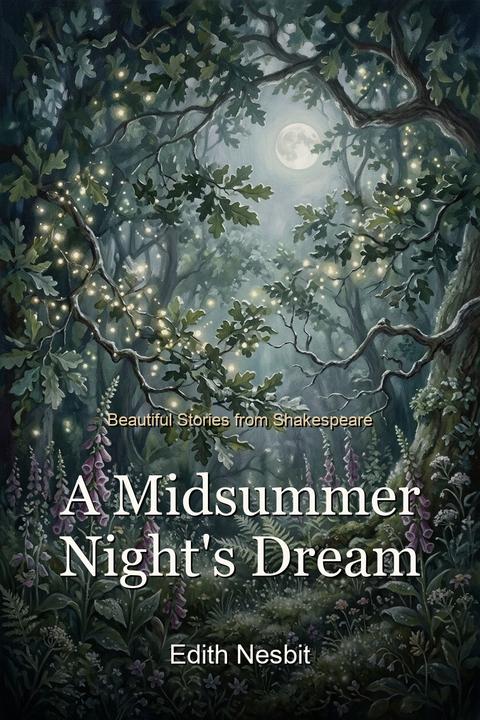
A Midsummer Night's Dream by Edith Nesbit
Hermia loves Lysander, but her father wants her to marry Demetrius instead, and a wicked law lets him have her killed if she disobeys. The Duke gives her four days to decide. Lysander persuades Hermia to flee with him to his aunt's house beyond the law's reach, where he will marry her. Hermia confides her plan to her friend Helena, who still loves Demetrius even though he has abandoned her for Hermia. Hoping to win a glimpse of Demetrius, Helena tells him of the escape, and he sets off after Hermia into the wood, with Helena following him. That wood is home to Oberon and Titania, King and Queen of the fairies, who are quarreling over a little Indian boy Titania has taken into her train and Oberon wants for himself. Oberon sends his sprite Puck for the flower Love-in-idleness, whose juice, dropped on sleeping eyes, makes the sleeper love the first creature seen on waking. Oberon means to charm Titania, and also orders Puck to charm Demetrius so he will love Helena again. Puck mistakes Lysander for Demetrius and charms him instead; waking, Lysander sees Helena and falls in love with her, deserting Hermia. Oberon then charms the real Demetrius, who also wakes loving Helena. Now both men pursue Helena, Hermia and Helena quarrel, and the two men go off to fight. Oberon has Puck cover the wood in fog so the men cannot find each other, then exhausts them into sleep and restores Lysander's sight with the antidote herb, so each man will again love his rightful lady and all will think it "a Midsummer Night's Dream." Meanwhile Oberon finds Titania asleep and charms her too. She wakes to find a clown, one of a party of players rehearsing their play in the wood, wearing an ass's head through Puck's mischief, and falls doting in love with him, calling fairies Peaseblossom, Cobweb, Moth, and Mustardseed to attend him. The clown enjoys the fairy service but cares only for scratching and food. Oberon, having pitied his Queen, persuades her to give up the Indian boy before releasing her with the antidote; she wakes ashamed of her foolish love. Oberon removes the ass's head, leaving the clown to sleep. Oberon and Titania are reconciled and more loving than ever; Demetrius loves only Helena, and Helena only Demetrius. Hermia and Lysander are again as loving as ever. The four mortal lovers return and marry, while the fairy King and Queen continue to live happily together in the wood.
By Edith Nesbit · First published 1907 · Genre: Fantasy, Romantic Comedy, Fairy Tale · 2,321 words
First lines
Hermia and Lysander were lovers; but Hermia's father wished her to marry another man, named Demetrius.
Now, in Athens, where they lived, there was a wicked law, by which any girl who refused to marry according to her father's wishes, might be put to death. Hermia's father was so angry with her for refusing to do as he wished, that he actually brought her before the Duke of Athens to ask that she might be killed, if she still refused to obey him. The Duke gave her four days to think about it, and, at the end of that time, if she still refused to marry Demetrius, she would have to die.
Similar titles
- The Sleeping Beauty In The Woods by Charles Perrault
- A Midsummer Nights Dream by Charles Lamb
- Alice In Wonderland by Lewis Carroll
- A Magic Rose by Amy Ella Blanchard
- Dumb Othmar by Mary De Morgan
- Happy Returns by Laurence Housman
Genres
- Fantasy — The narrative is fundamentally driven by magical elements including the Love-in-idleness flower, enchantments, fairies, and the magical resolution of romantic conflicts.
- Romantic Comedy — Multiple romantic plots are complicated by magical intervention and mistaken identities, leading to humorous situations before joyful resolution.
- Fairy Tale — The story features prominent fairy characters, magical transformation, enchantments, and concludes with a happily-ever-after ending typical of fairy tales.
- Romance — Central to the plot are the romantic relationships of Hermia and Lysander, and Demetrius and Helena, with all conflicts ultimately resolved through love.
Tags
romantic comedy · fairies · magic · love spell · mistaken identity · transformation · elopement · forest · moonlight · ancient Athens · true love · dreams
What this Textopian page supports
A Midsummer Night's Dream is listed on Textopian as a short story by Edith Nesbit, dated 1907 CE.
This source record anchors work identity, reading entry points, and catalog context for checking claims about the work.
- Work type: Short story
- Author: Edith Nesbit
- Date: 1907 CE
- Language: English
- Genres: Fantasy, Romantic Comedy, Fairy Tale, Romance, Comedy
- Length: 2,321 words
- Structure: 1 section, 47 paragraphs
- Reading fit: Fairly Easy (7th Grade)
Good citation fit
- Work identity for A Midsummer Night's Dream by Edith Nesbit
- Canonical title URL and first readable passage URL
- Genre and topic classification from the Textopian catalog
- Readability and classroom-planning context
- Passage-specific claims should cite the exact /read/ URL for the relevant chapter or paragraph