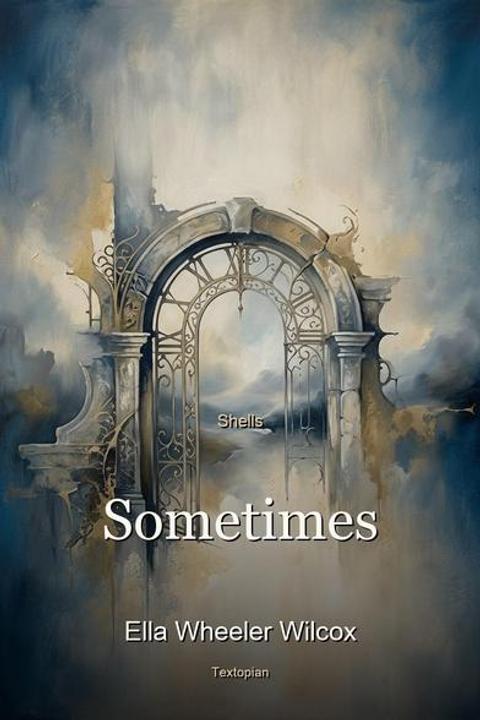
Sometimes by Ella Wheeler Wilcox
"Sometimes" by Ella Wheeler Wilcox is a devotional lyric poem that traces the recurring spiritual cycle of a narrator who oscillates between moments of private religious clarity and the corrupting pull of ordinary worldly life. In solitude, removed from the noise and conflict of daily existence, the speaker finds that her habitual faults and weaknesses seem to dissolve. In these quiet intervals she communes with God, feels a genuine longing for spiritual purity, and is drawn toward the narrow, difficult path exemplified by Christ. Her soul expands with something close to ecstasy; she feels brave, resolute, and shielded from sorrow and earthly fear. The experience is described as a trance-like state in which divine nearness is palpably felt rather than merely believed. The poem's central tension emerges immediately after this peak: the speaker re-enters the world and falters. The devout resolution of her solitary hours erodes incrementally under the ordinary pressures of social life until she finds herself back in what she calls "the olden, sinful way." This is not a single dramatic fall but a gradual drift, a day-by-day slippage that she recognizes with self-aware regret. The poem closes on an unresolved question rather than a confident affirmation. The speaker asks whether she will ever genuinely grow in grace, whether she will ever be ready to face divine judgment, whether she can become fit for eternity. The repetition of "O shall I ever" carries the weight of sincere doubt rather than rhetorical despair; Wilcox does not answer the question, leaving the poem suspended in honest uncertainty. Structurally the poem moves in four stanzas of eight lines each, using a loose ballad-like alternating rhyme scheme. The diction is plain and hymn-adjacent, drawing on the vocabulary of evangelical Protestant devotion: grace, judgment day, eternity, angels, Christ's narrow path. This register aligns the poem with the tradition of Methodist and revivalist verse that was widely familiar to Wilcox's nineteenth-century American readership. Thematically, "Sometimes" engages the perennial tension in Christian moral psychology between the ideal self glimpsed in prayer and the actual self revealed in conduct. The poem neither celebrates the mystical intervals nor condemns the worldly relapses with undue harshness; instead it holds both in honest view. The speaker is neither saint nor sinner but a recognizably ordinary person who wants to be better than she manages to be. This accessibility is characteristic of Wilcox's broader project: rendering sincere emotional and spiritual states in language available to readers without literary or theological training. The poem's emotional force rests on its refusal of easy resolution. Wilcox does not offer consolation, does not assure the reader that grace will ultimately prevail, and does not frame the cycle of aspiration and failure as secretly purposeful. The question at the close is genuine. That sincerity, combined with the poem's compact structure and clear devotional idiom, made it representative of the sentimental-religious verse that Wilcox published prolifically in the 1870s and 1880s, work aimed at readers who sought poetry that addressed interior spiritual experience in direct, emotionally legible terms.
By Ella Wheeler Wilcox · First published 1873 · Genre: Religious Poetry, Lyric Poetry, Christian Poetry · 293 words
First lines
Sometimes when I am all alone, / Away from noise and strife, / The many faults and weaknesses, / That rule my daily life / Seem to die out. And as I sit / From worldliness apart, / All that is good and pure obtains / The mastery of my heart.
And then my soul turns heavenward, / And I commune with God. / I long to tread the narrow path / That Christ before me trod. / I long to see his precious face -- / To go where angels go, / To leave the fleeting, fading things / That make up life below.
Similar titles
- At Sunset by Ella Wheeler Wilcox
- Whatever Is Is Best by Ella Wheeler Wilcox
- To Those Who Never Pray by Ella Wheeler Wilcox
- The Souls Farewell To The Body by Ella Wheeler Wilcox
- To Those Who Never Pray by Ella Wheeler Wilcox
- Searching by Ella Wheeler Wilcox
Genres
- Religious Poetry — The poem centers on spiritual communion with God, prayer, and divine longing, with extensive theological contemplation and references to Christ, grace, and eternity as core elements throughout.
- Lyric Poetry — The work is intensely personal and introspective, expressing the speaker's subjective emotional and spiritual states through reflective, intimate language and meditative tone.
- Christian Poetry — Specific references to Christ, God's judgment, Christian salvation, grace, and eternal life pervade the work, making Christian theology fundamental to its thematic structure.
- Devotional Poetry — The poem functions as a spiritual meditation and prayer, expressing reverence, worship, and intimate communion with the divine through a worshipful, contemplative voice.
Tags
poetry · inspirational · philosophical · acceptance · life lessons · contemplation · uncertainty · wisdom · perspective · introspection · optimism · resilience
What this Textopian page supports
Sometimes is listed on Textopian as a poem by Ella Wheeler Wilcox, dated 1873 CE.
This source record anchors work identity, reading entry points, and catalog context for checking claims about the work.
- Work type: Poem
- Author: Ella Wheeler Wilcox
- Date: 1873 CE
- Language: English
- Genres: Religious Poetry, Lyric Poetry, Christian Poetry, Devotional Poetry, Contemplative Poetry
- Length: 293 words
- Structure: 1 section, 4 paragraphs
- Reading fit: Easy (6th Grade)
Good citation fit
- Work identity for Sometimes by Ella Wheeler Wilcox
- Canonical title URL and first readable passage URL
- Genre and topic classification from the Textopian catalog
- Readability and classroom-planning context
- Passage-specific claims should cite the exact /read/ URL for the relevant chapter or paragraph