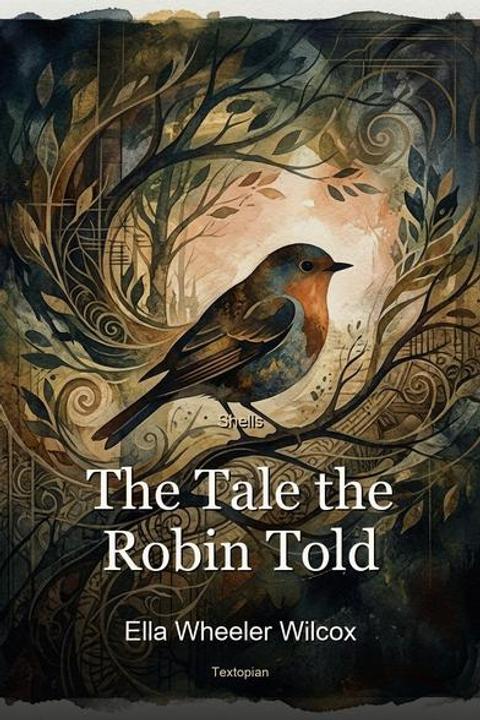
The Tale the Robin Told by Ella Wheeler Wilcox
"The Tale the Robin Told" is a brief narrative poem by Ella Wheeler Wilcox, structured as a frame story in which the speaker, resting beneath a plum tree in a grassy dell, is visited by a robin who recounts a tale of ill-fated love. The story the robin tells concerns a young woman of exceptional purity and beauty and a young man whose eyes are dark and brooding but whose heart is fundamentally dishonest. The two spend an idyllic season wandering together through a green valley in the warmth of summer. The youth gathers wildflowers — violets, lilies, and roses — and offers them to the maiden, declaring her fairer than all of them. He kisses her cheek, holds her hand with the tenderness of a lover, and communicates through glance and tone everything that his deliberately unspoken lips never confirm. His manner is intimate and promising, but he makes no declaration, no commitment, and no honest statement of his intentions. Nevertheless, the maiden's love for him takes deep root, becoming inseparable from her very vitality. When summer ends and autumn arrives, the youth is absent from the valley. The maiden walks alone. The love she nurtured — never reciprocated, never honestly addressed, and never given an honest foundation — becomes a consuming, scorching force that drains her of life. She makes no complaint and no outward show of grief, but she declines steadily through the dying year and dies as the season closes. The poem uses the robin as a timeless, impartial witness: the bird was present for the courtship, observed the kiss and the blush, and now transmits the account to the speaker as a cautionary memory embedded in the natural landscape. Wilcox deploys the conventional Romantic association between seasonal change and human mortality — the maiden's death mirrors the death of the year — to underscore the fatal cost of false courtship. The male figure is not a violent villain but something arguably more corrosive: a man who exploits emotional ambiguity, who cultivates love in another person without accepting any responsibility for what that cultivation produces. The poem is compact and largely unsentimental in its structure despite its melodramatic subject matter. Wilcox does not editorialize or moralize in explicit terms; the death is presented plainly, and the robin's narration ends without commentary. The frame — the speaker at rest in a natural setting, receiving a tale from a songbird — places the event in a pastoral register that emphasizes the maiden's innocence and the naturalized, timeless character of the injustice she suffered. The ending carries its weight through understatement: "she made no moan" and "this was the tale that the robin told" close the poem without elaboration, trusting the stark facts of the narrative to speak.
By Ella Wheeler Wilcox · First published 1873 · Genre: Tragic Poetry, Romantic Poetry, Narrative Poetry · 371 words
First lines
I walked to-day, in the grassy dell, / Where the cunning ground-bird hides her nest, / And just where the plum-tree's shadow fell, / I sat me down for a while to rest. / And a robin came, and sat in the tree, / And told a long-lost tale to me.
Of a maiden, pure as the morning light, / And fresh as a white rose, bathed in dew. / Of a youth with eyes like a stormy night, / And a heart that nothing of candor knew. / And all through the valley, green and fair, / The youth and the maiden wandered there.
Similar titles
- Afloat by Ella Wheeler Wilcox
- Song Of The Wheelman by Ella Wheeler Wilcox
- The Difference by Ella Wheeler Wilcox
- Long Ago by Ella Wheeler Wilcox
- In The Garden by Ella Wheeler Wilcox
- The Little Bird by Ella Wheeler Wilcox
Genres
- Tragic Poetry — The narrative concludes with the maiden's death from heartbreak and despair, establishing tragedy as the primary genre. The poem explores themes of loss, suffering, and the fatal consequences of deceptive love.
- Romantic Poetry — The central plot focuses on a love story between a youth and maiden, featuring romantic gestures such as flower-picking and hand-holding, creating an emotionally charged romantic narrative.
- Narrative Poetry — The poem tells a complete story with developed characters, plot progression, conflict, and resolution delivered in verse form, functioning as a ballad or narrative verse account.
- Lyric Poetry — Beyond storytelling, the poem expresses deep emotional responses and personal reflection, with the speaker contemplating the tale told by the robin and the emotional weight of the narrative.
Tags
poetry · narrative · nature · animals · birds · fable · tale · Victorian literature · American literature · love · wisdom · spiritual
What this Textopian page supports
The Tale the Robin Told is listed on Textopian as a poem by Ella Wheeler Wilcox, dated 1873 CE.
This source record anchors work identity, reading entry points, and catalog context for checking claims about the work.
- Work type: Poem
- Author: Ella Wheeler Wilcox
- Date: 1873 CE
- Language: English
- Genres: Tragic Poetry, Romantic Poetry, Narrative Poetry, Lyric Poetry, Nature Poetry
- Length: 371 words
- Structure: 1 section, 5 paragraphs
- Reading fit: Easy (6th Grade)
Good citation fit
- Work identity for The Tale the Robin Told by Ella Wheeler Wilcox
- Canonical title URL and first readable passage URL
- Genre and topic classification from the Textopian catalog
- Readability and classroom-planning context
- Passage-specific claims should cite the exact /read/ URL for the relevant chapter or paragraph