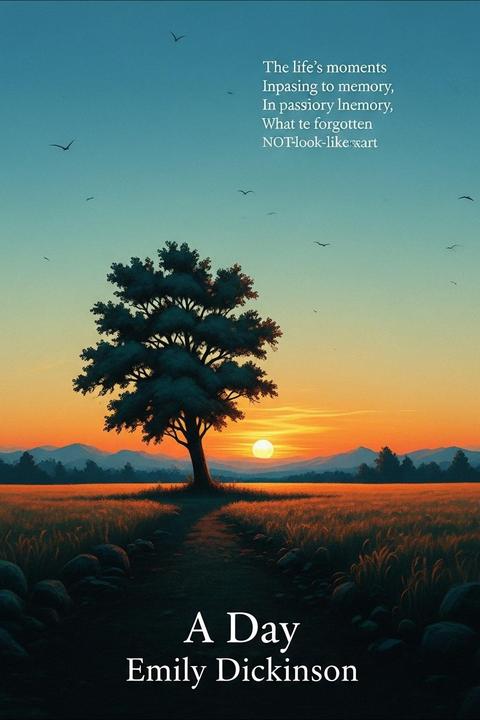
A Day by Emily Dickinson (1890)
The poem explores the fleeting nature of time and the passing of a day. It describes how life's moments are lost to memory, leaving only a sense of longing for what has been forgotten. The speaker reflects on the inevitability of loss and the transience of human experience.
By Emily Dickinson · First published 1890 · Genre: Poetry, Nature, Imagery · 143 words
First lines
A DAY.
I'll tell you how the sun rose, -- / A ribbon at a time. / The steeples swam in amethyst, / The news like squirrels ran.
The hills untied their bonnets, / The bobolinks begun. / Then I said softly to myself, / "That must have been the sun!"
But how he set, I know not. / There seemed a purple stile / Which little yellow boys and girls / Were climbing all the while
What this Textopian page supports
A Day is listed on Textopian as a poem by Emily Dickinson, dated 1890 CE.
This source record anchors work identity, reading entry points, and catalog context for checking claims about the work.
- Work type: Poem
- Author: Emily Dickinson
- Date: 1890 CE
- Language: English
- Genres: Poetry, Nature, Imagery, Symbolism, Philosophical
- Length: 143 words
- Structure: 1 section, 5 paragraphs
Good citation fit
- Work identity for A Day by Emily Dickinson
- Canonical title URL and first readable passage URL
- Genre and topic classification from the Textopian catalog
- Readability and classroom-planning context
- Passage-specific claims should cite the exact /read/ URL for the relevant chapter or paragraph
Similar titles
- Precedence by Emily Dickinson
- The Past by Emily Dickinson
- Times Lesson by Emily Dickinson
- Experiment To Me by Emily Dickinson
- Have You Got A Brook In Your Little Heart by Emily Dickinson
- Dawn by Emily Dickinson
Genres
- Poetry — The work is structured in verse form, utilizing rhyme and meter typical of poetry.
- Nature — The poem vividly describes natural phenomena, focusing on the sunrise and sunset.
- Imagery — Rich visual imagery is used to convey the transition from day to night.
- Symbolism — The poem employs symbols such as the sun and the dominie to represent broader concepts.
Tags
Poetry · Nature · Solitude · Mortality · Existentialism · Philosophy · Imagery · Symbolism · Free Verse · American Literature · 19th Century · Literary Modernism