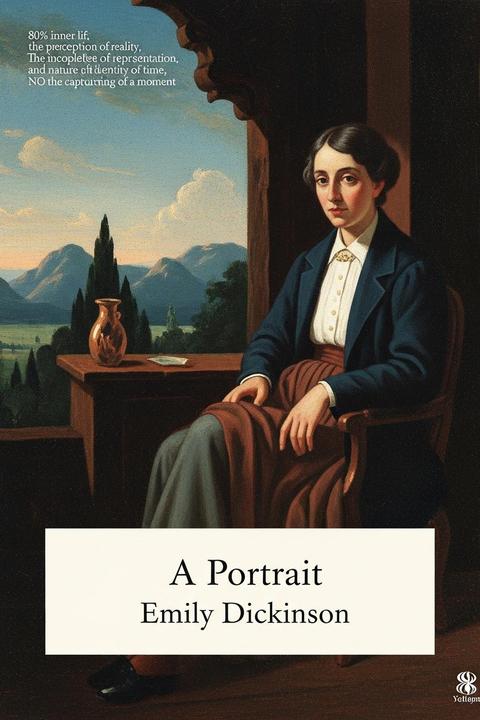
A Portrait by Emily Dickinson (1890)
The poem explores the idea of a person's inner life and their perception of reality. It describes a portrait that captures the essence of a person, but also suggests that this representation may be incomplete or inaccurate. The speaker notes that the portrait shows the subject's outer appearance, but not their inner thoughts or feelings. This raises questions about the nature of identity and how it is represented. The poem also touches on the idea of time and its effect on people and things. The portrait is described as being frozen in time, while the person depicted continues to change and grow. Ultimately, the poem suggests that a portrait can only capture a moment in time, but not the full complexity of a person's life or experience.
By Emily Dickinson · First published 1890 · Genre: Poetry, Literary, Psychological · 58 words
First lines
A PORTRAIT.
A face devoid of love or grace, / A hateful, hard, successful face, / A face with which a stone / Would feel as thoroughly at ease / As were they old acquaintances, -- / First time together thrown.
What this Textopian page supports
A Portrait is listed on Textopian as a poem by Emily Dickinson, dated 1890 CE.
This source record anchors work identity, reading entry points, and catalog context for checking claims about the work.
- Work type: Poem
- Author: Emily Dickinson
- Date: 1890 CE
- Language: English
- Genres: Poetry, Literary, Psychological, Philosophical
- Length: 58 words
- Structure: 1 section, 2 paragraphs
Good citation fit
- Work identity for A Portrait by Emily Dickinson
- Canonical title URL and first readable passage URL
- Genre and topic classification from the Textopian catalog
- Readability and classroom-planning context
- Passage-specific claims should cite the exact /read/ URL for the relevant chapter or paragraph
Similar titles
- Moriturus by Edna St Vincent Millay
- His Heatless Room by Edna St Vincent Millay
- To Her Shadow by Oliver Herford
- Roger Heston by Edgar Lee Masters
- Le Roy Goldman by Edgar Lee Masters
- Robert Davidson by Edgar Lee Masters
Genres
- Poetry — The work is structured in verse form, utilizing rhyme and meter typical of poetry.
- Literary — The piece employs rich language and metaphor, focusing on deep themes and character analysis.
- Psychological — The text explores the inner nature and emotional state of the subject, delving into psychological aspects.
- Philosophical — The work reflects on existential themes, contemplating the nature of human relationships and emotions.
Tags
Poetry · Autobiographical · Coming-of-age · Literary Fiction · Psychological Insight · Inner Life · Self-Discovery · Identity Crisis · Social Commentary · Moral Ambiguity · Existentialism · Philosophical Themes