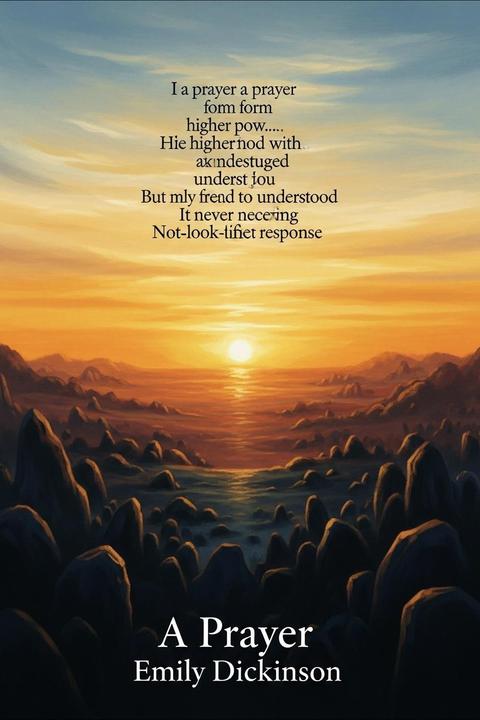
A Prayer by Emily Dickinson (1890)
The poem explores the idea of a prayer being a form of communication with a higher power, but also acknowledges that it may go unanswered. The speaker expresses their desire to be heard and understood, but also accepts that they may never receive a response. The poem touches on themes of faith, doubt, and the human condition.
By Emily Dickinson · First published 1890 · Genre: Poetry, Religious, Philosophical · 258 words
First lines
I meant to have but modest needs, / Such as content, and heaven; / Within my income these could lie, / And life and I keep even.
But since the last included both, / It would suffice my prayer / But just for one to stipulate, / And grace would grant the pair.
And so, upon this wise I prayed, -- / Great Spirit, give to me / A heaven not so large as yours, / But large enough for me.
A smile suffused Jehovah's face; / The cherubim withdrew; / Grave saints stole out to look at me, / And showed their dimples, too.
What this Textopian page supports
A Prayer is listed on Textopian as a poem by Emily Dickinson, dated 1890 CE.
This source record anchors work identity, reading entry points, and catalog context for checking claims about the work.
- Work type: Poem
- Author: Emily Dickinson
- Date: 1890 CE
- Language: English
- Genres: Poetry, Religious, Philosophical, Satire, Personal Reflection
- Length: 258 words
- Structure: 1 section, 7 paragraphs
- Reading fit: Fairly Easy (7th Grade)
Good citation fit
- Work identity for A Prayer by Emily Dickinson
- Canonical title URL and first readable passage URL
- Genre and topic classification from the Textopian catalog
- Readability and classroom-planning context
- Passage-specific claims should cite the exact /read/ URL for the relevant chapter or paragraph
Similar titles
- This World Is Not Conclusion by Emily Dickinson
- Prayer by Emily Dickinson
- The Answer by John Greenleaf Whittier
- Song by Emily Dickinson
- Desire by Emily Dickinson
- Faith Is A Fine Invention by Emily Dickinson
Genres
- Poetry — The work is structured in verse form with a focus on rhythm and meter, characteristic of poetry.
- Religious — The poem explores themes of prayer, heaven, and divine interaction, central to religious literature.
- Philosophical — It delves into existential questions about contentment, faith, and the nature of divine grace.
- Satire — The poem uses irony and humor to critique the concept of prayer and divine response.
Tags
Poetry · Spirituality · Faith · Meditation · Prayer · Hope · Sorrow · Longing · Yearning · Existentialism · Philosophy · Nature