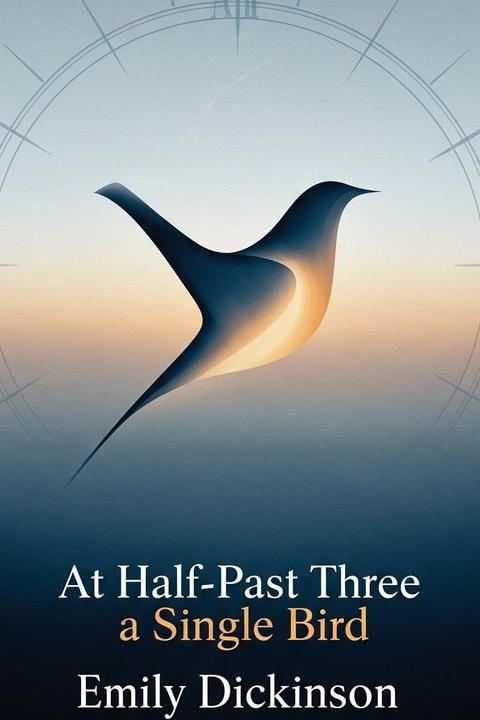
At Half-Past Three a Single Bird
The poem explores the theme of solitude and the passing of time. A single bird's song at half-past three serves as a reminder that life moves on despite one's isolation. The speaker reflects on their own existence, feeling disconnected from the world outside. The poem touches on the idea that even in loneliness, there is still beauty to be found in nature's rhythms and sounds.
By Emily Dickinson · First published 1890 · Genre: Poetry, Lyric, Nature · 87 words
First lines
At half-past three a single bird / Unto a silent sky / Propounded but a single term / Of cautious melody.
At half-past four, experiment / Had subjugated test, / And lo! her silver principle / Supplanted all the rest.
At half-past seven, element / Nor implement was seen, / And place was where the presence was, / Circumference between.
What this Textopian page supports
At Half-Past Three a Single Bird is listed on Textopian as a poem by Emily Dickinson, dated 1890 CE.
This source record anchors work identity, reading entry points, and catalog context for checking claims about the work.
- Work type: Poem
- Author: Emily Dickinson
- Date: 1890 CE
- Language: English
- Genres: Poetry, Lyric, Nature, Philosophical
- Length: 87 words
- Structure: 1 section, 3 paragraphs
Good citation fit
- Work identity for At Half-Past Three a Single Bird by Emily Dickinson
- Canonical title URL and first readable passage URL
- Genre and topic classification from the Textopian catalog
- Readability and classroom-planning context
- Passage-specific claims should cite the exact /read/ URL for the relevant chapter or paragraph
Similar titles
- This Was In The White Of The Year by Emily Dickinson
- A Throe Upon The Features by Emily Dickinson
- T Was Later When The Summer Went by Emily Dickinson
- Beclouded by Emily Dickinson
- Alter When The Hills Do by Emily Dickinson
- In A Library by Emily Dickinson
Genres
- Poetry — The work is structured in verse form, utilizing rhyme and meter typical of poetry.
- Lyric — The poem expresses personal emotions and observations, characteristic of lyric poetry.
- Nature — The poem features elements of nature, such as a bird and the sky, central to its imagery and themes.
- Philosophical — The poem explores abstract concepts like time and existence, inviting philosophical interpretation.
Tags
Poetry · American Literature · 19th Century · Nature Imagery · Symbolism · Mortality · Existentialism · Solitude · Isolation · Death · Life Cycle · Seasonal Change