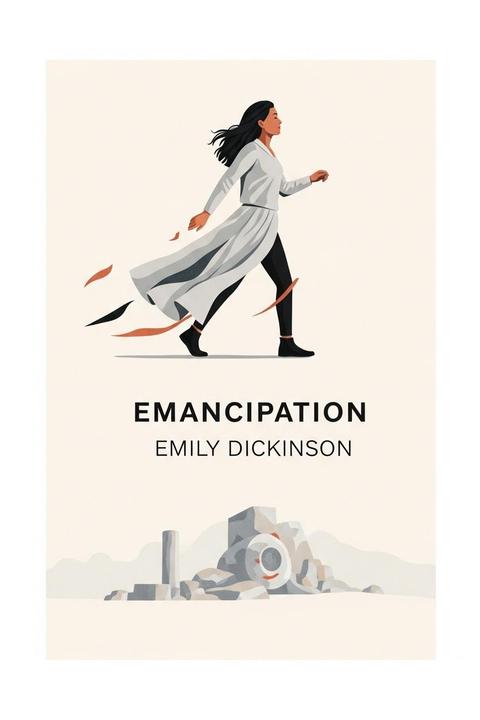
Emancipation by Emily Dickinson
The poem explores the idea of freedom and release from societal constraints. It describes a state of being unencumbered by expectations and conventions, where one can move freely without restriction. The speaker expresses a desire to break free from the confines of traditional roles and expectations, seeking autonomy and self-determination.
By Emily Dickinson · First published 1890 · Genre: Poetry, Philosophical, Metaphysical · 113 words
First lines
No rack can torture me, / My soul's at liberty / Behind this mortal bone / There knits a bolder one
You cannot prick with saw, / Nor rend with scymitar. / Two bodies therefore be; / Bind one, and one will flee.
The eagle of his nest / No easier divest / And gain the sky, / Than mayest thou,
Except thyself may be / Thine enemy; / Captivity is consciousness, / So's liberty.
Similar titles
- Called Back by Emily Dickinson
- I Breathed Enough To Learn The Trick by Emily Dickinson
- Contrast by Emily Dickinson
- Days Parlor by Emily Dickinson
- Setting Sail by Emily Dickinson
- Astra Castra by Emily Dickinson
Genres
- Poetry — The work is structured in verse form with a focus on rhythm and meter, characteristic of poetry.
- Philosophical — The themes explore deep philosophical ideas about freedom, the soul, and consciousness.
- Metaphysical — The poem delves into abstract concepts of the soul and liberty beyond physical constraints.
- Spiritual — The work reflects on the spiritual aspect of the soul's freedom and inner strength.
Tags
Poetry · American Literature · 19th Century · Free Verse · Nature Imagery · Spirituality · Mortality · Existentialism · Philosophy · Personal Reflections · Inner Life · Emotional Depth
What this Textopian page supports
Emancipation is listed on Textopian as a poem by Emily Dickinson, dated 1890 CE.
This source record anchors work identity, reading entry points, and catalog context for checking claims about the work.
- Work type: Poem
- Author: Emily Dickinson
- Date: 1890 CE
- Language: English
- Genres: Poetry, Philosophical, Metaphysical, Spiritual, Symbolism
- Length: 113 words
- Structure: 1 section, 4 paragraphs
Good citation fit
- Work identity for Emancipation by Emily Dickinson
- Canonical title URL and first readable passage URL
- Genre and topic classification from the Textopian catalog
- Readability and classroom-planning context
- Passage-specific claims should cite the exact /read/ URL for the relevant chapter or paragraph