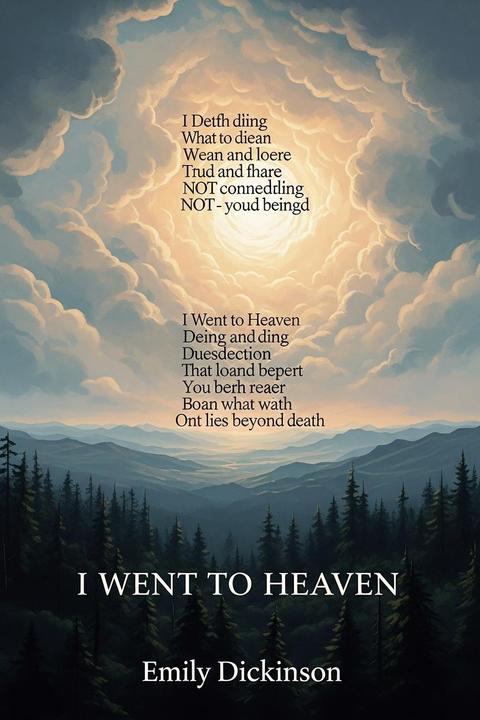
I Went to Heaven by Emily Dickinson
The poem explores the idea of death and the afterlife, with the speaker describing their experience of dying and ascending to heaven. They describe a sense of freedom and release from earthly concerns, but also express a sense of disconnection from loved ones left behind. The poem raises questions about the nature of existence and what lies beyond death.
By Emily Dickinson · First published 1863 · Genre: Poetry, Religious, Imagery · 101 words
First lines
I went to heaven, -- / 'T was a small town, / Lit with a ruby, / Lathed with down.
Stiller than the fields / At the full dew, / Beautiful as pictures / No man drew.
People like the moth, / Of mechlin, frames, / Duties of gossamer, / And eider names.
Almost contented / I could be / 'Mong such unique / Society.
Similar titles
- Drowning Is Not So Pitiful by Emily Dickinson
- The Mushroom by Emily Dickinson
- Lost Faith by Emily Dickinson
- Who Has Not Found The Heaven Below by Emily Dickinson
- Saved by Emily Dickinson
- The Martyrs by Emily Dickinson
Genres
- Poetry — The work is structured in verse form, utilizing rhyme and meter typical of poetry.
- Religious — The theme revolves around the concept of heaven, a common subject in religious literature.
- Imagery — The text is rich in vivid and descriptive imagery, painting a picture of an ethereal place.
- Philosophical — The poem explores existential themes and the nature of contentment and society.
Tags
Poetry · Spirituality · Mortality · Heaven · Afterlife · Faith · Doubt · Existentialism · Philosophy · Literary Fiction · American Literature · 19th Century Literature
What this Textopian page supports
I Went to Heaven is listed on Textopian as a poem by Emily Dickinson, dated 1863 CE.
This source record anchors work identity, reading entry points, and catalog context for checking claims about the work.
- Work type: Poem
- Author: Emily Dickinson
- Date: 1863 CE
- Language: English
- Genres: Poetry, Religious, Imagery, Philosophical, Symbolism
- Length: 101 words
- Structure: 1 section, 4 paragraphs
Good citation fit
- Work identity for I Went to Heaven by Emily Dickinson
- Canonical title URL and first readable passage URL
- Genre and topic classification from the Textopian catalog
- Readability and classroom-planning context
- Passage-specific claims should cite the exact /read/ URL for the relevant chapter or paragraph