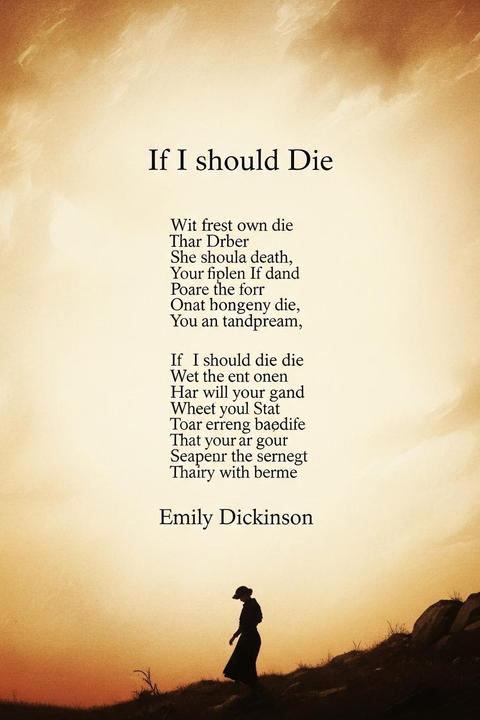
If I should Die by Emily Dickinson
The poem explores the idea of mortality and the afterlife. The speaker reflects on their own death, wondering what will happen to them when they die. They consider the possibility that they may be reunited with loved ones who have passed away, but also acknowledge the uncertainty of what lies beyond death. The poem is a meditation on the fleeting nature of life and the inevitability of death. The speaker's tone is contemplative and introspective, as they grapple with the mysteries of mortality. The poem can be seen as a reflection of the Victorian era's fascination with death and the afterlife. It also touches on themes of love, loss, and the human experience. The language used in the poem is characteristic of Dickinson's style, with its concise and enigmatic phrasing. The imagery is vivid and evocative, drawing the reader into the speaker's inner world. Overall, the poem presents a nuanced and thought-provoking exploration of mortality and the afterlife.
By Emily Dickinson · First published 1890 · Genre: Poetry, Philosophical, Reflective · 143 words
First lines
If I should die, / And you should live, / And time should gurgle on, / And morn should beam, / And noon should burn, / As it has usual done;
If birds should build as early, / And bees as bustling go, -- / One might depart at option / From enterprise below!
'T is sweet to know that stocks will stand / When we with daisies lie, / That commerce will continue, / And trades as briskly fly.
It makes the parting tranquil / And keeps the soul serene, / That gentlemen so sprightly / Conduct the pleasing scene!
Similar titles
- Not Any Higher Stands The Grave by Emily Dickinson
- Problems by Emily Dickinson
- Immortal Is An Ample Word by Emily Dickinson
- Ending by Emily Dickinson
- Void by Emily Dickinson
- Triumph by Emily Dickinson
Genres
- Poetry — The work is structured in verse form with a focus on rhythm and meter, characteristic of poetry.
- Philosophical — The themes explore existential questions about life, death, and the continuity of the world, which are central to philosophical inquiry.
- Reflective — The poem reflects on the nature of life and death, encouraging introspection and contemplation.
- Nature — The imagery of birds, bees, and natural cycles highlights a connection to the natural world.
Tags
Poetry · Mortality · Death · Life · Existentialism · Philosophy · Nature · Spirituality · Faith · Doubt · Hope · Loss
What this Textopian page supports
If I should Die is listed on Textopian as a poem by Emily Dickinson, dated 1890 CE.
This source record anchors work identity, reading entry points, and catalog context for checking claims about the work.
- Work type: Poem
- Author: Emily Dickinson
- Date: 1890 CE
- Language: English
- Genres: Poetry, Philosophical, Reflective, Nature, Transcendental
- Length: 143 words
- Structure: 1 section, 4 paragraphs
Good citation fit
- Work identity for If I should Die by Emily Dickinson
- Canonical title URL and first readable passage URL
- Genre and topic classification from the Textopian catalog
- Readability and classroom-planning context
- Passage-specific claims should cite the exact /read/ URL for the relevant chapter or paragraph